Best water filter pitcher
How to choose a pitcher filter by certification, cartridge cost per gallon, capacity, and what it actually removes. No scores, just the deciding specs.
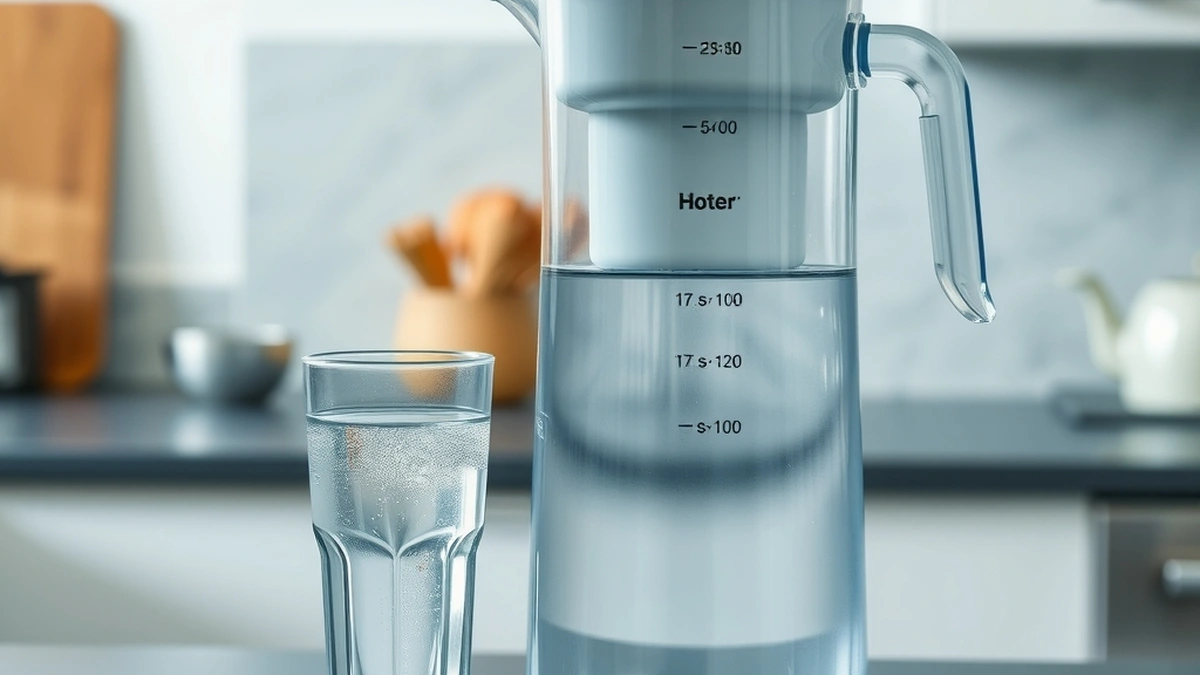
The best water filter pitcher is one certified to NSF/ANSI 42 and 53 for the contaminants in your water, with a large enough reservoir for your household and cartridges under about $0.30 per gallon. Pitchers cost $25 to $50 and cartridges $5 to $20 each.
- Pitcher cost
- $25 - $50
- Cartridge cost
- $5 - $20 each
- Cost per gallon
- $0.10 - $0.30
- Cartridge life
- About 40 gallons
- Best for
- Chlorine taste, light metal reduction
Some links on this page are affiliate links.If you buy through them we may earn a commission at no extra cost to you. We do not accept payment for rankings. Read the full disclosure.
A water filter pitcher is the cheapest way to improve drinking water taste, and the most oversold. The best one for your kitchen is the one whose certification matches your water report, whose reservoir you will actually refill, and whose cartridges cost less than $0.30 per gallon. Brand and colour do not enter into it.
Start With Certification
Certification is the only verifiable claim on the box. Two standards matter.
NSF/ANSI 42 covers aesthetic claims: chlorine taste and odour, and particulate reduction. Almost every pitcher has this.
NSF/ANSI 53 covers health-related claims: lead, cysts, volatile organic compounds, and some metals. Only some pitchers have this, and only for the specific contaminants listed.
A pitcher that says “reduces lead” without a 53 listing naming lead is making a claim you cannot check. Look up the model on the certification body’s website rather than trusting the front of the box.
| Claim | Standard | What to verify |
|---|---|---|
| Chlorine taste and odour | 42 | Almost universal |
| Particulate reduction | 42 | Class rating |
| Lead reduction | 53 | Model-specific |
| Cyst reduction | 53 | Model-specific |
| VOC reduction | 53 | Model-specific |
| PFAS reduction | 53 or 401 | Few pitchers qualify |
The Cost per Gallon
Pitchers are cheap to buy and the cartridges are where the money goes. The arithmetic is simple: cartridge price divided by the gallons it treats.
A $8 cartridge rated for 40 gallons is $8 ÷ 40 = $0.20 per gallon. A $20 cartridge rated for 60 gallons is $0.33 per gallon. A $5 cartridge rated for 30 gallons is $0.17 per gallon.
Add the pitcher itself, amortized over its life: a $35 pitcher over five years is $7 per year, which barely moves the per-gallon number for a household using 300 gallons a year.
| Pitcher type | Cartridge | Gallons | Cost per gallon |
|---|---|---|---|
| Basic carbon | $6 - $10 | 40 | $0.15 - $0.25 |
| Carbon plus ion exchange | $10 - $15 | 40 - 60 | $0.17 - $0.38 |
| High-capacity | $15 - $20 | 60 - 100 | $0.15 - $0.33 |
| Certified lead reduction | $12 - $18 | 40 - 60 | $0.20 - $0.45 |
Capacity and Refill Frequency
A pitcher holds 6 to 10 cups in the reservoir and 6 to 8 cups in the dispenser. A household drinking 2 gallons a day, which is 32 cups, refills the reservoir four to five times.
That is the practical limit of the format. It is fine for one or two people. For a family of four, the refills become a chore and the pitcher gets abandoned in favour of bottles, which defeats the purpose.
| Household | Daily drinking | Refills per day |
|---|---|---|
| 1 person | 0.5 gallon | 1 - 2 |
| 2 people | 1 gallon | 2 - 3 |
| 4 people | 2 gallons | 4 - 5 |
| 6 people | 3 gallons | 6 - 8 |
Above four people, an under-sink filter is the better format. A pitcher is a bridge, not a whole-house solution.
What Pitchers Do Not Do
They do not soften. The ion exchange resin in a pitcher is a small amount aimed at trace metals. It cannot handle the calcium and magnesium load in hard water, and the cartridge would exhaust in days if it tried.
They do not remove nitrate. Nitrate needs reverse osmosis or ion exchange designed for it.
They do not disinfect. Carbon is not a microbiological barrier.
They are slow. A pitcher takes several minutes to filter a full reservoir, which is why the dispenser always seems empty when you want a glass.
If your water report shows nitrate near 10 mg/L, a pitcher is the wrong purchase. Under-sink RO at $300 to $900 installed is the right one, covered in best under-sink reverse osmosis.
Five Steps to Choose
- Read your water report and list the contaminants you actually want removed.
- Match the certification to that list, not to the marketing copy.
- Calculate cost per gallon from the cartridge price and rated gallons.
- Count refills for your household size and decide whether the format fits.
- Check cartridge availability locally and online before committing to a model.
Pitcher vs Under-Sink vs Bottled
| Option | Upfront | Per gallon | Capacity | Effort |
|---|---|---|---|---|
| Pitcher | $25 - $50 | $0.10 - $0.30 | 6 - 10 cups | Refill 2 - 5 times daily |
| Under-sink carbon | $150 - $400 | Low | Unlimited | Cartridge yearly |
| Under-sink RO | $300 - $900 | $0.15 - $0.40 | 2 - 4 gallon tank | Cartridge yearly |
| Bottled | $0 | $0.50 - $2.00 | As bought | Carry and store |
The pitcher wins on upfront cost and loses on throughput. For a single person or a couple, it is the sensible first purchase. For a family, the under-sink filter pays for itself in avoided bottle purchases within a year, as the arithmetic in bottled water versus a filter shows.
Maintenance That Actually Matters
Change the cartridge on the gallon rating, not on the indicator light alone. Many indicator lights are simple timers that assume average use; a household that filters more than average will exhaust the carbon before the light changes.
Rinse the reservoir and lid weekly with warm soapy water. The pitcher itself grows biofilm if it is never cleaned, and a filter downstream of a dirty reservoir is doing less than its rating.
Store the pitcher in the fridge if the water tastes better cold, but do not leave it in direct sun. Warm, sunlight-exposed water in a plastic reservoir is a bad combination for taste.
For a broader comparison of filter formats, water filter pitcher reviews covers the model-level differences, and water filter for sink covers the step up in capacity.
Frequently asked questions
What should I look for in a water filter pitcher?
Certification to NSF/ANSI 42 for taste and chlorine and 53 for health-related contaminants, a reservoir sized for your household, and cartridges with a published cost per gallon.
How much does a pitcher filter cost per gallon?
Roughly $0.10 to $0.30 per gallon including the pitcher and cartridges, depending on cartridge price and the stated gallon rating.
Do pitcher filters remove lead?
Some do, but only if the certification listing names lead reduction; a standard chlorine-taste cartridge does not, so check the specific model's certification.
How often do pitcher cartridges need changing?
Usually every 40 gallons or about two months for an average household, whichever comes first, and the indicator light on some models is a timer rather than a sensor.
Is a pitcher filter better than an under-sink filter?
It is cheaper and portable but slower and lower capacity; an under-sink filter costs more upfront and delivers unlimited flow at one tap.
Can a pitcher filter soften hard water?
No. Ion exchange in a pitcher is limited to trace metals, not the calcium and magnesium load that makes water hard, so hardness passes through.
Sources
Some links are affiliate links.If you buy through them we may earn a commission at no extra cost to you. We do not accept payment for rankings. Read the full disclosure.