
Under sink water filter
Under-sink filters put treated water at one tap without a pitcher. See the carbon and RO formats, install requirements, and cost per year.
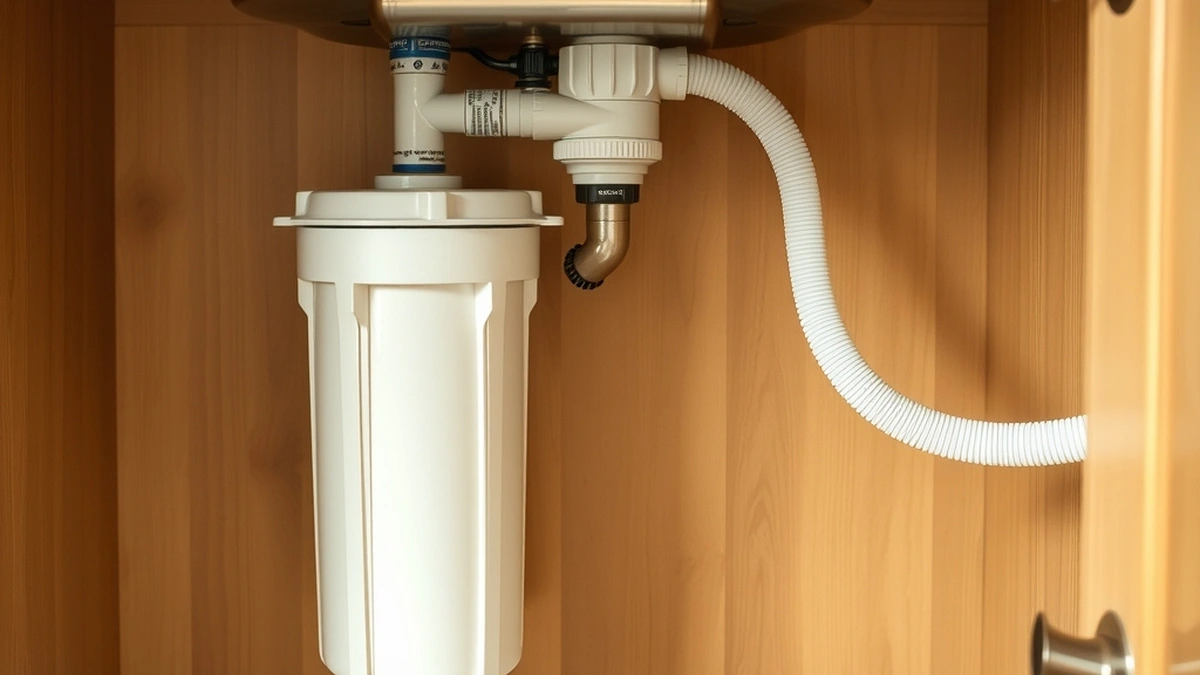
An under-sink water filter treats one tap from a housing mounted in the cabinet, costing $150 to $500 installed for carbon and $300 to $900 for reverse osmosis. It needs a cold supply connection and, for RO, a drain line and a faucet hole.
- Carbon installed
- $150 - $500
- RO installed
- $300 - $900
- Annual cartridges
- $40 - $150
- Flow
- 1 - 2 gpm carbon
- Install time
- 1 - 3 hours
Some links on this page are affiliate links.If you buy through them we may earn a commission at no extra cost to you. We do not accept payment for rankings. Read the full disclosure.
An under-sink water filter puts treated water at the kitchen tap without a pitcher to refill. Carbon systems cost $150 to $500 installed and remove chlorine and taste. Reverse osmosis systems cost $300 to $900 and remove dissolved contaminants as well. The format is the same; the treatment is not.
The Two Formats
Carbon under-sink. One or two housings connected to the cold supply, feeding a dedicated faucet or the existing tap through an adapter. Flow is 1 to 2 gallons per minute, which is fine for drinking and cooking.
Reverse osmosis under-sink. A four- or five-stage system with a storage tank. Slower to produce but removes dissolved solids at 80 to 95 percent.
| Feature | Carbon | RO |
|---|---|---|
| Installed cost | $150 - $500 | $300 - $900 |
| Annual cost | $40 - $120 | $60 - $150 |
| Flow | 1 - 2 gpm | Tank-fed |
| Removes chlorine | Yes | Yes, via pre-filter |
| Removes nitrate | No | Yes |
| Removes hardness | No | Yes, at that tap |
| Needs a drain | No | Yes |
The drain line is the practical difference. A carbon unit needs only a supply connection. An RO unit needs somewhere for the reject stream to go, which usually means tapping the sink drain or a dedicated line.
What Each Removes
| Contaminant | Carbon | RO |
|---|---|---|
| Chlorine | Yes | Yes, pre-filter |
| Taste and odour | Yes | Yes |
| Sediment | With pre-filter | With pre-filter |
| Lead | Some, if certified | Yes |
| Nitrate | No | Yes |
| Sodium | No | Yes |
| PFAS | Some, certified media | Yes, certified membrane |
| Bacteria | No | Not a barrier |
The bacteria row matters on a well. Neither format disinfects, and an RO membrane is not a reliable microbiological barrier because a pinhole defeats it. UV is the tool for that.
Installation Requirements
Carbon. A cold supply connection, usually a saddle valve or a tee, and tubing to the faucet. No drain, no power. A dedicated faucet requires a hole in the counter.
RO. Everything above plus a drain connection and, for tank models, space for a 2 to 4 gallon tank. A permeate pump or booster may be needed below 40 psi.
A saddle valve is the weak point in many DIY installs. It pierces the pipe with a needle and seals with a rubber gasket, and those gaskets fail over years. If the supply line is accessible, a proper tee with a shut-off valve is the more durable choice and costs only a few dollars more. Plumbers generally prefer it, and so do homeowners who have cleaned up after a saddle valve leak.
| Requirement | Carbon | RO |
|---|---|---|
| Cold supply | Yes | Yes |
| Drain | No | Yes |
| Faucet hole | Optional | Yes |
| Power | No | No for tank models |
| Cabinet space | Small | Moderate to large |
What It Costs to Run
Carbon: $40 to $120 per year for cartridges, changed every 6 to 12 months.
RO: $60 to $150 per year plus a membrane every 2 to 3 years at $40 to $80.
Five-year arithmetic for a $300 carbon install with $80 per year: $300 + $400 = $700, or $140 per year. For a $600 RO install with $100 per year and one membrane: $600 + $500 + $60 = $1,160, or $232 per year.
Against bottled water at $1 per gallon for 2 gallons a day, $730 per year, both pay back quickly. The comparison is in bottled water versus a filter.
One cost that surprises people is the faucet. A dedicated filtered-water faucet runs $30 to $120, and it is often not included in the system price. If the counter already has a hole from a soap dispenser, that saves the drilling; if not, a plumber may charge $75 to $150 to cut one in stone or stainless.
Choosing Between Them
Use the water report, not the price.
Carbon is enough when the complaint is chlorine taste or odour, the report is otherwise clean, and the household wants filtered water at full flow.
RO is needed when the report shows nitrate, sodium, arsenic, or high dissolved solids, or when the household wants the broadest removal at one tap.
Neither is enough when hardness is the issue. An under-sink filter treats one tap and leaves the rest of the house hard. A softener is the answer, and RO at the sink should sit downstream of it.
Five Steps to Install
- Shut off the cold supply under the sink and open the tap to relieve pressure.
- Connect the supply with a saddle valve or a tee, following the manufacturer’s torque guidance.
- Mount the housing to the cabinet wall with clearance below for cartridge removal.
- Run the faucet line and drill the counter hole if a dedicated faucet is used.
- Flush the new cartridge for a few minutes before drinking, then check every joint for leaks.
Maintenance
Carbon every 6 to 12 months, sediment every 3 to 6 months if present, RO membrane every 2 to 3 years.
Write the change date on the housing. Keep one spare cartridge. A filter that sits exhausted is worse than no filter, because adsorbed material can release back into the water.
If flow drops early, the cartridge is loading faster than expected. On well water that usually means sediment, and a pre-filter is the fix.
Sanitize the RO storage tank at membrane change if the manufacturer specifies it. A tank that is never cleaned develops a stale taste that no new cartridge fixes, and the symptom is easy to blame on the membrane. The tank and the post-carbon filter are the two places to look when rejection is fine but the water still tastes off.
For the carbon-versus-RO comparison, see reverse osmosis versus carbon. For the buying guide, best under-sink reverse osmosis covers the RO side, and water filter for sink covers faucet-mount alternatives.
Frequently asked questions
What is an under sink water filter?
A filter housing or multi-stage system mounted inside the kitchen cabinet, connected to the cold supply and feeding a dedicated faucet or the existing tap.
How much does an under sink water filter cost?
Carbon systems run $150 to $500 installed with $40 to $120 per year in cartridges, while reverse osmosis systems run $300 to $900 with $60 to $150 per year.
Do I need a plumber to install an under sink filter?
Not necessarily; most carbon systems connect with a saddle valve and push-fit tubing, though a dedicated faucet hole and any soldering call for a plumber.
How often do under sink filters need changing?
Carbon cartridges every 6 to 12 months, sediment every 3 to 6 months, and RO membranes every 2 to 3 years.
Can an under sink filter soften water?
No. Carbon filtration does not remove calcium and magnesium; only a softener or a reverse osmosis membrane removes hardness, and RO does it only at that tap.
Does an under sink filter reduce water pressure?
It reduces flow at the filtered tap, which is normal for a 1 to 2 gpm device; it does not affect pressure elsewhere in the house.
Sources
Some links are affiliate links.If you buy through them we may earn a commission at no extra cost to you. We do not accept payment for rankings. Read the full disclosure.


