What a water softener costs
A line-by-line breakdown of softener equipment, labour, salt, and resin costs, with arithmetic for a typical installed job.
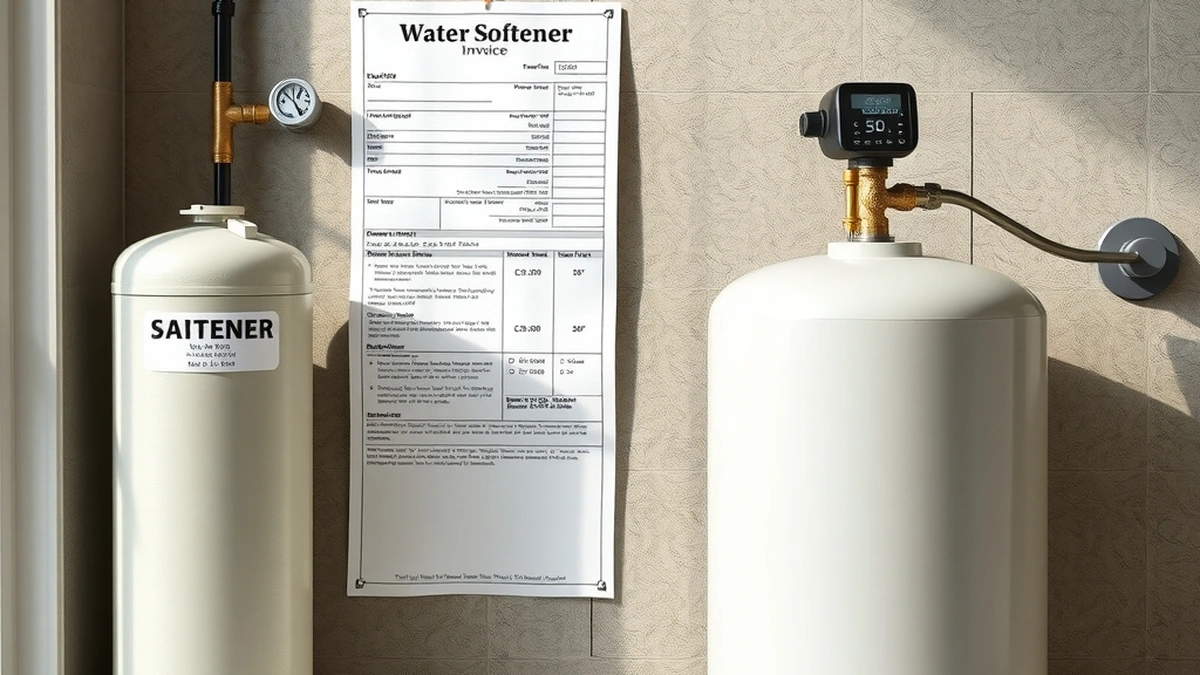
A water softener costs $1,200 to $4,500 installed, with equipment at $600 to $2,500 and labour at $500 to $1,500. Salt runs $120 to $400 per year, and a resin rebed costs $300 to $600 every 8 to 12 years.
- Installed total
- $1,200 - $4,500
- Equipment
- $600 - $2,500
- Labour
- $500 - $1,500
- Salt per year
- $120 - $400
- Resin rebed
- $300 - $600
Some links on this page are affiliate links.If you buy through them we may earn a commission at no extra cost to you. We do not accept payment for rankings. Read the full disclosure.
A water softener costs $1,200 to $4,500 installed, with equipment at $600 to $2,500 and labour at $500 to $1,500. Salt adds $120 to $400 per year, and a resin rebed costs $300 to $600 every 8 to 12 years. The total is easy to check once the capacity and the included lines are written down.
The four cost lines
| Line | Typical range | What it covers |
|---|---|---|
| Equipment | $600 - $2,500 | Tank, valve, resin, brine tank |
| Labour | $500 - $1,500 | Bypass, connections, drain, startup |
| Salt | $120 - $400 per year | Regeneration salt |
| Resin rebed | $300 - $600 every 8 - 12 years | Replacement resin |
A permit, if required, is a separate line. So is any new electrical outlet or drain run. Those two items are the most common reasons a final invoice exceeds the quote.
Equipment cost by capacity
Capacity drives the equipment price more than brand does. A familiar name on a small tank is still a small tank, and it will behave like one in a hard-water house.
A 24,000 to 32,000-grain cabinet unit sits at the low end, around $600 to $1,200. A 40,000 to 48,000-grain two-tank unit runs $1,200 to $1,800. A 60,000 to 64,000-grain unit runs $1,800 to $2,500, which is the range that suits a large household on very hard water.
The capacity has to match the water. A 24,000-grain unit on 18 gpg water with four people will regenerate constantly and still let hardness through, which means the cheapest unit becomes the most expensive to run.
Labour is roughly half a day for a standard install, and it is the line that varies most between quotes.
The lines are typically the shut-off and main-line connection, the bypass, the drain line and air gap, the electrical hookup, programming, and old unit removal if there is one. Ask for them itemised, because a single labour figure is where padding hides.
A basement with the main line exposed and a floor drain nearby is the easy case. A finished ceiling, a remote drain, or a crawl space access adds hours, and a plumber working in a tight cabinet will charge for the difficulty.
Arithmetic for a typical job
A 40,000-grain unit at $1,500 with $900 of labour is $2,400 installed.
Add a permit at $150 and a first fill of salt at $40, and the total is $2,590.
Over ten years, add salt at $250 per year for $2,500, plus one rebed at $450. The ten-year cost is $2,590 + $2,500 + $450 = $5,540.
That works out to about $554 per year for softened water across the whole house. A cheaper 24,000-grain unit at $900 with $700 of labour is $1,600 installed, but only if the water test supports that capacity.
Salt cost in detail
A regeneration uses 8 to 12 pounds of salt, set by the valve and the capacity. A household regenerating twice a week at 10 pounds uses about 1,040 pounds per year, or 26 bags of 40 pounds.
At $5 to $8 per bag, that is $130 to $208 per year for that household. A smaller household on softer water may use half as much, which is why the salt line is quoted as a range rather than a number.
Salt cost is a function of hardness and volume, not of the softener brand.
What changes the price
Hardness above 15 gpg pushes capacity up, which pushes equipment cost up.
Iron above 2 to 3 ppm requires an iron filter at $800 to $2,500 before the softener, or the resin fouls.
A remote drain or no electrical outlet adds labour and materials.
A permit requirement adds a fee and a delay of one to three weeks.
Is it worth it
The case for a softener is equipment protection and cleaning time. Scale shortens the life of the water heater, the dishwasher, and the washing machine, and it makes every cleaning job harder. A tankless water heater is particularly exposed, because scale coats the heat exchanger and reduces both flow and efficiency.
At 4 to 6 gpg, the case is weaker and depends on preference. Above 7 gpg, scale is usually visible and the arithmetic tends to favour softening, especially where the water heater and the dishwasher are expensive to replace.
How to compare quotes
- Confirm the measured hardness and the capacity it implies.
- Check whether the bypass, drain, and permit are included.
- Divide the equipment line by the grain capacity to compare value.
- Ask for the salt dose setting and the expected regeneration frequency.
- Confirm the warranty terms and who services the unit.
A quote that does not state the hardness is not comparable with one that does, and a quote that hides the permit in a lump sum is hiding a delay as well as a fee.
For the installation detail, see water softener installation cost and how much does a water softener cost. For the running costs, water softener salt cost covers salt pricing.
Bottom line
A water softener costs $1,200 to $4,500 installed and about $550 a year all-in over a decade. Match the capacity to the test, confirm the included lines, and treat salt and resin as part of the price rather than an afterthought.
Frequently asked questions
How much does a water softener cost installed?
A typical installed job runs $1,200 to $4,500, combining $600 to $2,500 in equipment with $500 to $1,500 in labour.
What is included in the installed price?
The unit, bypass valve, drain line, plumbing connections, programming, and startup, plus a permit where the municipality requires one.
How much is salt per year?
Salt costs $120 to $400 per year depending on hardness, household size, and local salt prices.
When does resin need replacing?
Resin typically lasts 8 to 12 years, and a rebed costs $300 to $600 when capacity drops.
Is a softener worth the money?
It is worth it where hardness is above 7 gpg and scale is affecting fixtures, the water heater, and appliances.
Can I reduce the installed cost?
Buying a standard-capacity unit and having a plumber install it can lower the total, provided the capacity matches the water test.
Sources
Some links are affiliate links.If you buy through them we may earn a commission at no extra cost to you. We do not accept payment for rankings. Read the full disclosure.