When to Replace Softener Resin: Signs and Costs
Learn the signs that water softener resin needs replacement, typical lifespan, and rebed costs versus a new softener.
Replace softener resin every 8 to 12 years, or sooner if hardness returns, salt use rises, or the resin bed looks broken or mushy.
- Resin lifespan
- 8-12 years
- Resin rebed cost
- $300-$600
- New softener installed
- $1,200-$4,500
- Common warning signs
- Hardness return, salt bridging, poor regeneration
Some links on this page are affiliate links.If you buy through them we may earn a commission at no extra cost to you. We do not accept payment for rankings. Read the full disclosure.
Water softener resin usually needs replacement every 8 to 12 years. You should replace it sooner if hardness returns between regenerations, salt usage climbs without explanation, or resin beads appear broken, mushy, or discolored. A resin rebed costs an estimated $300 to $600, compared with $1,200 to $4,500 for a new installed softener.
What softener resin does
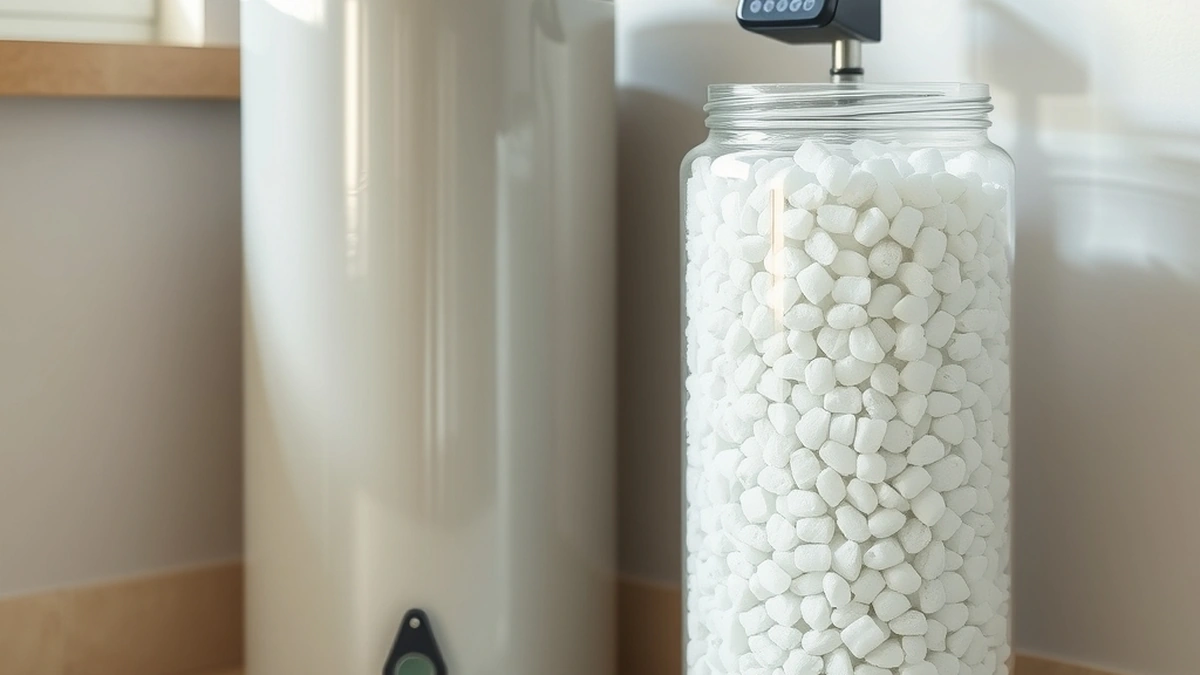
Resin is the ion-exchange medium inside the softener tank. It trades sodium ions for hardness minerals, mainly calcium and magnesium, as water passes through. During regeneration, the control valve draws brine through the resin bed to flush captured minerals down the drain and restore sodium capacity.
Resin does not last forever. Chlorine in municipal water, iron fouling, and repeated regeneration cycles gradually degrade the beads. When capacity drops, the softener cannot fully remove hardness even after a normal regeneration cycle.
Signs it is time to replace resin
Watch for these indicators before assuming the entire softener has failed:
- Hardness returns shortly after regeneration, shown by soap scum, scale buildup, or stiff laundry.
- Salt use increases while softening performance decreases.
- Resin beads appear in faucet aerators, showerheads, or appliance screens.
- The resin bed looks broken, mushy, or discolored when inspected.
- Regeneration cycles run longer or more frequently without improving water quality.
If the softener is under 8 years old and the valve, tank, and plumbing are sound, a failing resin bed is often the culprit. If the unit is approaching 10 to 15 years of total service, replacing the whole softener may make more sense than rebedding.
Resin lifespan versus softener lifespan
Resin and the softener cabinet do not age on the same schedule.
| Component | Typical lifespan |
|---|---|
| Resin bed | 8-12 years |
| Full softener system | 10-15 years |
A softener installed 10 years ago may still have a functional valve and tank, but exhausted resin. In that case, a rebed at $300 to $600 can extend service. A unit that is 14 or 15 years old with worn seals, a leaking tank, or an outdated control valve is usually a better candidate for full replacement.
How to check resin condition
Start with a water test. A lab test costs an estimated $40 to $150 and can confirm whether hardness is breaking through. If your water tested at 7-10 grains per gallon (hard) or 10+ grains per gallon (very hard) when the softener was new, and now tests near the same level after regeneration, the resin is likely spent.
Next, inspect the brine tank and resin bed. Salt bridging—a hard crust over the salt—can prevent proper brine formation and mimic resin failure. Break up any bridge and run a manual regeneration. If hardness persists after bridging is cleared and the valve settings are correct, the resin bed is the next suspect.
Iron levels also matter. Softeners generally handle iron up to 2-3 ppm. Higher iron can coat resin beads and reduce exchange capacity over time. If your water contains persistent iron above that range, resin may foul faster than the 8-to-12-year baseline.
Rebed cost versus replacement cost
A resin rebed is an estimated $300 to $600. That covers media and labor but not necessarily a new valve, tank, or plumbing connections. A new softener costs $600 to $2,500 for equipment, with installation adding $500 to $1,500, for a total installed range of $1,200 to $4,500.
Use this simple comparison:
- Softener under 8 years old, otherwise sound: rebed resin at $300 to $600.
- Softener 10-15 years old with multiple worn parts: new installation at $1,200 to $4,500.
- Uncertain condition: water test plus service inspection before spending on either option.
Salt is an ongoing cost regardless. Expect $120 to $400 per year for salt, depending on household water use and hardness level. Failing resin can drive salt use higher without improving results, which is another reason to address the media rather than keep adding salt.
Capacity and regeneration math
Softener capacity ranges from 24,000 to 64,000 grains. Regeneration typically uses 8 to 12 pounds of salt per cycle. If a 32,000-grain softener regenerates twice per month, that is 24 cycles per year. At 10 pounds of salt per cycle, annual salt use is roughly 240 pounds. At $0.50 to $1.67 per pound (implied by the $120 to $400 annual range), that aligns with the estimated yearly salt cost.
When resin loses capacity, the system may regenerate more often to compensate, increasing salt and water use without restoring soft water. Tracking regeneration frequency and salt bags per year can reveal a gradual decline before hardness becomes obvious at the tap.
Alternatives if the softener is done
If you decide not to rebed or replace the softener, other treatment options exist for different water issues. A whole-house filter costs an estimated $500 to $1,800 installed. Carbon cartridges run $80 to $300 per year and need replacement every 6 to 12 months. Sediment cartridges typically need replacement every 3 to 6 months.
Reverse osmosis is a separate path for drinking water. Under-sink RO equipment costs $200 to $600, with installed costs of $300 to $900. Running costs are $60 to $150 per year, and membranes last 2 to 3 years. RO waste ratios run 3-4:1, and rejection rates range from 80-95 percent depending on the contaminant. Whole-house RO is substantially more expensive, at $3,000 to $8,000 installed.
None of these alternatives soften water by ion exchange. If hardness is the main problem, resin replacement or a new softener remains the direct solution.
Bottom line
Replace softener resin every 8 to 12 years, or sooner if testing shows hardness breakthrough and the valve and tank are otherwise sound. A rebed costs an estimated $300 to $600, while a new installed softener runs $1,200 to $4,500. Start with a water test and a visual inspection of the resin bed before deciding between media replacement and full system replacement.
Next, compare how much does a water softener cost, water softener installation cost, whole house water filter cost before you commit.
Frequently asked questions
How long does softener resin last?
Resin typically lasts 8 to 12 years, depending on water quality, regeneration frequency, and maintenance.
What does bad resin look like?
Bad resin may appear broken, mushy, discolored, or may escape into plumbing as small beads.
Can I replace just the resin?
Yes. A resin rebed typically costs $300 to $600, while a new installed softener runs $1,200 to $4,500.
Does iron damage resin?
Iron above 2-3 ppm can coat or foul resin over time, reducing capacity and shortening usable life.
Will a water test tell me if resin is bad?
A lab water test ($40-$150) can confirm hardness breakthrough, which may indicate exhausted or failing resin.
Is resin replacement a DIY job?
Some homeowners rebed a softener themselves, but improper handling can damage the valve or distributor.
Sources
Some links are affiliate links.If you buy through them we may earn a commission at no extra cost to you. We do not accept payment for rankings. Read the full disclosure.