
water softener salt installation: what it involves
Softener salt installation is a 15-minute job: fill the brine tank, keep the level above water, and set the dose. See salt types, doses, and costs.
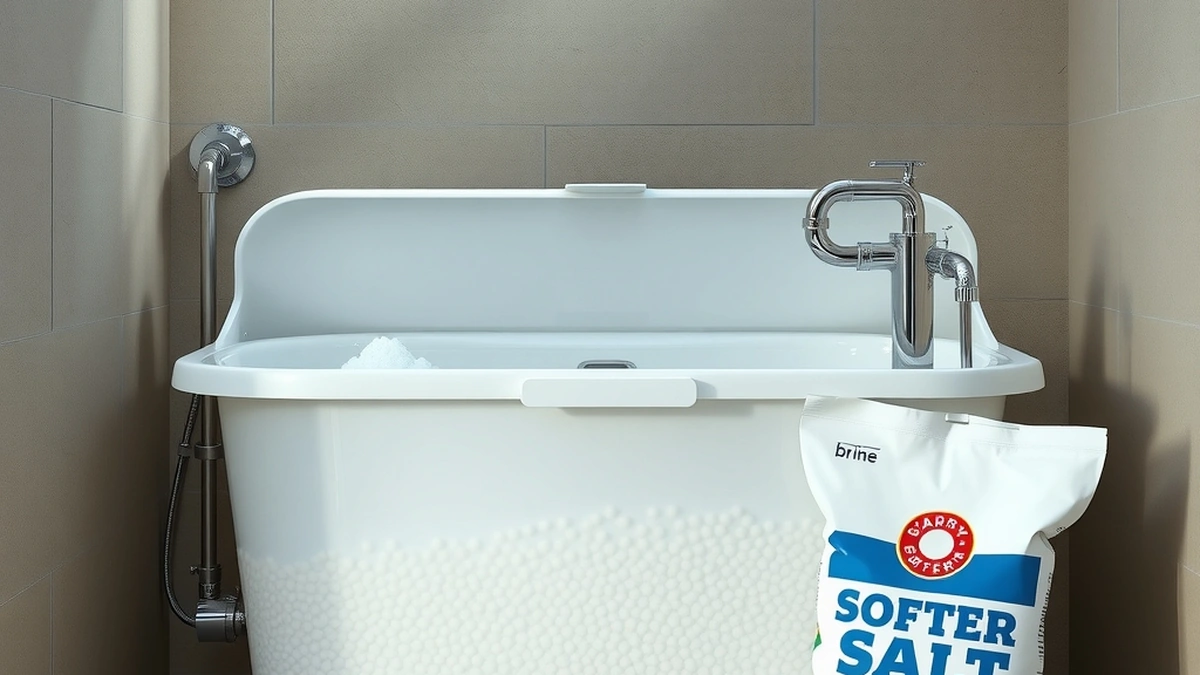
Water softener salt installation is a 15-minute job: pour 40-pound bags into the brine tank, keep the salt level above the water line, and never fill above the tank's marked maximum. Salt costs $120-$400 per year.
- Time
- 15 minutes
- Bag size
- 40 pounds
- Salt per year
- $120 - $400
- Dose per regen
- 8 - 12 pounds
- Tank fill limit
- Below the overflow
Some links on this page are affiliate links.If you buy through them we may earn a commission at no extra cost to you. We do not accept payment for rankings. Read the full disclosure.
Water softener salt installation is a 15-minute job: open the brine tank, check the level, and pour in 40-pound bags until the salt sits three-quarters full. The part people get wrong is the fill line, not the pouring. Salt costs $120-$400 per year.
What the brine tank is doing
A water softener removes hardness through ion exchange, and salt is what recharges the resin. The brine tank dissolves salt into a concentrated solution that the valve draws through the resin bed during regeneration.
That means salt is not a filter media and does not pass into the house water. It is consumed in the regeneration cycle and discharged to drain, which is why the tank level drops over weeks.
The tank holds 200-400 pounds of salt in most residential units. A household regenerating weekly at 10 pounds uses 520 pounds per year, so the tank needs refilling roughly every four to six months.
Filling it correctly
- Open the lid and look at the salt level and the water line.
- Confirm the salt is at least a few inches above the water and below the maximum mark.
- Pour 40-pound bags in, keeping them away from the brine well and float assembly.
- Break up any crust or bridging with a clean stick before adding more.
- Close the lid and note the date on the bag or a calendar.
- Run a manual regeneration if the tank had run completely dry.
Do not fill above the maximum mark printed inside the tank. An overfilled tank compacts under its own weight, forms a bridge, and stops dissolving salt even though it looks full.
Salt types and what they cost
| Type | Cost per 40 lb | Purity | Best for |
|---|---|---|---|
| Pellets | $8 - $15 | High | Most valves, default choice |
| Solar salt | $6 - $12 | Medium | Budget use, sunny storage |
| Rock salt | $5 - $10 | Low | Units rated for it only |
| Block salt | $10 - $20 | High | Specific older softeners |
| Potassium chloride | $25 - $45 | High | Salt-sensitive households |
Pellets dissolve cleanly and leave little insoluble residue, which is why most manufacturers specify them. Solar salt is evaporated seawater and works fine but carries more calcium sulfate that can form sludge.
Potassium chloride is the alternative for households avoiding sodium, and it costs two to three times as much. It also requires a higher dose for the same capacity, so the annual cost can triple.
The dose setting
Salt dose per regeneration is usually 8-12 pounds, set on the valve. Higher doses deliver more capacity per regeneration but use salt less efficiently per pound; lower doses are more efficient but regenerate more often.
A 32,000-grain softener at a 10-pound dose gets roughly 3,200 grains of capacity per pound, which is a reasonable efficiency point. Pushing to 15 pounds gains capacity but wastes salt.
The dose should match the resin volume and the water’s hardness, not a default from the installer. If the valve is set for 12 pounds and the house only needs 8, the extra salt goes down the drain every cycle.
When salt stops dissolving
A salt bridge is a crust that forms across the top of the salt while the tank stays empty underneath. The softener runs, the brine is weak, and the water turns hard while the tank looks full.
Break the bridge with a broom handle or a clean stick, then run a manual regeneration. If bridging recurs, the humidity in the room is too high, or the salt is the wrong type for the tank.
Salt mushing is the opposite problem: the salt dissolves into sludge that blocks the brine pick-up. It happens with too much water in the tank or with rock salt in a humid space. Salt bridge in softener covers the diagnosis.
Cost accounting over a year
Thirteen bags of pellets at $11 each is $143 per year, which sits at the low end of the $120-$400 band. A household with very hard water regenerating twice a week uses 1,040 pounds, or 26 bags at $11, which is $286.
Potassium chloride at $35 per bag for the same 26 bags is $910 per year, which is why most households stay with sodium pellets.
If the softener is using noticeably more salt than the arithmetic suggests, the valve is regenerating too often or the dose is set too high. Softener regenerating every night covers the likely causes, and salt dose and efficiency explains how to tune it.
How much salt to keep on hand
A brine tank holds 200-400 pounds, and a household uses 8-12 pounds per regeneration. At one regeneration per week, that is roughly 500 pounds a year, or 13 bags.
Keeping two spare bags in the garage is enough for most homes. Buying a pallet saves $2-$4 per bag but stores 2,000 pounds somewhere dry, and salt that absorbs moisture from a damp garage cakes before it is used.
If the tank is in a humid basement, keep the lid sealed and the tank off a concrete floor that sweats. A paving stone or a plastic riser under the tank makes a difference over a year.
Watch the level after a vacation. A softener that regenerated on schedule while the house was empty still used salt, and the tank may be lower than expected when you return.
Salt and the septic system
A softener discharges brine to the drain during regeneration, roughly 40-80 gallons per cycle. On a septic system, that volume and its salt load arrive in a slug rather than spread out.
Most systems handle it, but the brine should not be routed to a septic tank if a dry well or a dedicated line is available. Check local rules before installing; some jurisdictions restrict softener discharge to septic systems.
Newer demand-initiated valves reduce the volume by regenerating only when capacity is used, which cuts both salt and discharge. That is a valve choice, not a salt choice, and it matters more on a septic system than on sewer.
Frequently asked questions
How do I add salt to a water softener?
Open the brine tank lid, check that the salt level is below the maximum mark, and pour 40-pound bags in until the level reaches three-quarters full. Do not pour salt into the brine well or over the float.
How high should the salt be in the brine tank?
Keep it at least a few inches above the water line but below the tank's maximum fill mark. A tank filled to the top can bridge and stop drawing brine.
How much salt does a softener use per year?
Most households spend $120-$400 per year. A system regenerating weekly at 10 pounds uses 520 pounds, which is 13 bags at $10-$30 each.
What type of salt should I use?
Pellets are the safest default for most valves. Solar salt is cheaper and works but leaves more insoluble residue, and block salt is for specific older units.
Can I use rock salt in a water softener?
Only if the manufacturer specifies it. Rock salt carries more insoluble material and can clog the brine valve and the injector screen over time.
What happens if I let the softener run out of salt?
The resin stops regenerating and the house gets hard water within a few days. Refill and run a manual regeneration to restore capacity rather than waiting for the next scheduled cycle.
Sources
Some links are affiliate links.If you buy through them we may earn a commission at no extra cost to you. We do not accept payment for rankings. Read the full disclosure.


