Salt Dose and Efficiency: The 8 lb Rule
How salt dose affects water softener efficiency, grain capacity, and annual salt costs, with the 8 lb rule explained.
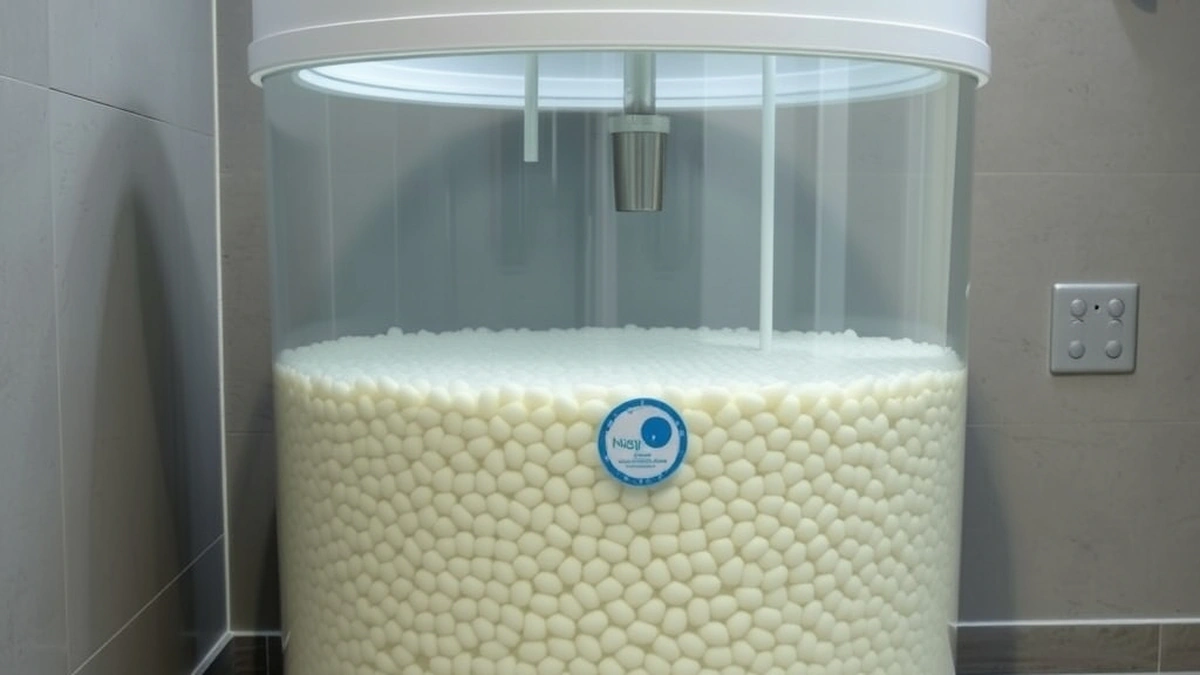
Set most residential softeners to about 8 pounds of salt per regeneration for a balance of grain capacity and salt efficiency; higher doses recover more grains but waste salt.
- Typical salt dose range
- 8-12 lbs per regeneration
- Softener equipment cost
- $600-$2,500
- Installed softener cost
- $1,200-$4,500
- Annual salt cost
- $120-$400 per year
- Resin bed replacement
- $300-$600
Some links on this page are affiliate links.If you buy through them we may earn a commission at no extra cost to you. We do not accept payment for rankings. Read the full disclosure.
What the 8 lb Rule Means
The 8 lb rule is a practical starting point for programming a water softener’s salt dose. Setting the brine draw to about 8 pounds of salt per regeneration targets a middle ground between grain capacity and salt efficiency. A higher salt dose recovers more resin capacity per cycle but wastes salt; a lower dose saves salt but reduces the grains removed before the next regeneration. For most residential softeners, 8 pounds per regeneration is the efficiency breakpoint where additional salt produces diminishing returns.
How Salt Dose Affects Grain Capacity
Water softener capacity is measured in grains of hardness removed. Resin capacity is not fixed; it changes with the salt dose. A typical cubic foot of resin might deliver roughly 20,000 grains at a low salt dose and approach 30,000 grains at a higher dose, but the grains removed per pound of salt declines as the dose rises.
Here is how the math works for a 48,000-grain-rated softener:
- At a 6 lb salt dose, effective capacity may be about 30,000 grains, or 5,000 grains per pound of salt.
- At an 8 lb salt dose, effective capacity may be about 36,000 grains, or 4,500 grains per pound of salt.
- At a 12 lb salt dose, effective capacity may be about 42,000 grains, or 3,500 grains per pound of salt.
The 8 lb rule accepts slightly lower total capacity in exchange for better grains-per-pound efficiency. Over a year, that difference shows up in the salt budget.
Annual Salt Cost Arithmetic
Salt is the recurring operating cost of an ion-exchange softener. Canonical estimates place annual salt costs at $120 to $400, depending on hardness, water use, and dose settings. To see how dose drives that range, assume a household uses 300 gallons per day with 15 grains per gallon (gpg) hardness.
Daily hardness load: 300 gallons × 15 gpg = 4,500 grains per day
Monthly load: 4,500 grains × 30 days = 135,000 grains per month
If the softener is set to an 8 lb dose and delivers 36,000 grains per regeneration: 135,000 ÷ 36,000 = 3.75 regenerations per month, or about 45 per year
Salt use: 45 regenerations × 8 lbs = 360 lbs of salt per year
At $0.40 to $0.80 per pound for bulk salt, that is roughly $144 to $288 annually. If the same household used a 12 lb dose, salt use would rise to 540 lbs per year, or roughly $216 to $432, while gaining only modest extra capacity between cycles. That arithmetic is why the 8 lb rule matters for long-term operating cost.
Equipment and Installation Cost Context
A water softener is an upfront investment plus ongoing salt and maintenance. Equipment typically costs $600 to $2,500, and installed cost ranges from $1,200 to $4,500 depending on plumbing, location, and unit size. For a full cost breakdown, see how much does a water softener cost. Installation-specific pricing is covered in water softener installation cost.
Resin does not last forever. A resin rebed costs approximately $300 to $600 and is typically needed within the 8 to 12 year resin life, inside the 10 to 15 year expected softener life. Running an unnecessarily high salt dose does not extend resin life, but it does increase brine discharge and salt purchases over that decade.
When to Adjust the Dose
The 8 lb rule is a baseline, not a hard limit. Very hard water above 10 gpg, or water with iron near the 2 to 3 ppm softener limit, may justify a higher dose to protect capacity between regenerations. Very soft water in the 0 to 3 gpg range may allow a lower dose. Iron above the softener limit usually requires separate treatment; see iron filter cost for context.
Programming should follow the manufacturer’s manual and the results of a water test. A lab test typically costs $40 to $150 and confirms hardness, iron, and other parameters before equipment is selected or settings are changed. For homes with multiple water quality issues, whole-house treatment costs are summarized in whole house water filter cost.
Salt Efficiency Versus Other Treatment Types
Salt-based ion exchange is not the only option, but it is the only common whole-house technology that exchanges hardness minerals for sodium using a regenerable resin bed. Salt-free conditioners cost $500 to $1,800 installed and do not use salt or regeneration, but they do not remove hardness by ion exchange. Carbon filters cost $500 to $1,800 installed with cartridges at $80 to $300 per year, and they target chlorine, taste, and odor rather than hardness. Reverse osmosis systems cost $300 to $900 installed under sink, with $60 to $150 in annual running costs, and they treat drinking water at a single tap rather than the whole house. Whole-house RO runs $3,000 to $8,000 installed and wastes 3 to 4 gallons for every gallon produced.
For hardness removal across the whole house, a properly programmed softener remains the standard, and salt dose is the main operating lever.
Maintenance and Long-Term Cost
Salt dose settings interact with maintenance schedules. A brine tank should be checked periodically for salt bridging and proper water level. Resin beds last 8 to 12 years under normal use, and rebedding costs $300 to $600. Running the softener at extreme salt doses does not replace routine maintenance, and it will not prevent eventual resin replacement.
For salt pricing specifics, see water softener salt cost. If the application involves well water, broader treatment costs are outlined in well water treatment cost.
Bottom Line
Set the softener salt dose near 8 pounds per regeneration as a default efficiency point. Verify with a water test, program for actual household hardness and usage, and expect annual salt costs in the $120 to $400 range. Higher doses buy more grain capacity per cycle but cost more per grain removed; lower doses save salt but shorten the run between regenerations. The 8 lb rule is the point where those trade-offs balance for most homes.
Frequently asked questions
What is the 8 lb rule for water softeners?
The 8 lb rule is a starting point for setting the salt dose at roughly 8 pounds per regeneration to balance grain capacity and salt efficiency rather than maximizing either extreme.
Does more salt always mean softer water?
No. More salt per regeneration increases total grain capacity up to the resin limit, but it lowers efficiency and increases salt cost without improving softening quality.
How often does a softener regenerate?
Regeneration frequency depends on water hardness, household usage, and programmed capacity; it is not fixed by the salt dose alone.
Can I lower the salt dose to save money?
Yes, lowering the salt dose reduces salt use per regeneration, but it also reduces the grains removed between regenerations, which can trigger more frequent cycles.
What is grain capacity?
Grain capacity is the amount of hardness, measured in grains, a softener can remove before it must regenerate; residential units typically range from 24,000 to 64,000 grains.
Should I test water before setting salt dose?
Yes. A water test establishes hardness and iron levels so the softener can be sized and programmed correctly; lab tests typically cost $40-$150.
Sources
Some links are affiliate links.If you buy through them we may earn a commission at no extra cost to you. We do not accept payment for rankings. Read the full disclosure.