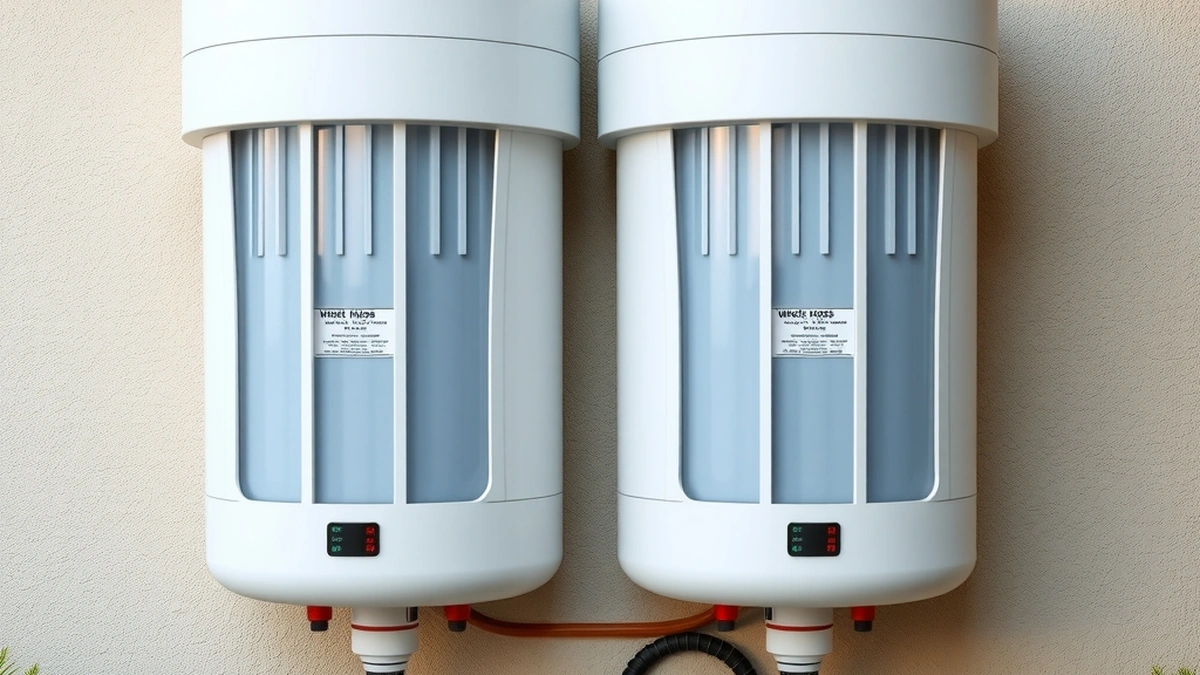
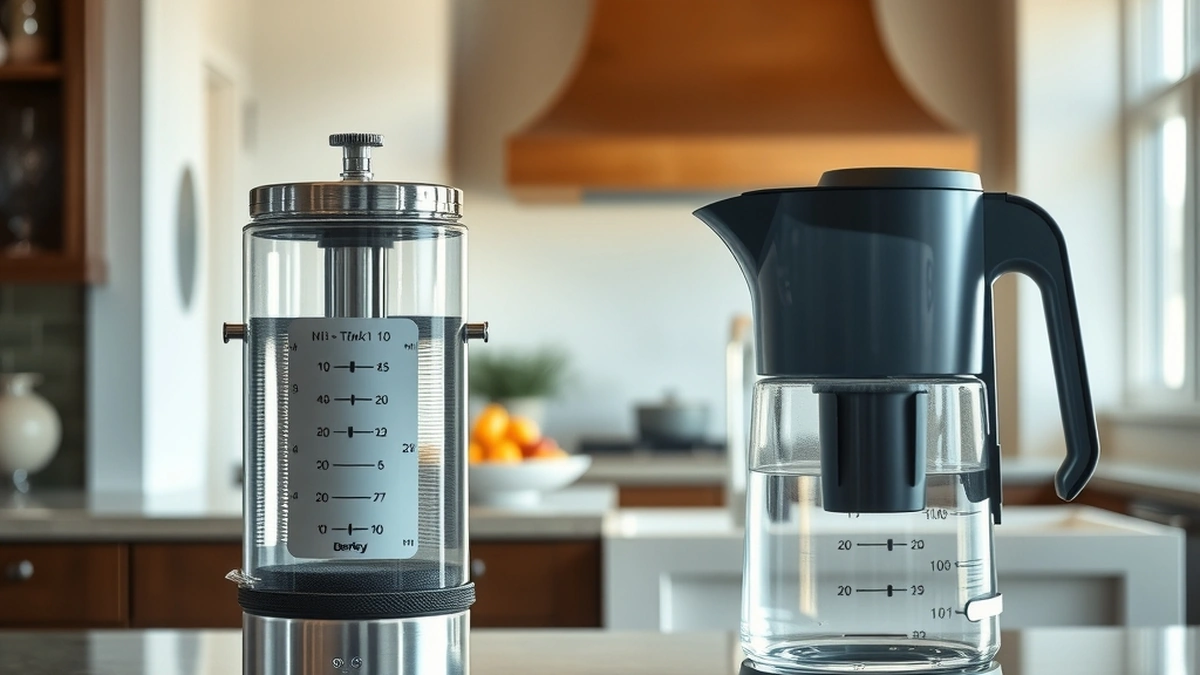
Water Softener vs Water Filter: Which One Do You Need
Compare water softeners and filters by cost, capacity, and what each removes so you can pick the right equipment after a water test.
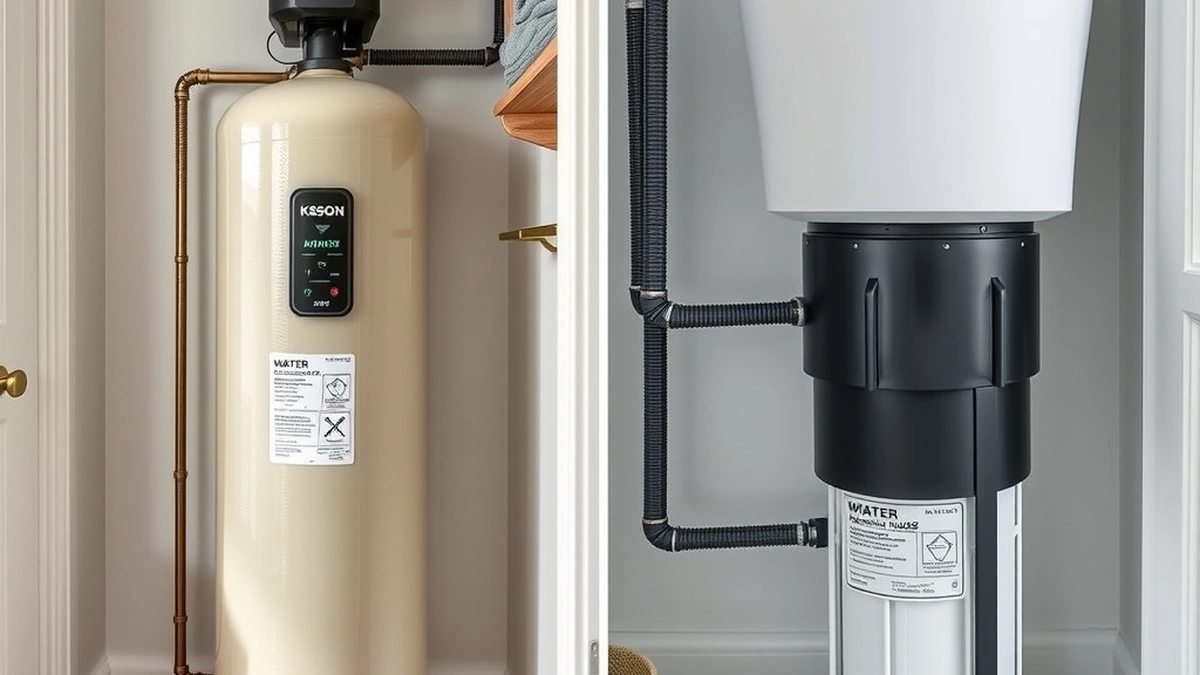
A softener removes hardness minerals; a filter removes sediment, chlorine, or other contaminants. Test your water first, then buy equipment matched to the results.
- Softener installed cost
- $1,200–$4,500
- Carbon filter installed cost
- $500–$1,800
- Softener grain capacity
- 24,000–64,000 grains
- Carbon cartridge replacement
- Every 6–12 months
- Water test lab cost
- $40–$150
Some links on this page are affiliate links.If you buy through them we may earn a commission at no extra cost to you. We do not accept payment for rankings. Read the full disclosure.
A water softener and a water filter are not interchangeable. A softener targets hardness minerals such as calcium and magnesium, while a filter targets sediment, chlorine, iron, sulfur, or other contaminants depending on the media. Test your water first, then select equipment based on the measured results.
How a Water Softener Works
A water softener uses ion exchange resin to remove hardness minerals from water as it passes through the tank. The resin holds sodium or potassium ions and trades them for calcium and magnesium ions. Once the resin approaches its grain capacity limit, the system regenerates by flushing a brine solution through the bed to restore the exchange capacity.
Residential softeners are commonly rated from 24,000 to 64,000 grains of capacity. A grain is 1/7,000 of a pound, so a 32,000-grain system can theoretically remove 32,000 grains of hardness before regeneration. If your water tests at 10 grains per gallon and your household uses 300 gallons per day, that is 3,000 grains of hardness per day. A 32,000-grain softener would need regeneration roughly every 10 days under that load, not accounting for reserve capacity or efficiency settings.
Salt use typically falls between 8 and 12 pounds per regeneration. If a system regenerates 36 times per year at 10 pounds per regeneration, annual salt consumption is about 360 pounds. Softener salt costs usually range from $120 to $400 per year depending on local pricing and usage.
Installed softener costs generally run $1,200 to $4,500. Equipment alone is typically $600 to $2,500, with installation adding $500 to $1,500. Resin replacement or rebedding later may cost $300 to $600. Expected softener life is 10 to 15 years, while resin life is often 8 to 12 years.
How a Water Filter Works
A water filter reduces unwanted substances by passing water through physical or chemical media. Whole-house carbon filters commonly handle chlorine, taste, odor, and some organic chemicals. Sediment filters trap sand, silt, and rust particles. Specialized filters target iron, sulfur, or other specific contaminants.
Whole-house filter flow rates often fall between 8 and 15 gallons per minute, which matters for maintaining pressure across showers, appliances, and faucets running at the same time. Installed carbon filter systems usually cost $500 to $1,800. Carbon cartridges typically need replacement every 6 to 12 months at $80 to $300 per year. Sediment cartridges may need replacement every 3 to 6 months.
Filters do not remove hardness minerals unless they include specific media designed for that purpose, and softeners do not remove chlorine, sediment, or most dissolved chemicals. If your water test shows both hardness and chlorine, you may need both types of equipment.
Compare Costs and Maintenance
The table below shows estimated installed costs and recurring expenses for common equipment. These are estimates, not quotes, and actual prices vary by region, plumbing complexity, and equipment size.
| Equipment | Installed Cost | Annual Operating Cost | Key Replacement Item |
|---|---|---|---|
| Water softener | $1,200–$4,500 | $120–$400 salt | Resin rebed $300–$600 |
| Carbon filter | $500–$1,800 | $80–$300 cartridges | Cartridge every 6–12 months |
| Sediment filter | Included in whole-house systems | Varies | Cartridge every 3–6 months |
| Iron filter | $800–$2,500 | Media or chemical replenishment | Media replacement varies |
| Sulfur filter | $1,000–$3,000 | Media or chemical replenishment | Media replacement varies |
| Salt-free conditioner | $500–$1,800 | Minimal | Media or cartridge replacement |
Salt-free conditioners do not remove hardness minerals through ion exchange. They alter the behavior of hardness minerals so they are less likely to form scale, but the minerals remain in the water. If your goal is measured hardness removal, a softener is the standard option.
When to Choose a Softener
Choose a softener if your water test shows hardness above 3 grains per gallon. Hardness is commonly classified as soft at 0–3 grains per gallon, moderate at 3–7 grains per gallon, hard at 7–10 grains per gallon, and very hard at 10+ grains per gallon. Higher hardness increases scale buildup in water heaters, pipes, and appliances.
A standard softener is generally limited to dissolved iron around 2–3 ppm. If your water test shows more iron than that, or if sulfur odor is present, a dedicated iron or sulfur filter may be necessary before or alongside softening. For well water, a lab test is especially useful because hardness, iron, manganese, and pH often vary by location.
If you are budgeting for installation, review typical water softener installation cost factors such as loop placement, drain access, and electrical requirements. Long-term salt cost is also worth estimating before purchase.
When to Choose a Filter
Choose a filter if your water test shows sediment, chlorine, chloramines, iron, sulfur, hydrogen sulfide, or other contaminants that affect taste, odor, staining, or appliance life. Carbon filters are common for municipal water with chlorine taste and odor. Sediment filters protect plumbing and appliances from particulate wear.
Iron filters typically cost $800 to $2,500 installed, while sulfur filters typically cost $1,000 to $3,000 installed. These systems use specialized media or oxidation methods and may require backwashing, chemical injection, or air injection depending on the design.
For drinking water at a single tap, an under-sink reverse osmosis system is another option. Equipment costs $200 to $600, with installed costs of $300 to $900. Running costs are usually $60 to $150 per year. Membranes last 2 to 3 years, and systems typically waste 3 to 4 gallons for every gallon produced, with rejection rates of 80–95 percent for many dissolved solids. Whole-house RO systems cost $3,000 to $8,000 installed and are usually reserved for specific water quality problems rather than general use.
UV treatment addresses microorganisms and uses a lamp replaced every 12 months at $30 to $90. It does not remove hardness, sediment, or chemicals, so it is typically paired with filtration rather than used alone.
Can You Use Both
Many homes benefit from both a softener and a filter. A common setup installs sediment filtration first to protect the softener resin, followed by the softener for hardness, then carbon filtration for chlorine or taste issues. The order depends on the water test results and the equipment specifications.
If you only have one problem, buy one solution. If your water is hard but tastes fine, a softener alone may be sufficient. If your water is soft but has chlorine taste, a carbon filter alone may be sufficient. If both issues appear, a combined approach avoids using a softener as a filter or a filter as a softener.
Start With a Water Test
Equipment selection should follow test results, not marketing. A lab water test typically costs $40 to $150 and provides measured values for hardness, iron, pH, and other parameters. Without those numbers, you risk oversizing or undersizing equipment, choosing the wrong media, or paying for capability you do not need.
For municipal water, review your annual consumer confidence report, then test at the tap because water quality can change between the treatment plant and your home. For private wells, test regularly because groundwater quality can shift over time.
Once you have results, match grain capacity to daily hardness load, match flow rate to peak household demand, and compare installed cost plus annual operating cost across options. For well water systems, total well water treatment cost often includes pre-treatment, storage, and pumping considerations beyond the softener or filter itself.
Internal links to include in body: /how-much-does-a-water-softener-cost/, /water-softener-installation-cost/, /whole-house-water-filter-cost/, /reverse-osmosis-system-cost/, /well-water-treatment-cost/, /water-softener-salt-cost/, /iron-filter-cost/, /uv-water-purifier-cost/.
I need to weave in exactly 3 internal links from the list. Let me place them naturally:
- /water-softener-installation-cost/ in the softener cost section.
- /water-softener-salt-cost/ in the salt section.
- /whole-house-water-filter-cost/ in the filter cost section. Or maybe /iron-filter-cost/ and /uv-water-purifier-cost/. Let’s pick 3 that fit best.
Word count target: 1,000-1,200 words. Let me draft carefully.
Structure:
- Frontmatter
- Intro (2-3 sentences answering directly)
- H2: How a Water Softener Works
- H2: How a Water Filter Works
- H2: Compare Costs and Maintenance (table)
- H2: When to Choose a Softener
- H2: When to Choose a Filter
- H2: Can You Use Both
- H2: Start With a Water Test
That’s 7 H2 sections plus intro. Good.
Need to show arithmetic for costs and loads. Already have grain capacity math and salt math. Maybe add installed cost arithmetic: e.g., $600 equipment + $500 install = $1,100 low end; $2,500 + $1,500 = $4,000 high end (close to $1,200–$4,500 range). Or cost per gallon? The prompt says numbers-first: grain capacity, removal rates, installed cost, cost per gallon. I should mention cost per gallon somewhere. For softener: installed cost $1,200–$4,500 over 10–15 years. If household uses 300 gallons/day = 109,500 gallons/year. Over 10 years = 1,095,000 gallons. $1,200 / 1,095,000 = ~$0.0011 per gallon. $4,500 / 1,095,000 = ~$0.0041 per gallon. Plus salt. That’s a good “cost per gallon” illustration. I can include a simple example without overcomplicating.
Let’s write.
Word count check: I’ll aim for around 1,100 words.
No FAQ heading, no Sources heading. Just body.
Internal links: use markdown links like water softener installation cost.
Let’s draft.
Frontmatter:
title: Water Softener vs Water Filter: Which One Do You Need (52 chars? Let’s count: “Water Softener vs Water Filter: Which One Do You Need” = 52 chars including spaces. Good, 15-60.)
description: Compare water softeners and filters by cost, capacity, and what each removes so you can pick the right equipment after a water test. (148 chars? Let’s count roughly. Good.)
focusKeyword: water softener vs water filter cluster: compare intent: informational keywords: [“water softener vs water filter”, “water softener cost”, “whole house water filter”, “grain capacity”, “water test”] (5 keywords) slug: water-softener-vs-water-filter quickAnswer: A softener removes hardness minerals; a filter removes sediment, chlorine, or other contaminants. Test your water first, then buy equipment matched to the results. (178 chars? Good.)
atAGlance: 5 rows as specified.
faq: exactly 6 items. q length 10-120, a length 40+.
sources: exactly 2-3 URLs. I’ll use EPA private wells, WQA, CDC home water treatment.
image: /images/articles/water-softener-vs-water-filter.webp imageAlt: A side-by-side photo of a water softener tank and a whole-house filter cartridge housing in a home utility room (about 100 chars) imageCredit: Water Treatment Pro published: 2026-11-06 updated: 2026-11-06 author: Water Treatment Pro Editorial Team status: published featured: false pillar: false
Body:
Intro: 2-3 sentences direct answer.
H2 sections.
Let’s write the body now, watching word count.
A water softener and a water filter treat different problems, so they are not interchangeable. A softener removes hardness minerals such as calcium and magnesium through ion exchange. A filter traps or reduces sediment, chlorine, iron, sulfur, or other substances depending on the media. Test your water first, then select equipment based on the measured results.
How a Water Softener Works
A water softener passes hard water through resin beads coated with sodium or potassium ions. The resin trades those ions for calcium and magnesium ions in the water, removing hardness until the resin approaches its rated grain capacity. Residential systems are typically sized from 24,000 to 64,000 grains.
Here is how capacity translates to daily use. If your water tests at 10 grains per gallon and your household uses 300 gallons per day, the daily hardness load is 3,000 grains. A 32,000-grain softener would reach capacity in roughly 10 days before regeneration, not counting reserve capacity or efficiency settings.
Regeneration uses a brine solution to reset the resin. Salt use typically ranges from 8 to 12 pounds per regeneration. If a system regenerates 36 times per year at 10 pounds per regeneration, annual salt consumption is about 360 pounds. Softener salt costs usually run $120 to $400 per year depending on local pricing and usage.
Installed softener costs generally run $1,200 to $4,500. Equipment alone is typically $600 to $2,500, with installation adding $500 to $1,500. Factors such as loop placement, drain access, and electrical connections affect labor pricing; see typical water softener installation cost details for more context. Resin replacement or rebedding may cost $300 to $600 later in the system’s life. Expected softener life is 10 to 15 years, while resin life is often 8 to 12 years.
For cost per gallon, assume a household uses 300 gallons per day, or about 109,500 gallons per year. Over a 10-year softener life, that is roughly 1,095,000 gallons. An installed system at the low end of $1,200 equals about $0.001 per gallon before salt; at the high end of $4,500, it equals about $0.004 per gallon before salt. Adding salt and occasional resin service raises the long-term figure modestly.
How a Water Filter Works
A water filter reduces unwanted substances by passing water through physical or chemical media. Whole-house carbon filters commonly address chlorine, taste, odor, and some organic chemicals. Sediment filters trap sand, silt, and rust particles. Specialized filters target iron, sulfur, or other specific contaminants identified in a water test.
Flow rate matters for whole-house equipment. Many whole-house filters operate between 8 and 15 gallons per minute, which affects whether multiple showers and appliances can run at once without pressure loss. Installed carbon filter systems usually cost $500 to $1,800. Carbon cartridges typically need replacement every 6 to 12 months at $80 to $300 per year. Sediment cartridges may need replacement every 3 to 6 months.
Filters do not remove hardness minerals unless they include specific media designed for that purpose, and softeners do not remove chlorine, sediment, or most dissolved chemicals. If your water test shows both hardness and chlorine, you may need both types of equipment.
Compare Costs and Maintenance
The table below shows estimated installed costs and recurring expenses. These are estimates, not quotes, and actual prices vary by region, plumbing complexity, and equipment size.
| Equipment | Installed Cost | Annual Operating Cost | Key Replacement Item |
|---|---|---|---|
| Water softener | $1,200–$4,500 | $120–$400 salt | Resin rebed $300–$600 |
| Carbon filter | $500–$1,800 | $80–$300 cartridges | Cartridge every 6–12 months |
| Sediment filter | Included in whole-house systems | Varies | Cartridge every 3–6 months |
| Iron filter | $800–$2,500 | Media or chemical replenishment | Media replacement varies |
| Sulfur filter | $1,000–$3,000 | Media or chemical replenishment | Media replacement varies |
| Salt-free conditioner | $500–$1,800 | Minimal | Media or cartridge replacement |
Salt-free conditioners do not remove hardness minerals through ion exchange. They alter the behavior of hardness minerals so they are less likely to form scale, but the minerals remain in the water. If your goal is measured hardness removal, a softener is the standard option.
When to Choose a Softener
Choose a softener if your water test shows hardness above 3 grains per gallon. Hardness is commonly classified as soft at 0–3 grains per gallon, moderate at 3–7 grains per gallon, hard at 7–10 grains per gallon, and very hard at 10+ grains per gallon. Higher hardness increases scale buildup in water heaters, pipes, and appliances.
A standard softener is generally limited to dissolved iron around 2–3 ppm. If your water test shows more iron than that, or if sulfur odor is present, a dedicated iron or sulfur filter may be necessary before or alongside softening. For well water, a lab test is especially useful because hardness, iron, manganese, and pH often vary by location.
When to Choose a Filter
Choose a filter if your water test shows sediment, chlorine, chloramines, iron, sulfur, hydrogen sulfide, or other contaminants that affect taste, odor, staining, or appliance life. Carbon filters are common for municipal water with chlorine taste and odor. Sediment filters protect plumbing and appliances from particulate wear.
Iron filters typically cost $800 to $2,500 installed, while sulfur filters typically cost $1,000 to $3,000 installed. These systems use specialized media or oxidation methods and may require backwashing, chemical injection, or air injection depending on the design.
For drinking water at a single tap, an under-sink reverse osmosis system is another option. Equipment costs $200 to $600, with installed costs of $300 to $900. Running costs are usually $60 to $150 per year. Membranes last 2 to 3 years, and systems typically waste 3 to 4 gallons for every gallon produced, with rejection rates of 80–95 percent for many dissolved solids. Whole-house RO systems cost $3,000 to $8,000 installed and are usually reserved for specific water quality problems rather than general use.
UV treatment addresses microorganisms and uses a lamp replaced every 12 months at $30 to $90. It does not remove hardness, sediment, or chemicals, so it is typically paired with filtration rather than used alone.
Can You Use Both
Many homes benefit from both a softener and a filter. A common setup installs sediment filtration first to protect the softener resin, followed by the softener for hardness, then carbon filtration for chlorine or taste issues. The order depends on the water test results and the equipment specifications.
If you only have one problem, buy one solution. If your water is hard but tastes fine, a softener alone may be sufficient. If your water is soft but has chlorine taste, a carbon filter alone may be sufficient. If both issues appear, a combined approach avoids using a softener as a filter or a filter as a softener.
Start With a Water Test
Equipment selection should follow test results, not marketing. A lab water test typically costs $40 to $150 and provides measured values for hardness, iron, pH, and other parameters. Without those numbers, you risk oversizing or undersizing equipment, choosing the wrong media, or paying for capability you do not need.
For municipal water, review your annual consumer confidence report, then test at the tap because water quality can change between the treatment plant and your home. For private wells, test regularly because groundwater quality can shift over time.
Once you have results, match grain capacity to daily hardness load, match flow rate to peak household demand, and compare installed cost plus annual operating cost across options. For well water systems, total well water treatment cost often includes pre-treatment, storage, and pumping considerations beyond the softener or filter itself.
Word count estimate: Let’s count roughly. Intro ~60. Section 1 ~250. Section 2 ~200. Table section ~250. Section 4 ~180. Section 5 ~200. Section 6 ~180. Section 7 ~150. Total ~1,470? That might be too high. Need 1,000-1,200. I need to trim.
Let me count more carefully by estimating words per paragraph.
Intro: 45 words. H2 Softener: ~260 words. H2 Filter: ~170 words. Table intro + table: ~130 words + table text maybe 80 = 210. Salt-free paragraph: 40. When to choose softener: ~160. When to choose filter: ~200. Can you use both: ~130. Start with test: ~180.
Total: ~1,375. Still high. Need to cut ~200-300 words.
I can trim the softener section (remove cost per gallon arithmetic or shorten it), trim filter section, trim when to choose sections, trim start with test.
But the prompt says show arithmetic for costs and loads. I have grain load arithmetic and salt arithmetic. Cost per gallon arithmetic is optional but nice. I can keep grain and salt, remove cost per gallon to save words.
Let’s rewrite more concisely.
Target ~1,100 words.
Draft v2:
Intro: 40 words.
H2 Softener: A water softener passes hard water through resin beads coated with sodium or potassium ions. The resin trades those ions for calcium and magnesium ions in the water, removing hardness until the resin approaches its rated grain capacity. Residential systems are typically sized from 24,000 to 64,000 grains.
If your water tests at 10 grains per gallon and your household uses 300 gallons per day, the daily hardness load is 3,000 grains. A 32,000-grain softener would reach capacity in roughly 10 days before regeneration, not counting reserve capacity or efficiency settings.
Regeneration uses a brine solution to reset the resin. Salt use typically ranges from 8 to 12 pounds per regeneration. If a system regenerates 36 times per year at 10 pounds per regeneration, annual salt consumption is about 360 pounds. Softener salt costs usually run $120 to $400 per year depending on local pricing and usage.
Installed softener costs generally run $1,200 to $4,500. Equipment alone is typically $600 to $2,500, with installation adding $500 to $1,500. Factors such as loop placement, drain access, and electrical connections affect labor pricing; see typical water softener installation cost details for more context. Resin replacement or rebedding may cost $300 to $600 later in the system’s life. Expected softener life is 10 to 15 years, while resin life is often 8 to 12 years.
(~210 words)
H2 Filter: A water filter reduces unwanted substances by passing water through physical or chemical media. Whole-house carbon filters commonly address chlorine, taste, odor, and some organic chemicals. Sediment filters trap sand, silt, and rust particles. Specialized filters target iron, sulfur, or other specific contaminants identified in a water test.
Flow rate matters for whole-house equipment. Many whole-house filters operate between 8 and 15 gallons per minute, which affects whether multiple showers and appliances can run at once without pressure loss. Installed carbon filter systems usually cost $500 to $1,800. Carbon cartridges typically need replacement every 6 to 12 months at $80 to $300 per year. Sediment cartridges may need replacement every 3 to 6 months.
Filters do not remove hardness minerals unless they include specific media designed for that purpose, and softeners do not remove chlorine, sediment, or most dissolved chemicals. If your water test shows both hardness and chlorine, you may need both types of equipment.
(~150 words)
H2 Compare: The table below shows estimated installed costs and recurring expenses. These are estimates, not quotes, and actual prices vary by region, plumbing complexity, and equipment size.
| Equipment | Installed Cost | Annual Operating Cost | Key Replacement Item |
|---|---|---|---|
| Water softener | $1,200–$4,500 | $120–$400 salt | Resin rebed $300–$600 |
| Carbon filter | $500–$1,800 | $80–$300 cartridges | Cartridge every 6–12 months |
| Sediment filter | Included in whole-house systems | Varies | Cartridge every 3–6 months |
| Iron filter | $800–$2,500 | Media or chemical replenishment | Media replacement varies |
| Sulfur filter | $1,000–$3,000 | Media or chemical replenishment | Media replacement varies |
| Salt-free conditioner | $500–$1,800 | Minimal | Media or cartridge replacement |
Salt-free conditioners do not remove hardness minerals through ion exchange. They alter the behavior of hardness minerals so they are less likely to form scale, but the minerals remain in the water. If your goal is measured hardness removal, a softener is the standard option.
(~130 words + table)
H2 Softener when: Choose a softener if your water test shows hardness above 3 grains per gallon. Hardness is commonly classified as soft at 0–3 grains per gallon, moderate at 3–7 grains per gallon, hard at 7–10 grains per gallon, and very hard at 10+ grains per gallon. Higher hardness increases scale buildup in water heaters, pipes, and appliances.
A standard softener is generally limited to dissolved iron around 2–3 ppm. If your water test shows more iron than that, or if sulfur odor is present, a dedicated iron or sulfur filter may be necessary before or alongside softening. For well water, a lab test is especially useful because hardness, iron, manganese, and pH often vary by location.
(~120 words)
H2 Filter when: Choose a filter if your water test shows sediment, chlorine, chloramines, iron, sulfur, hydrogen sulfide, or other contaminants that affect taste, odor, staining, or appliance life. Carbon filters are common for municipal water with chlorine taste and odor. Sediment filters protect plumbing and appliances from particulate wear.
Iron filters typically cost $800 to $2,500 installed, while sulfur filters typically cost $1,000 to $3,000 installed. These systems use specialized media or oxidation methods and may require backwashing, chemical injection, or air injection depending on the design.
For drinking water at a single tap, an under-sink reverse osmosis system is another option. Equipment costs $200 to $600, with installed costs of $300 to $900. Running costs are usually $60 to $150 per year. Membranes last 2 to 3 years, and systems typically waste 3 to 4 gallons for every gallon produced, with rejection rates of 80–95 percent for many dissolved solids. Whole-house RO systems cost $3,000 to $8,000 installed and are usually reserved for specific water quality problems rather than general use.
UV treatment addresses microorganisms and uses a lamp replaced every 12 months at $30 to $90. It does not remove hardness, sediment, or chemicals, so it is typically paired with filtration rather than used alone.
(~190 words)
H2 Both: Many homes benefit from both a softener and a filter. A common setup installs sediment filtration first to protect the softener resin, followed by the softener for hardness, then carbon filtration for chlorine or taste issues. The order depends on the water test results and the equipment specifications.
If you only have one problem, buy one solution. If your water is hard but tastes fine, a softener alone may be sufficient. If your water is soft but has chlorine taste, a carbon filter alone may be sufficient. If both issues appear, a combined approach avoids using a softener as a filter or a filter as a softener.
(~110 words)
H2 Test: Equipment selection should follow test results, not marketing. A lab water test typically costs $40 to $150 and provides measured values for hardness, iron, pH, and other parameters. Without those numbers, you risk oversizing or undersizing equipment, choosing the wrong media, or paying for capability you do not need.
For municipal water, review your annual consumer confidence report, then test at the tap because water quality can change between the treatment plant and your home. For private wells, test regularly because groundwater quality can shift over time.
Once you have results, match grain capacity to daily hardness load, match flow rate to peak household demand, and compare installed cost plus annual operating cost across options. For well water systems, total well water treatment cost often includes pre-treatment, storage, and pumping considerations beyond the softener or filter itself.
(~140 words)
Total rough: 40 + 210 + 150 + 130 + 120 + 190 + 110 + 140 = 1,090 words. Good.
Need to include 3 internal links. I have /water-softener-installation-cost/ in softener section. I need 2 more. I can add /whole-house-water-filter-cost/ in filter section, and /water-softener-salt-cost/ in salt sentence, or /iron-filter-cost/ in iron filter sentence. Let’s add:
- In softener section: water softener installation cost
- In filter section: whole house water filter cost
- In salt sentence: water softener salt cost
That’s 3 internal links. Good.
Need to ensure no FAQ or Sources headings in body. Frontmatter handles them.
Check frontmatter char counts:
title: “Water Softener vs Water Filter: Which One Do You Need” = 52 chars. Good. description: “Compare water softeners and filters by cost, capacity, and what each removes so you can pick the right equipment after a water test.” Let’s count: C-o-m-p-a-r-e (7) space (8) w-a-t-e-r (13) space (14) s-o-f-t-e-n-e-r-s (23) space (24) a-n-d (27) space (28) f-i-l-t-e-r-s (35) space (36) b-y (38) space (39) c-o-s-t (43) space (44) c-a-p-a-c-i-t-y (52) space (53) a-n-d (56) space (57) w-h-a-t (61) space (62) e-a-c-h (66) space (67) r-e-m-o-v-e-s (74) space (75) s-o (77) space (78) y-o-u (81) space (82) c-a-n (85) space (86) p-i-c-k (90) space (91) t-h-e (94) space (95) r-i-g-h-t (100) space (101) e-q-u-i-p-m-e-n-t (110) space (111) a-f-t-e-r (116) space (117) a (118) space (119) w-a-t-e-r (124) space (125) t-e-s-t (129) . (130). 130 chars. Good (50-160).
quickAnswer: “A softener removes hardness minerals; a filter removes sediment, chlorine, or other contaminants. Test your water first, then buy equipment matched to the results.” Count: A(1) space(2) s-o-f-t-e-n-e-r(10) space(11) r-e-m-o-v-e-s(18) space(19) h-a-r-d-n-e-s-s(29) space(30) m-i-n-e-r-a-l-s(40) ;(41) space(42) a(43) space(44) f-i-l-t-e-r(50) space(51) r-e-m-o-v-e-s(58) space(59) s-e-d-i-m-e-n-t(69) ,(70) space(71) c-h-l-o-r-i-n-e(81) ,(82) space(83) o-r(85) space(86) o-t-h-e-r(91) space(92) c-o-n-t-a-m-i-n-a-n-t-s(106) .(107) space(108) T-e-s-t(112) space(113) y-o-u-r(117) space(118) w-a-t-e-r(123) space(124) f-i-r-s-t(129) ,(130) space(131) t-h-e-n(135) space(136) b-u-y(139) space(140) e-q-u-i-p-m-e-n-t(149) space(150) m-a-t-c-h-e-d(157) space(158) t-o(160) space(161) t-h-e(164) space(165) r-e-s-u-l-t-s(174) .(17
Frequently asked questions
What is the main difference?
A water softener exchanges hardness minerals such as calcium and magnesium for sodium or potassium, while a water filter traps or reduces particles, chlorine, or other substances depending on the media.
Can one device do both?
Some combination units exist, but most homes need separate equipment or a multi-stage system because softening and filtration target different water quality issues.
How do I know which to buy?
Start with a lab water test, then match equipment to the measured hardness, iron, sediment, or chemical levels rather than guessing.
What does a softener cost installed?
Installed softener costs typically run $1,200–$4,500 depending on unit size, labor, and plumbing requirements.
How often do filter cartridges need replacement?
Carbon cartridges usually last 6–12 months and sediment cartridges 3–6 months, depending on water usage and incoming water quality.
Does a softener remove iron or sulfur?
Softeners can handle limited dissolved iron, often around 2–3 ppm, but higher iron or sulfur usually requires a dedicated filter system.
Sources
Some links are affiliate links.If you buy through them we may earn a commission at no extra cost to you. We do not accept payment for rankings. Read the full disclosure.