
Water test for well water
How to arrange a proper well water test, which lab to use, how to sample, and how to read bacteria, nitrate, and mineral results.
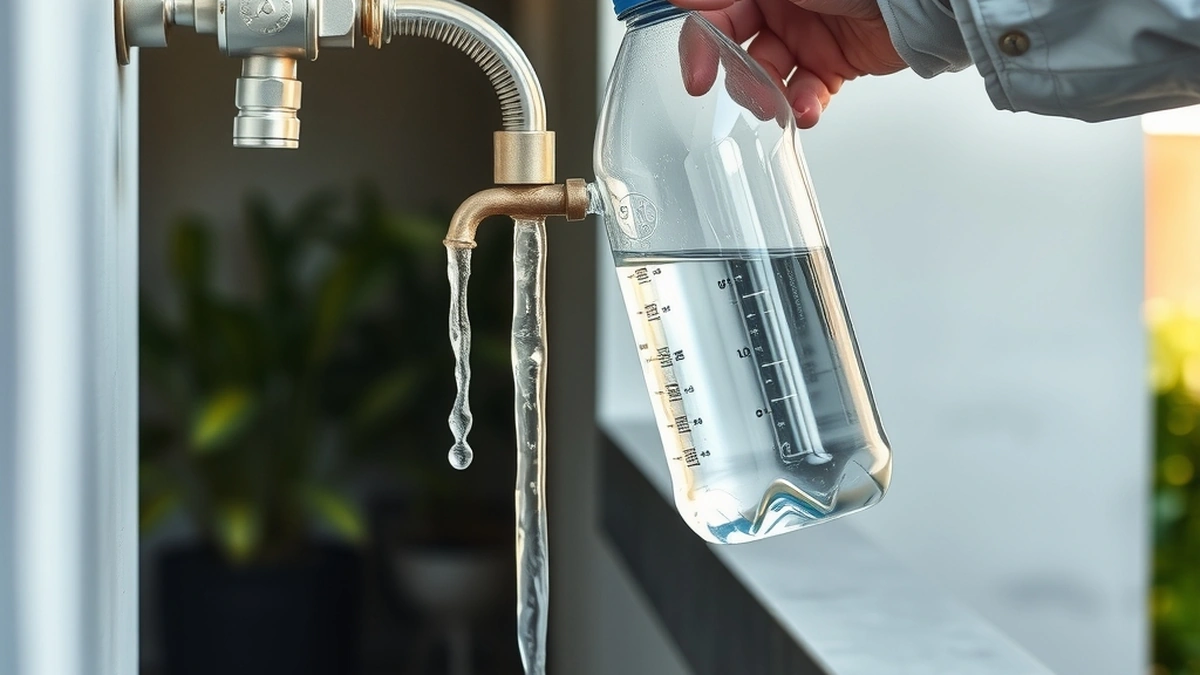
A water test for well water should go to a certified lab and cover coliform bacteria, nitrate, iron, manganese, hardness, and pH, for $40 to $150. Sample before any treatment and retest annually, after flooding, or when the water changes.
- Lab test cost
- $40 - $150
- Nitrate limit
- 10 mg/L
- Iron softener limit
- 2 - 3 ppm
- Hard water
- Above 7 gpg
- Retest interval
- Annually
Some links on this page are affiliate links.If you buy through them we may earn a commission at no extra cost to you. We do not accept payment for rankings. Read the full disclosure.
A water test for well water should go to a certified laboratory and cover coliform bacteria, nitrate, iron, manganese, hardness, and pH. The panel costs $40 to $150, and the sample has to be taken before any treatment. A private well has no utility testing it, so the report is the only specification you have for equipment.
Why a lab, not a strip
Strips are fine for a quick hardness check. They are not adequate for bacteria or nitrate, which are the two parameters with the clearest action thresholds.
Bacteria testing needs a sterile bottle, a controlled incubation, and a laboratory reading. Nitrate needs a colorimetric or ion method with a detection limit below the 10 mg/L standard.
A certified lab also produces a report that a lender, a buyer, or a health department will accept. That matters at a real estate closing.
What the panel should cover
| Parameter | Why it matters | Threshold |
|---|---|---|
| Coliform bacteria | Contamination pathway | Absent |
| E. coli | Faecal contamination | Absent |
| Nitrate | Septic and agricultural influence | 10 mg/L |
| Iron | Staining, softener fouling | 2 - 3 ppm for softeners |
| Manganese | Staining, taste | Low levels |
| Hardness | Scale and soap performance | Above 7 gpg is hard |
| pH | Corrosion or scaling tendency | Roughly 6.5 - 8.5 |
| Arsenic | Regional geology | Check locally |
Arsenic and lead are worth adding where the geology or the plumbing suggests them. Lead usually comes from pipes and solder rather than the aquifer.
Choosing a laboratory
Look for a state-certified lab, which is required for certain tests in many states. The lab should supply the bottles, the instructions, and the chain-of-custody paperwork.
Ask about turnaround time. Bacteria results are usually available in two to five days, and chemistry panels in a week or two.
Ask whether the lab reports hardness in grains per gallon or milligrams per litre. If it reports mg/L, divide by 17.1 to get gpg, because softener sizing uses grains. A report that says 205 mg/L is describing about 12 gpg, which is a different capacity bracket.
Sampling correctly
- Use the lab’s bottles and do not rinse them.
- Remove any aerator, filter, or hose from the tap.
- Run the water for several minutes to clear the line.
- Sample before any softener, filter, or UV unit.
- Fill to the line, cap immediately, and keep the sample cool.
- Return or ship the sample the same day.
A sample taken after the softener reports soft water and tells you nothing about the raw supply. A sample from a garden hose can pick up contamination from the hose itself.
Reading the results
Bacteria is reported as presence or absence. A positive coliform result means the well or the plumbing needs investigation and disinfection, followed by a resample. It does not automatically mean the water is unsafe for every use, but it does mean the source needs attention.
Nitrate at or above 10 mg/L is the point where the water should not be used for drinking without treatment. A dedicated nitrate treatment is a different device from a softener.
Iron above 2 to 3 ppm exceeds what most softeners handle. An iron filter at $800 to $2,500 installed is the usual upstream treatment.
Hardness above 7 gpg is hard, and above 10 gpg is very hard. Softener sizing uses the number multiplied by daily gallons.
What the test does not tell you
A single test is a snapshot. It does not predict what happens after a flood, a drought, or a change in nearby land use, and it does not establish a trend. Two reports a year apart tell a more useful story than one perfect result.
It also does not test everything. PFAS, pesticides, and solvents require specific panels that cost more and are not part of a standard well package.
If a contaminant is a local concern, ask the lab for the specific method rather than assuming the standard panel covers it.
Test annually for bacteria and nitrate at minimum, and retest after any of these events.
Flooding that submerges the wellhead. A new well or pump. A change in taste, colour, or smell. A positive result at a neighbour’s well. A pregnancy or a new infant in the home. Installation of a treatment system, to confirm it works.
Using the report to buy equipment
The report is the specification. Iron decides whether an iron filter comes first. Hardness decides the softener capacity. Bacteria decides whether disinfection is needed before anything else.
A treatment system sized without the report is a guess, and a guess usually shows up as a softener that cannot keep up or a filter that fouls in months. Keep the report with the equipment manual so the next service call starts from data.
For the equipment side, see well water treatment system installation and iron filter cost. For reading the numbers, how to read a water test report explains the units.
Bottom line
A well water test belongs at a certified lab, costs $40 to $150, and should cover bacteria, nitrate, iron, hardness, and pH. Sample before treatment, retest annually, and use the report as the specification for every piece of equipment you buy.
Frequently asked questions
How do I get my well water tested?
Order a kit from a certified laboratory, follow its sampling instructions, and return the sample the same day for bacteria and chemistry panels.
What should a well water test include?
Coliform bacteria, nitrate, iron, manganese, hardness, and pH, with arsenic, lead, or PFAS added where local conditions suggest them.
How much does a well water test cost?
A basic lab panel costs $40 to $150, and broader contaminant panels cost more depending on the number of analytes.
Can I test well water with strips?
Strips are useful for hardness and pH screening, but bacteria and nitrate require a laboratory method with proper handling.
How often should a private well be tested?
Test bacteria and nitrate annually, and retest after flooding, a new well, a pump replacement, or any change in taste or colour.
What if the test shows bacteria?
A positive coliform result calls for disinfection of the well and a resample, and E. coli requires immediate action before drinking.
Sources
Some links are affiliate links.If you buy through them we may earn a commission at no extra cost to you. We do not accept payment for rankings. Read the full disclosure.


