
well water treatment system installation: what it involves
A well treatment train takes 1-2 days to install and costs $2,000-$8,000. See the typical stack, drain and power needs, and how to phase the purchase.
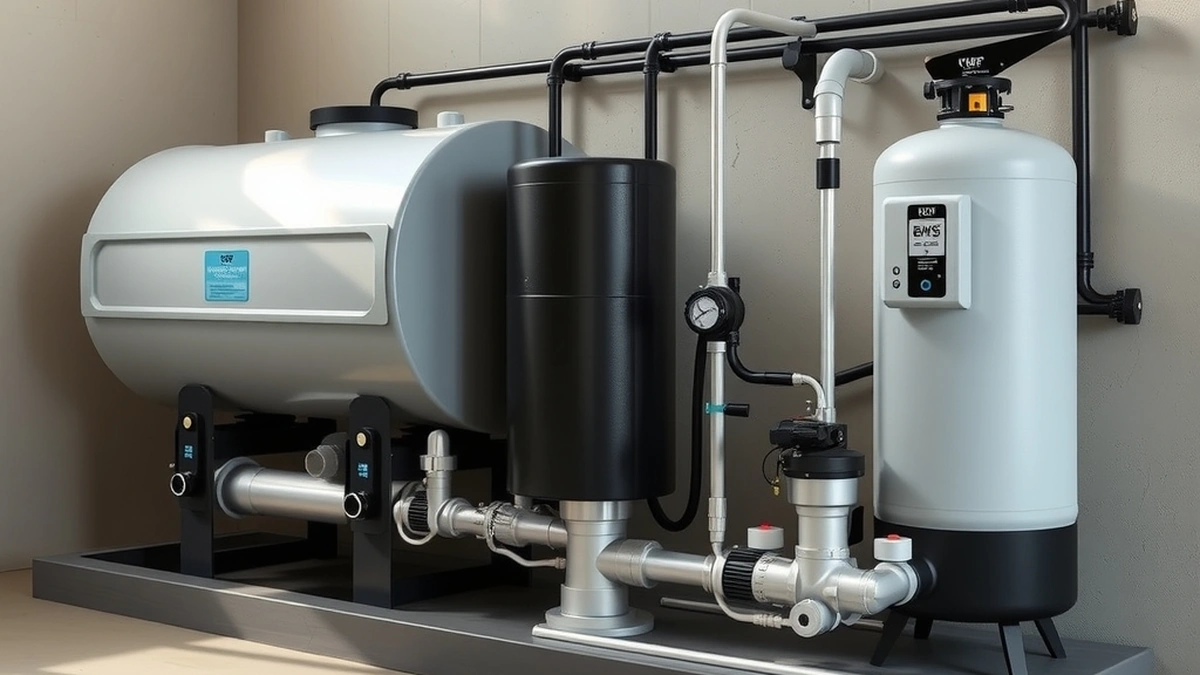
Well water treatment system installation takes 1-2 days for a full train and costs $2,000-$8,000. The stack usually runs sediment, iron or sulfur oxidation, softener, and UV, installed after the pressure tank in that order.
- Installed total
- $2,000 - $8,000
- Install time
- 1 - 2 days
- Lab panel
- $40 - $150
- Typical flow
- 8 - 15 GPM
- Power needed
- 2 - 3 outlets
Some links on this page are affiliate links.If you buy through them we may earn a commission at no extra cost to you. We do not accept payment for rankings. Read the full disclosure.
Well water treatment system installation takes 1-2 days for a full train and costs $2,000-$8,000 installed. The equipment is installed after the pressure tank, in a fixed order: sediment, iron or sulfur oxidation, softener, then UV. Get the order wrong and every stage downstream works harder than it should.
Start with the lab panel, not the catalog
A well water treatment system is a chain of point-of-entry devices that each remove a different class of contaminant. Which devices you need is decided by a lab panel that reports bacteria, nitrate, iron, manganese, hardness, pH, and arsenic at minimum.
That panel costs $40-$150. It is the cheapest line in the project and the only one that prevents buying the wrong $2,500 tank.
Well water varies block by block. A neighbor’s iron level says nothing about yours, because the aquifer is not uniform and the well’s casing depth, screen, and grouting all change what arrives at the tap. Test your own water.
The typical train
| Stage | Equipment | Installed cost | What it handles |
|---|---|---|---|
| 1 | Sediment housing | $80 - $400 | Sand, grit, rust flakes |
| 2 | Iron or sulfur filter | $800 - $3,000 | Iron, manganese, hydrogen sulfide |
| 3 | Water softener | $1,200 - $4,500 | Hardness above 3-7 gpg |
| 4 | Carbon polisher | $500 - $1,800 | Taste, odor, residual chlorine |
| 5 | UV purifier | $300 - $900 | Microbial load |
Not every house needs all five. A well with 2 ppm iron, 12 grains of hardness, and a clean bacteria test needs stages 1, 2, 3, and possibly 4. A well with soft, low-iron water and a positive bacteria test needs stage 1 and 5, plus shock chlorination of the well itself.
Add the low end: $80 + $800 + $1,200 = $2,080. Add the high end: $400 + $3,000 + $4,500 + $1,800 + $900 = $10,600. The $2,000-$8,000 band covers the common three- and four-stage configurations.
The pressure tank is the anchor
Every piece of treatment equipment goes downstream of the pressure tank. The tank provides steady flow, buffers the pump’s cycle, and supplies the volume a backwashing filter needs during its cycle.
Put a filter between the pump and the tank and the pump short-cycles against a restriction, which burns motors. That mistake shows up as a pump that runs every few minutes and a pressure gauge that swings.
Tank size matters for backwash. A 20-gallon tank cannot supply a 10 GPM backwash for 15 minutes without dropping below the pump cut-in. A 44- or 52-gallon tank is the usual minimum for a house with two backwashing devices.
If the tank is old and waterlogged, replace it before adding equipment. A $400-$800 tank replacement is cheaper than diagnosing mysterious pressure problems after a $5,000 install.
Drain, vent, and power
Three utilities decide whether the job is one day or three.
Drain: backwashing filters and softeners need a discharge point within 10-15 feet, sized for 5-10 GPM. A floor drain is ideal. A standpipe, laundry sink, or dry well works with the right air gap.
Vent: air injection iron and sulfur filters need a vent to the outdoors or a well-ventilated space. Chemical oxidation needs a solution tank and sometimes a vented enclosure.
Power: a softener needs one outlet, a backwashing filter another, UV a third, and an injection pump a fourth. Most treatment rooms have one. Adding a circuit costs $150-$350 each, and that line item is routinely forgotten in budgets.
Installation sequence
- Test the raw water and confirm the well’s yield and recovery rate.
- Replace or verify the pressure tank and the main shutoff.
- Install a bypass manifold so each device can be isolated.
- Mount the sediment housing first, then the oxidation filter with its drain and vent.
- Install the softener, then the carbon polisher, then the UV last.
- Run manual cycles on each device, check for leaks, and test treated water at the tap.
Phasing the purchase
Most homeowners do not buy the whole train at once. A sensible order is: fix the safety issues first (bacteria, nitrate), then the damage issues (iron, hardness), then the comfort issues (taste, odor).
Shock chlorinating the well and installing UV addresses the bacteria question for a few hundred dollars. Iron and hardness come next because they damage plumbing and appliances over years. Carbon polishing is last because it is a taste purchase.
That phasing also spreads the cost across two or three budget years, and each stage can be tested before the next is added. Well water treatment cost breaks the stages down by price, and municipal versus well water treatment explains why the well train differs from a city setup.
What changes the quote
Access is the first driver. A treatment room with a floor drain, outlets, and 6 feet of clear main is a one-day job. A crawlspace with no drain and a main buried in insulation is a three-day job with a premium.
Well condition is the second. A low-yield well may not support backwash, which forces a different design or a storage tank. A failing pump adds $1,000-$2,500 and should be handled before treatment equipment is installed.
Permits are the third. Most jurisdictions treat appliance swaps as minor work, but a new drain line, a pressure tank replacement, or a main reroute can require inspection. Ask before scheduling, not after.
A fourth is the lab work itself. A single panel at $40-$150 is enough to size the train, but a well that has never been tested should get a bacteria and nitrate screen before anything is purchased, because those two results can reorder the whole project. Water testing cost lists what each panel includes, and iron filter installation covers the stage that most wells need first.
Frequently asked questions
How much does a whole well water treatment system cost installed?
Two thousand to eight thousand dollars for a full train. A sediment and carbon pair sits near $1,000; adding iron, sulfur, softening, and UV pushes past $6,000.
What order should well water equipment be installed in?
Sediment first, then iron or sulfur oxidation, then softener, then UV last. Each stage protects the next, and reversing the order shortens media and resin life.
How long does installation take?
One to two days for a four-stage train with a drain and outlets already present. Building a new treatment room or adding circuits can extend it to three days.
Does a well system need a pressure tank before treatment?
Yes. Treatment equipment goes downstream of the pressure tank so it sees steady flow and the pump is not cycling against a filter. The tank also provides backwash volume.
Can I install well treatment equipment myself?
A sediment housing or a single softener is manageable for a confident DIYer. A multi-stage train with oxidation, venting, and UV is a plumber and electrician job in most jurisdictions.
How often should a well system be tested after installation?
Bacteria and nitrate annually, a full panel every two to three years, and a retest any time taste, color, or pressure changes. Test treated water at the tap, not at the tank.
Sources
Some links are affiliate links.If you buy through them we may earn a commission at no extra cost to you. We do not accept payment for rankings. Read the full disclosure.


