
Well water test kit
What to test in private well water, which kits are worth buying, and how to read bacteria, nitrate, and mineral results.
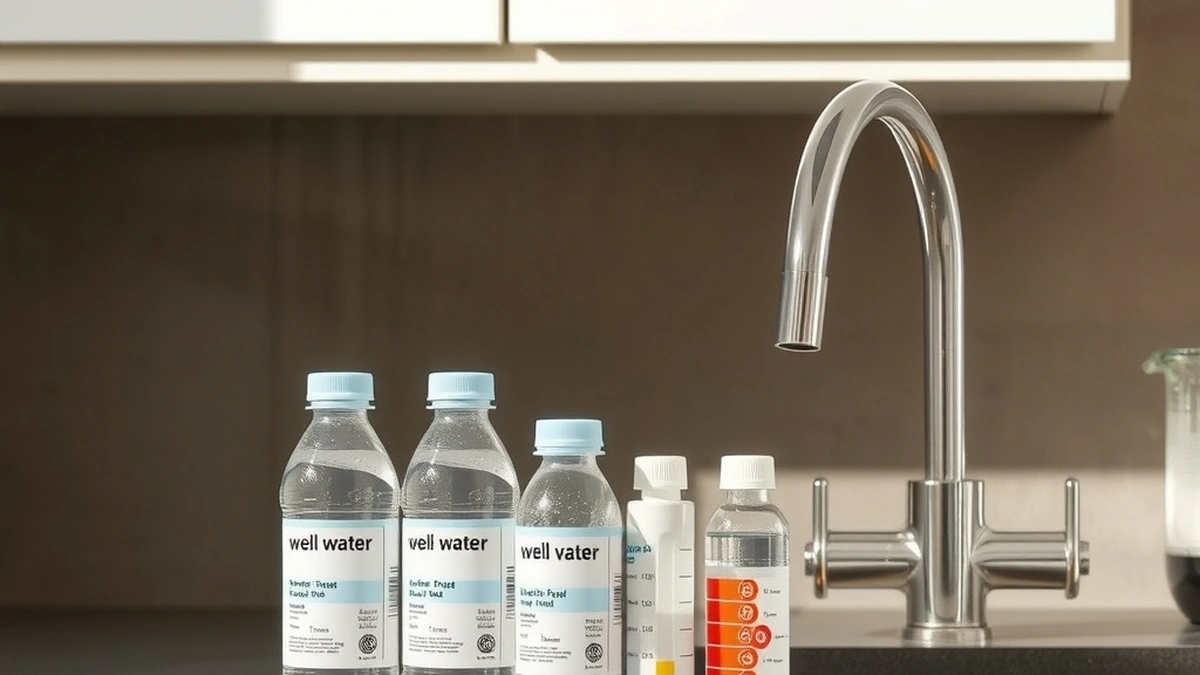
A well water test kit should cover coliform bacteria, nitrate, iron, manganese, hardness, and pH, and a lab test runs $40 to $150. Test annually, after flooding, and whenever the water changes taste, colour, or smell.
- Lab test cost
- $40 - $150
- Bacteria test
- Coliform and E. coli
- Nitrate limit
- 10 mg/L
- Iron softener limit
- 2 - 3 ppm
- Testing frequency
- Annually
Some links on this page are affiliate links.If you buy through them we may earn a commission at no extra cost to you. We do not accept payment for rankings. Read the full disclosure.
A well water test kit should cover coliform bacteria, nitrate, iron, manganese, hardness, and pH, and a lab panel typically costs $40 to $150. Test once a year, after flooding, and whenever the water changes taste, colour, or smell. A kit that reports only hardness is not a well test; it is a softener sales tool.
Why well water needs its own test
A private well is not covered by municipal treatment or municipal testing. The homeowner is the water utility, and the only way to know what is in the water is to sample it.
Public water systems publish annual reports. A well has no such report, and the geology under one property can differ from the next.
Bacteria and nitrate are the two parameters with the clearest action thresholds. Hardness and iron are equipment-selection parameters. All of them belong in one sample so the results can be read together.
What to test
| Parameter | Why it matters | Action level |
|---|---|---|
| Coliform bacteria | Indicates contamination path | Absent |
| E. coli | Indicates faecal contamination | Absent |
| Nitrate | Agricultural and septic influence | 10 mg/L |
| Iron | Staining, taste, softener fouling | 2 - 3 ppm for softeners |
| Manganese | Staining, taste | Low levels |
| Hardness | Scale and soap performance | Above 7 gpg is hard |
| pH | Corrosion or scaling tendency | Roughly 6.5 - 8.5 |
| Arsenic | Regional geology | Test where relevant |
| Lead | Plumbing, not the aquifer | Test in older homes |
Arsenic and lead are not universal, but they are common enough in some regions that a comprehensive panel is worth the extra cost.
Kit types
A laboratory mail-in kit is the reference standard. You collect the sample, ship it overnight, and receive a report with numbers.
A DIY bacteria kit uses a culture medium and an incubation period. It can detect coliform presence, but the incubation conditions matter and false results are possible.
Test strips are useful for hardness, pH, and iron screening. They are not adequate for nitrate or bacteria.
A digital meter suits repeated checks of a single parameter, such as hardness or pH, once the baseline is known. It is also useful for tracking whether a softener is keeping up, because the same meter used the same way gives a comparable reading each month.
Sampling correctly
- Use the bottles supplied with the kit and do not rinse them.
- Remove any aerator or filter from the tap.
- Run the water for several minutes to clear the line.
- Sample from a tap that is not connected to a softener or filter.
- Fill to the line, cap immediately, and keep the sample cool.
- Ship or drop off the sample the same day.
A sample taken after a softener will show low hardness and tell you nothing about the raw water. A sample taken from a garden hose can pick up contamination from the hose itself.
Reading the results
Bacteria results are presence or absence. A positive coliform result calls for disinfection of the well and a resample, and a positive E. coli result calls for immediate action.
Nitrate is reported in mg/L. The federal limit is 10 mg/L as nitrogen. A result near or above that should be addressed before the water is used for drinking, and the fix is usually a dedicated treatment rather than a softener.
Iron above 2 to 3 ppm exceeds what most softeners handle, and a dedicated iron filter at $800 to $2,500 installed is the usual next step.
Hardness above 7 gpg is hard, and above 10 gpg is very hard. Softener sizing uses the hardness number multiplied by daily gallons.
Test frequency and triggers
Test annually for bacteria and nitrate at minimum. Retest after any of the following.
Flooding that submerged the wellhead. A new well or a new pump. A change in taste, colour, or smell. A neighbour’s well showing contamination. A pregnancy or a new infant in the house. Installation of a treatment system, to confirm it is working.
Testing after treatment is as important as testing before. A softener that is regenerating incorrectly, or a UV lamp that has failed, will not show up in the water until someone tests. Keep the reports in a folder with the well log, because a service technician will ask for the last one.
Kit or full lab panel
The choice comes down to what the result will be used for. A kit answers “is this hard enough to matter” in ten minutes and costs less than a takeaway meal. A lab panel answers “what is in this water and is it safe” in a week and costs $40 to $150.
Neither replaces the other, and the mistake is buying one and expecting both answers.
A kit is enough for routine hardness and pH checks. A lab panel is the right choice for the annual bacteria and nitrate test, and for any first test on a property you have just bought.
If you are buying a house on a well, get the panel before closing. It is easier to negotiate a treatment system than to discover the problem after move-in, and a seller who has a recent report can usually produce the well log as well.
For the treatment side, see well water treatment system installation and iron filter cost. For reading a report, how to read a water test report explains the units.
Bottom line
A well water test kit should cover bacteria, nitrate, iron, hardness, and pH, and a lab panel costs $40 to $150. Test yearly, sample before any treatment, and treat the results as the specification for whatever equipment you buy.
Frequently asked questions
What should a well water test kit include?
At minimum coliform bacteria, nitrate, iron, manganese, hardness, and pH, with arsenic and lead added where local geology or plumbing suggests them.
How much does a well water test cost?
A lab test typically costs $40 to $150 depending on the panel, and comprehensive packages cost more.
How often should I test well water?
Test annually for bacteria and nitrate, and retest after flooding, a new well, or any change in taste, colour, or smell.
Are test strips good enough for well water?
Strips are useful for hardness and pH checks, but bacteria and nitrate need a lab or a certified kit with proper incubation.
What nitrate level is unsafe?
The federal drinking water limit is 10 mg/L nitrate as nitrogen, and private wells should be tested rather than assumed.
Can a water softener fix bacteria?
No. Softeners remove hardness minerals, not microbes, and a bacteria problem needs disinfection and a resample.
Sources
Some links are affiliate links.If you buy through them we may earn a commission at no extra cost to you. We do not accept payment for rankings. Read the full disclosure.


