
What Reverse Osmosis Removes (and What Passes Through)
What Reverse Osmosis Removes (and What Passes Through): practical numbers, costs, and trade-offs, written independently.
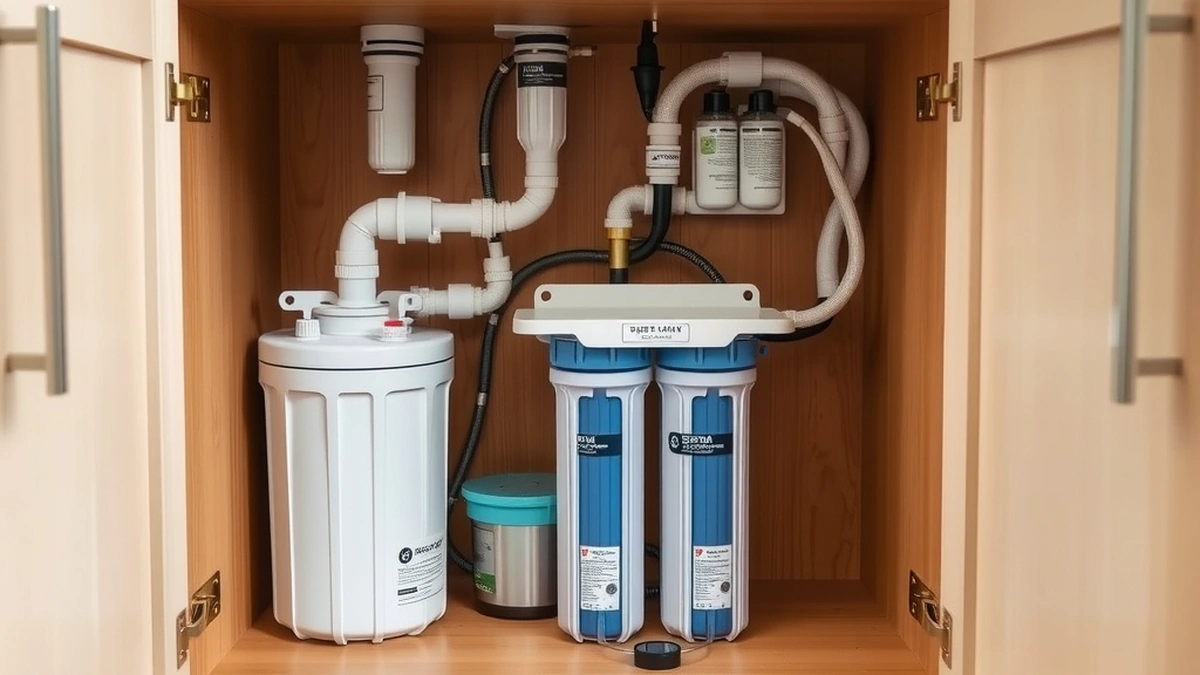
Reverse osmosis typically rejects 80-95 percent of dissolved solids, including lead, arsenic, nitrate, and sodium, while water passes through as permeate and concentrated contaminants go to drain.
- Typical rejection rate
- 80-95%
- Under-sink RO equipment
- $200-600
- Under-sink RO installed
- $300-900
- Annual RO running cost
- $60-150
- Membrane life
- 2-3 years
Some links on this page are affiliate links.If you buy through them we may earn a commission at no extra cost to you. We do not accept payment for rankings. Read the full disclosure.
Reverse osmosis removes a broad range of dissolved contaminants by forcing water through a semi-permeable membrane. Typical rejection rates fall between 80 and 95 percent for total dissolved solids, with specific results varying by contaminant, membrane condition, and operating pressure. The balance of this article explains what RO captures, what passes through, what it costs, and when pretreatment matters.
How Reverse Osmosis Works
RO uses pressure to push feed water across a membrane. Water molecules that pass through become permeate, while concentrated contaminants are routed to drain as reject or brine water. A standard under-sink RO unit includes a sediment pre-filter, a carbon pre-filter, the RO membrane, a storage tank, and a carbon post-filter.
The membrane is the main barrier to dissolved ions. Pre-filters protect it from chlorine and particles, and the post-filter polishes taste before water reaches the faucet. System performance depends on incoming water quality, temperature, pressure, and membrane age.
What RO Removes
RO is most effective at dissolved inorganic contaminants. Common reductions include:
- Dissolved solids such as sodium, chloride, and sulfate
- Heavy metals including lead, arsenic, and copper
- Nitrate and nitrite
- Fluoride
- Radionuclides such as uranium and radium
- Some pharmaceutical and pesticide residues
Rejection rates are not universal. A membrane rated at 90 percent rejection for a given ion still allows 10 percent through. If incoming nitrate is 20 mg/L, permeate may contain roughly 2 mg/L at 90 percent rejection. That is why post-installation testing matters.
What Passes Through
No membrane removes everything. RO generally allows some dissolved gases to pass, including carbon dioxide, which can lower permeate pH. Very small neutral molecules and certain volatile organic compounds may also pass at higher rates than ions. Rejection depends on molecular size, charge, and membrane chemistry.
Permeate TDS is almost never zero. If feed water measures 300 parts per million and rejection averages 90 percent, permeate TDS is roughly 30 ppm. The remaining 270 ppm concentrates in the reject stream.
RO Costs and Operating Numbers
Under-sink RO equipment typically costs $200 to $600. Installed, the range is usually $300 to $900. Annual running costs for filters and membrane replacement are commonly $60 to $150. Membranes typically last 2 to 3 years, while carbon and sediment cartridges often require replacement every 6 to 12 months.
Waste ratio is a real operating cost. A 3-to-1 waste ratio means 3 gallons go to drain for every 1 gallon of product water. A household using 2 gallons of RO water per day sends roughly 6 gallons to drain daily, or about 2,190 gallons per year. At a combined water and sewer rate of $0.015 per gallon, that adds roughly $33 per year in wastewater costs alone.
Whole-house RO is a different category. Installed costs typically run $3,000 to $8,000, and the system usually requires pretreatment, storage, and repressurization. Whole-house RO is generally reserved for specific water-quality problems rather than general drinking-water improvement.
RO Compared With Other Treatment Options
RO is not the right tool for every water problem. Water softeners exchange hardness ions for sodium and cost $1,200 to $4,500 installed, with annual salt costs of $120 to $400. Softener capacity ranges from 24,000 to 64,000 grains, and resin life is typically 8 to 12 years. For hardness-dominated water, a softener is usually more economical than RO.
Carbon filters cost $500 to $1,800 installed, with cartridge costs of $80 to $300 per year. Carbon is strong for chlorine, taste, odor, and many organic compounds, but it does not remove dissolved inorganics the way RO does. Sediment pre-filters typically need replacement every 3 to 6 months.
For well water with iron, sulfur, or bacteria, dedicated treatment may be required before RO. Iron filters cost $800 to $2,500 installed, and sulfur filters range from $1,000 to $3,000. UV systems add lamp replacement every 12 months at $30 to $90 per lamp. These numbers are estimates and vary by local water quality and installer pricing.
When Pretreatment Is Required
RO membranes can be fouled by chlorine, hardness, iron, and sediment. Chlorine damages thin-film composite membranes, so carbon pretreatment is standard when municipal water is chlorinated. Hard water can scale the membrane, reducing flow and rejection over time. Iron and manganese can coat the membrane surface.
Water testing comes first. A lab test typically costs $40 to $150 and identifies hardness, iron, manganese, TDS, nitrate, and pH. Those results determine whether RO alone is sufficient or whether softening, carbon, sediment filtration, or iron removal should come first. Equipment selection follows test results, not the other way around.
Realistic Expectations for RO Water
RO permeate is low in minerals and may taste flat compared with tap water. Some systems include a remineralization stage to add calcium and magnesium back for taste, though that is optional. Low pH permeate can be more aggressive toward certain plumbing materials, so check faucet and pipe compatibility before installation.
Storage tanks add convenience but can affect water quality if not sanitized periodically. Tank size typically ranges from 2 to 4 gallons for under-sink units, and fill rates depend on incoming pressure. Low pressure may require a booster pump, which adds equipment and electricity costs.
RO is a capable tool for dissolved contaminants, but it is not universal. Match the system to your lab results, account for waste ratio and annual filter costs, and treat hardness or iron upstream when the water chemistry calls for it.
Internal links: Readers comparing softener pricing can review how much a water softener costs, while installation-specific figures are in water softener installation cost. For whole-house filtration context, see whole house water filter cost.
Frequently asked questions
Does RO remove water hardness?
RO can reduce dissolved calcium and magnesium, but it is not a substitute for a water softener; hardness can scale and foul the membrane over time.
What passes through an RO membrane?
Some dissolved gases, very small molecules, and a percentage of dissolved solids pass through as permeate, while the rest goes to drain.
How much wastewater does RO produce?
Standard under-sink RO systems send roughly 3 to 4 gallons to drain for every 1 gallon of product water, depending on pressure and temperature.
How often does an RO membrane need replacement?
RO membranes typically last 2 to 3 years, while carbon and sediment pre-filters usually need replacement every 6 to 12 months.
Is RO water safe for all plumbing?
RO water is low in minerals and can be more aggressive than untreated water, so check faucet and piping compatibility before installing.
Should I test water before buying RO?
Yes. A lab test identifies the contaminants present so you can match the right pretreatment and confirm RO is the appropriate tool.
Sources
Some links are affiliate links.If you buy through them we may earn a commission at no extra cost to you. We do not accept payment for rankings. Read the full disclosure.


