
Whole home water softener
How a whole home softener is sized and placed, what it costs, and how it differs from a point-of-use filter.
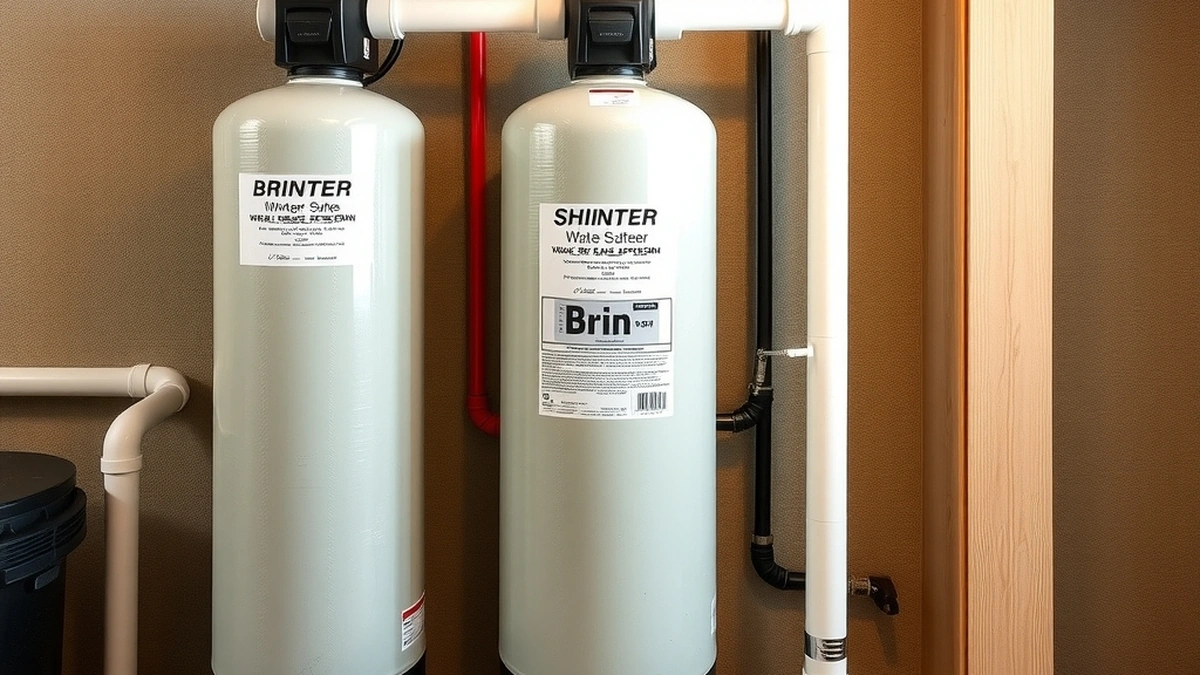
A whole home water softener treats every tap by installing on the main line after the meter or pressure tank. Expect $1,200 to $4,500 installed, sized by daily gallons times hardness in grains per gallon, with $120 to $400 per year in salt.
- Installed cost
- $1,200 - $4,500
- Grain capacity
- 24,000 - 64,000
- Salt per year
- $120 - $400
- Placement
- Main line, before heater
- System life
- 10 - 15 years
Some links on this page are affiliate links.If you buy through them we may earn a commission at no extra cost to you. We do not accept payment for rankings. Read the full disclosure.
A whole home water softener installs on the main line and treats every tap, appliance, and fixture in the house. Installed cost is $1,200 to $4,500, and sizing comes from daily gallons multiplied by hardness in grains per gallon. It is the right tool when scale appears on fixtures, the water heater, and the shower door at the same time.
Point of entry versus point of use
A whole home softener is a point-of-entry device. It sits where the water enters the house, so everything downstream is treated.
A point-of-use device treats one tap. An under-sink reverse osmosis system at $300 to $900 installed is the common example, and it improves drinking water without touching hardness elsewhere.
The two solve different problems. A softener addresses scale across the house. A point-of-use filter addresses taste at one faucet. Installing both is common when the water is hard and chlorinated.
Sizing the system
Start with a water test at $40 to $150. The report gives hardness in grains per gallon and flags iron.
Estimate daily demand at roughly 75 gallons per person. Four people use about 300 gallons per day.
Multiply gallons by hardness. At 12 gpg, 300 x 12 = 3,600 grains per day.
A unit that regenerates weekly needs about 25,200 grains of capacity plus a reserve, which points to a 32,000-grain model. At 20 gpg, the same household needs 300 x 20 = 6,000 grains per day, or 42,000 grains weekly, which points to a 48,000 or 64,000-grain unit.
| Household | Gallons/day | Hardness | Grains/day | Capacity |
|---|---|---|---|---|
| 2 people | 150 | 8 gpg | 1,200 | 24,000 |
| 4 people | 300 | 12 gpg | 3,600 | 32,000 |
| 4 people | 300 | 20 gpg | 6,000 | 48,000 - 64,000 |
| 6 people | 450 | 15 gpg | 6,750 | 64,000 |
Those numbers are estimates. Oversizing wastes salt; undersizing lets hard water through between regenerations.
Placement and plumbing
The softener goes after the meter or pressure tank and before the water heater. Softening before the heater protects the tank and elements from scale.
A bypass valve is required. It allows service and any future plumbing work without shutting off the house.
The drain line needs an air gap or standpipe and a slope that cannot back up into the tank. Most valves need a grounded outlet within a few feet.
Many installs leave outdoor hose bibs unsoftened. Softened water is fine for plants in most cases, but sending it to irrigation wastes salt and capacity. A bypass on the hose bib is a small plumbing detail with a long-running payoff.
What it costs
| Line | Typical range |
|---|---|
| Equipment | $600 - $2,500 |
| Installation labour | $500 - $1,500 |
| Installed total | $1,200 - $4,500 |
| Salt per year | $120 - $400 |
| Resin rebed | $300 - $600 |
A mid-range 40,000-grain unit at $1,500 with $1,000 of installation is $2,500 installed. Add a permit, a new drain line, or an electrical outlet and the total moves toward the top of the band, which is still well below a whole-house reverse osmosis system at $3,000 to $8,000 installed.
Salt is the running cost. A household regenerating twice a week at 10 pounds per cycle uses about 1,040 pounds per year, or 26 bags of 40 pounds.
Whole home or salt-free
| Factor | Whole home softener | Salt-free conditioner |
|---|---|---|
| Removes hardness | Yes | No |
| Water tests soft | Yes | No |
| Salt use | Yes | None |
| Installed cost | $1,200 - $4,500 | $500 - $1,800 |
| Scale reduction | Yes | Partial |
| Best fit | Hard and very hard water | Moderate hardness, no salt |
A salt-free unit is not a softener. It changes how minerals precipitate, which can reduce scale adhesion, but the water still carries calcium and magnesium.
Installation sequence
- Test the water and record hardness and iron.
- Choose the capacity from the sizing arithmetic.
- Select a location with drain, power, and service access.
- Install a bypass and a sediment pre-filter if the water is gritty.
- Set the valve for the measured hardness and the salt dose.
- Verify hardness at a tap after the first regeneration.
The sixth step is the one that catches mistakes. A valve programmed for 8 gpg on 18 gpg water will regenerate too late and let hardness through.
Maintenance expectations
Check salt every month and break any bridge before it hardens. Clean the brine tank once a year. Test hardness monthly with a strip to catch a decline early.
Resin lasts 8 to 12 years. A rebed at $300 to $600 restores capacity, and it is usually cheaper than replacing a system whose tank and valve are still sound.
For the sizing detail, see what size water softener do i need and water softener sizing. For the installation quote, water softener installation cost breaks down the lines.
Bottom line
A whole home water softener treats every tap and is sized from gallons per day and grains per gallon. Expect $1,200 to $4,500 installed and $120 to $400 a year in salt, and leave the outdoor taps unsoftened if irrigation is a large share of use.
The outdoor tap point deserves a line of its own. Softening irrigation water wastes salt and resin capacity on water that never touches a fixture, and the bypass for a hose bib costs a few dollars at install. A softener sized with 200 gallons a day of irrigation included will regenerate twice as often as it needs to.
Keep the model and serial number with the invoice. It is the first thing a warranty claim asks for, and it tells a future technician which valve parts to bring.
Frequently asked questions
What is a whole home water softener?
It is a point-of-entry ion exchange system on the main water line that removes hardness minerals from every tap, appliance, and fixture in the house.
How much does a whole home softener cost?
Equipment runs $600 to $2,500 and installation $500 to $1,500, for a typical installed total of $1,200 to $4,500.
Where should the softener be installed?
After the meter or pressure tank and before the water heater, with a bypass valve, drain, and electrical outlet nearby.
Does it soften outdoor taps?
It can, but many installs leave hose bibs unsoftened to avoid wasting softened water on irrigation and to keep sodium off garden soil.
How is capacity chosen?
Multiply daily gallons by hardness in grains per gallon, then pick a capacity that regenerates about once a week with a reserve.
Does a whole home softener remove iron?
Most handle only 2 to 3 ppm; above that, an iron filter at $800 to $2,500 installed should be installed ahead of the softener.
Sources
Some links are affiliate links.If you buy through them we may earn a commission at no extra cost to you. We do not accept payment for rankings. Read the full disclosure.


