
Brita water filter
What Brita pitchers and faucet filters remove, what they cost per gallon, and where they stop being enough for hard or contaminated water.
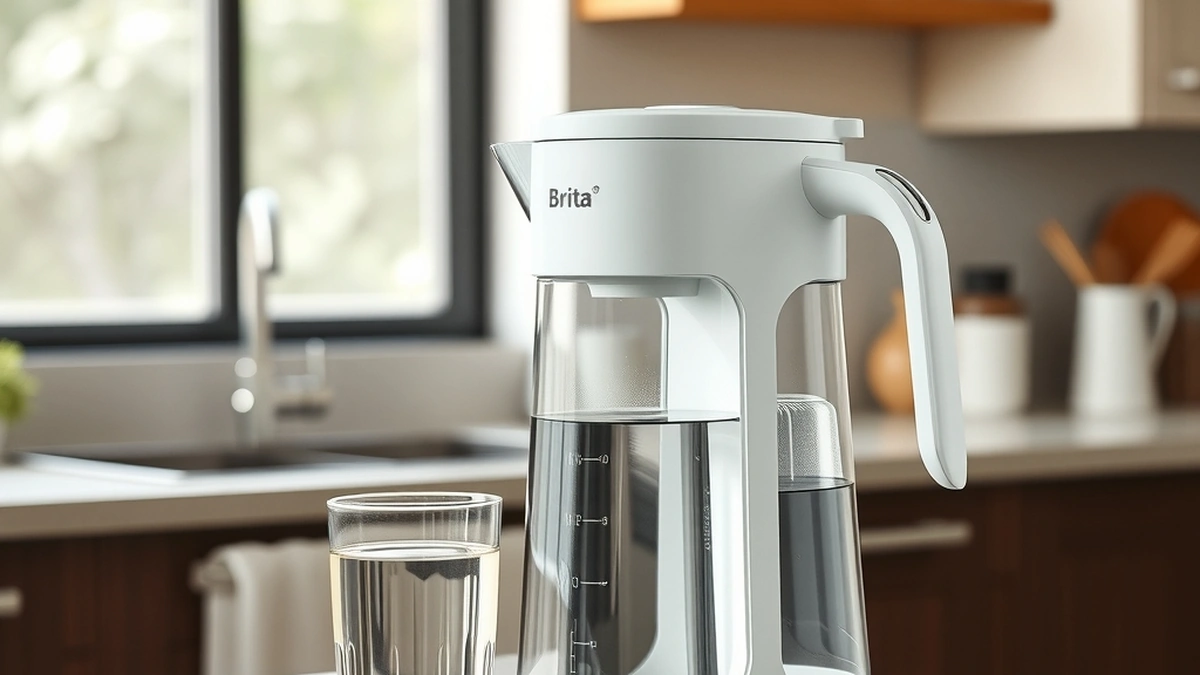
Brita filters are carbon pitchers and faucet mounts that reduce chlorine taste, odour, and some metals at roughly $0.15 to $0.30 per gallon. They do not soften water, remove nitrate, or disinfect, so they suit treated municipal water rather than a contaminated well.
- Pitcher cost
- $25 - $50
- Cartridge
- $6 - $20
- Cost per gallon
- $0.15 - $0.30
- Cartridge life
- About 40 gallons
- Removes hardness
- No
Some links on this page are affiliate links.If you buy through them we may earn a commission at no extra cost to you. We do not accept payment for rankings. Read the full disclosure.
Brita makes carbon water filters: pitchers, faucet mounts, and bottles. They reduce chlorine taste and odour, along with some particulate matter and trace metals depending on the cartridge. They are a good fit for treated municipal water with a taste complaint, and the wrong tool for hard water or a contaminated well.
The Product Formats
Pitchers and dispensers. A reservoir on top, a carbon cartridge in the middle, and a dispenser below. Capacity runs 6 to 10 cups. This is the most common format.
Faucet mount. A small housing that attaches to the aerator and switches between filtered and unfiltered flow. Convenient, but it adds bulk at the sink and the cartridge life is short.
Bottles and tumblers. A filter built into a portable bottle. Useful away from home, expensive per gallon.
| Format | Capacity | Cartridge life | Best for |
|---|---|---|---|
| Pitcher | 6 - 10 cups | 40 gallons | Small households, renters |
| Dispenser | 10 - 18 cups | 40 gallons | Families, fridge storage |
| Faucet mount | On demand | 100 gallons | One sink, no counter space |
| Filter bottle | 20 - 30 oz | 40 gallons | Travel, gym |
What It Removes
| Contaminant | Brita performance |
|---|---|
| Chlorine taste and odour | Yes |
| Particulate matter | Some |
| Copper and zinc | Some |
| Lead | Model-specific |
| Hardness | No |
| Nitrate | No |
| Bacteria | No |
| PFAS | Model-specific, limited |
The lead row is the one to check carefully. Some Brita models carry an NSF/ANSI 53 certification for lead reduction; others carry only 42 for taste. The certification listing names the model, and it is the only reliable claim.
The nitrate row matters for well owners. Nitrate has a federal limit of 10 mg/L and a pitcher does not touch it. If a well test shows nitrate near that limit, a pitcher is not a solution.
Cost per Gallon
A $8 cartridge rated for 40 gallons is $0.20 per gallon. A $20 long-life cartridge rated for 60 gallons is $0.33 per gallon. A $6 cartridge rated for 30 gallons is $0.20 per gallon.
Add the pitcher: $35 over five years is $7 per year, which is negligible for a household using a few hundred gallons.
Then compare. Bottled water at $1 per gallon costs five times as much. A $600 under-sink RO at $0.24 per gallon costs about the same per gallon but delivers far more capacity and removes dissolved contaminants. The pitcher’s advantage is the $30 entry price, not the long-run cost.
There is a hidden cost in the format that the per-gallon figure misses: the water you do not drink because the pitcher is empty. Households that keep bottled water “for backup” are paying both costs. If that pattern sounds familiar, an under-sink filter at $150 to $500 removes the refill bottleneck and often eliminates the bottled purchase entirely.
Where Brita Stops Being Enough
Hard water. Carbon does not remove calcium and magnesium. If hardness is above 7 GPG, the water is still hard after filtering, and the scale, soap scum, and spotting remain.
Nitrate. Not removed. A well with nitrate near 10 mg/L needs reverse osmosis.
Bacteria. Not removed. A positive bacteria test needs shock chlorination and UV.
High sediment. A pitcher cartridge blinds quickly on turbid water, which makes it an expensive way to filter sediment.
High volume. A family of four drinking 2 gallons a day refills the pitcher four or five times daily. The format becomes a chore and gets abandoned.
There is one more limit that is easy to miss: the filter only treats cold water at the tap it serves. Cooking water, ice, and any drink made in the kitchen is covered, but the shower, the laundry, and the water heater are not. A household complaining about chlorine in the shower is looking at a whole-house problem, and a pitcher cannot solve it.
Five Steps to Decide
- Read the water report. If chlorine taste is the only complaint, Brita is sufficient.
- Check hardness. Above 7 GPG, a softener is the relevant purchase.
- Check nitrate and bacteria if you are on a well.
- Calculate cost per gallon from the cartridge price and rated gallons.
- Count refills for your household and decide whether the format fits.
Brita vs the Alternatives
| Option | Cost per gallon | Removes dissolved solids | Capacity |
|---|---|---|---|
| Brita pitcher | $0.15 - $0.30 | No | 6 - 10 cups |
| Faucet mount | $0.10 - $0.20 | No | On demand |
| Under-sink carbon | Low | No | Unlimited |
| Under-sink RO | $0.15 - $0.40 | Yes | 2 - 4 gallon tank |
| Bottled | $0.50 - $2.00 | Varies | As bought |
A faucet mount is the cheapest per gallon of the Brita formats and the most convenient, at the cost of a bulky fixture. An under-sink carbon filter is the step up for a household that wants filtered water at full flow without refilling anything.
Maintenance
Change the cartridge on the gallon rating or when flow slows. Rinse the reservoir weekly; a pitcher that is never cleaned grows biofilm that the cartridge downstream cannot fix.
Do not leave a pitcher in direct sun or in a hot car. Warm water in a plastic reservoir tastes worse and grows more biofilm.
Two habits extend cartridge life. Fill the pitcher from the cold tap rather than the hot, because hot water carries more dissolved material and shortens carbon life. And do not run the first two pitchers after a new cartridge down the drain out of habit; a brief flush is enough, and the rest is perfectly good water.
For the model-level comparison, see water filter pitcher reviews and best water filter pitcher. If the complaint is scale rather than taste, hard water filter covers what actually addresses it, and bottled water versus a filter works the cost comparison in full.
Frequently asked questions
What does a Brita filter remove?
Primarily chlorine taste and odour, plus some particulate matter and trace metals depending on the cartridge; it is not designed to remove nitrate, bacteria, or hardness.
How much does Brita filtered water cost per gallon?
Roughly $0.15 to $0.30 per gallon including the pitcher and cartridges, based on a cartridge costing $6 to $20 and treating about 40 gallons.
Does a Brita filter soften hard water?
No. The carbon media does not remove calcium and magnesium, so hardness passes through and soap scum still forms.
How often should a Brita cartridge be changed?
About every 40 gallons or two months for an average household, and sooner if the flow slows noticeably or the taste changes.
Is Brita water safe for a well?
Only if the well tests clean for bacteria and nitrate; a pitcher does not disinfect and does not remove nitrate, so a contaminated well needs different treatment.
Brita or reverse osmosis?
Brita is cheaper and simpler for chlorine taste, while reverse osmosis removes dissolved contaminants including nitrate and sodium at a higher cost.
Sources
Some links are affiliate links.If you buy through them we may earn a commission at no extra cost to you. We do not accept payment for rankings. Read the full disclosure.


