
General Electric water filter for fridge
GE fridge filters are keyed cartridges, usually MWF or XWFE. See how to identify yours, what each removes, and how to avoid a cartridge that will not fit.
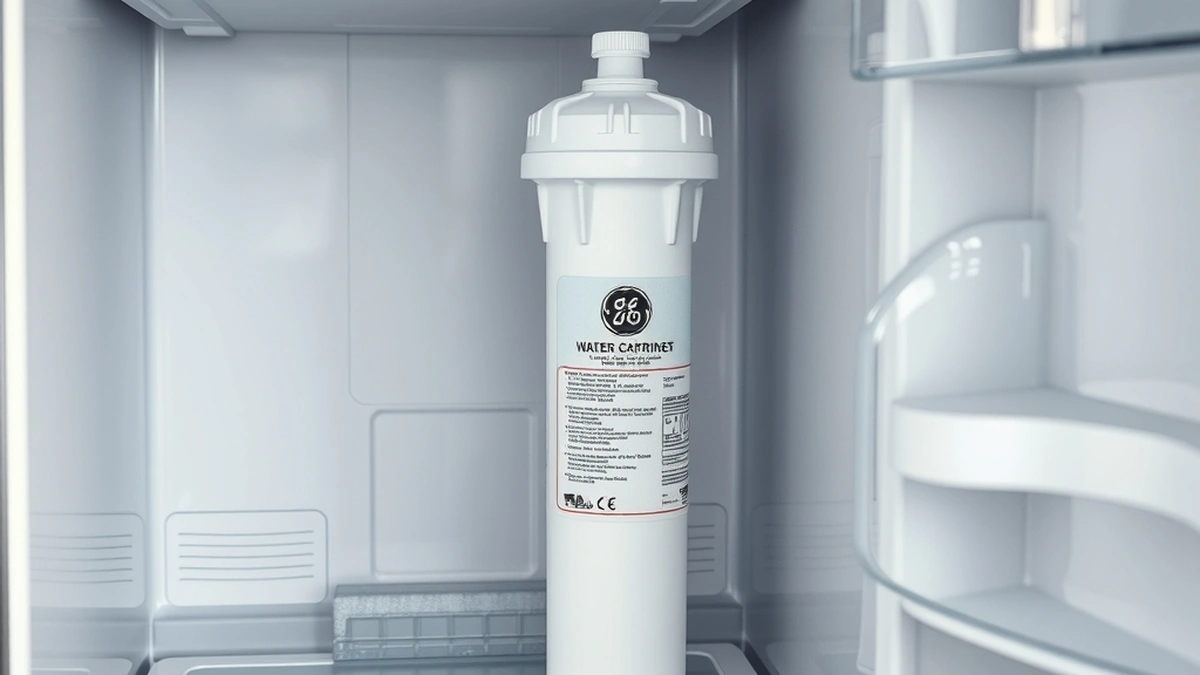
GE refrigerator filters are keyed cartridges, most commonly the MWF and the newer XWFE, which are not interchangeable. Identify the cartridge by the number on the old filter or the fridge model plate, then buy a certified replacement at $30 to $60 every six months.
- Common models
- MWF, XWFE, RPWFE
- Cartridge cost
- $30 - $60
- Change interval
- About 6 months
- Volume rating
- 200 - 300 gallons
- Certification
- NSF/ANSI 42, some 53
Some links on this page are affiliate links.If you buy through them we may earn a commission at no extra cost to you. We do not accept payment for rankings. Read the full disclosure.
GE refrigerator filters are proprietary cartridges, and the two most common families, MWF and XWFE, do not interchange. The cartridge number is the only reliable way to buy the right one. Get it from the old filter or the fridge model plate, then buy a certified replacement at $30 to $60.
The Main GE Cartridge Families
GE has used several filter systems across its refrigerator lines.
| Cartridge | Fits | Notes |
|---|---|---|
| MWF | Many GE and Hotpoint side-by-side | Widely available |
| XWFE | Newer GE French-door models | Not interchangeable with MWF |
| RPWFE | GE Profile and Café lines | RFID chip in some versions |
| GSWF | Older GE models | Being phased out |
The RFID detail matters on some newer models. The fridge reads a chip in the cartridge, and an aftermarket cartridge without the chip may be rejected or may not reset the indicator. That is a design choice by the manufacturer, and it limits aftermarket options on those models.
Finding Your Cartridge
Three sources, in order of reliability.
- The old cartridge. Pull it and read the number molded into the body or printed on the label.
- The fridge label. Many GE models have a sticker inside the door or on the frame listing the filter.
- The model plate. Located inside the fresh food compartment, and used with the manufacturer’s filter finder.
Write the number somewhere you will find it in six months. Cartridge numbers change with model years, and a fridge bought several years ago may take a filter that is not the one currently displayed for that model name.
What These Filters Remove
A standard GE cartridge is a carbon block rated for chlorine, taste, and odour. Some models add certification for lead, cysts, or pharmaceuticals.
| Contaminant | Standard cartridge | Certified models |
|---|---|---|
| Chlorine | Yes | Yes |
| Taste and odour | Yes | Yes |
| Sediment | Yes, nominal | Yes |
| Lead | No | Some, NSF 53 |
| Cysts | No | Some, NSF 53 |
| Nitrate | No | No |
| Hardness | No | No |
The nitrate and hardness rows are the limits. A fridge filter is a small carbon cartridge. It does not soften, it does not remove dissolved salts, and it does not disinfect.
It also has a limited contact time. Water passes through a small carbon block quickly, so the filter handles chlorine well and handles slower-adsorbing compounds less well. That is why a fridge cartridge rated for 250 gallons and an under-sink cartridge rated for 1,000 gallons are not doing the same job at different scales; the under-sink unit has more media and more contact time, which is what allows it to carry broader certifications.
If the water report shows nitrate near 10 mg/L, the fridge dispenser is not the place to solve it. Treat at the sink with reverse osmosis and feed the fridge from the treated line, or bypass the fridge filter if the whole house is already treated.
Cost and Frequency
Cartridges run $30 to $60 for OEM and $20 to $35 for certified aftermarket. Two changes a year is $40 to $120 annually.
At 250 gallons per cartridge, the cost per gallon is $0.12 to $0.24 for OEM, which is cheaper than bottled water and more expensive than an under-sink filter.
| Source | Cost per gallon | Capacity |
|---|---|---|
| GE fridge cartridge | $0.12 - $0.24 | 250 gallons |
| Under-sink carbon | $0.02 - $0.08 | 500 - 1,500 gallons |
| Bottled water | $0.50 - $2.00 | As bought |
The fridge filter is convenient, not economical. That is a fair trade for water at the door.
Five Steps to Replace
- Locate the housing, usually in the upper right of the fresh food compartment or behind the base grille.
- Turn the old cartridge a quarter turn and pull, or press the release depending on the model.
- Remove the cap from the new cartridge and insert it fully, then turn to lock.
- Flush 2 to 3 gallons through the dispenser to clear carbon fines and air.
- Reset the indicator by holding the filter button for three seconds.
Maintenance Notes
Change on the calendar or the gallon rating, not on the light alone. Write the install date on the cartridge body.
If flow slows before six months, the cartridge is loading faster than expected, which often means sediment in the supply. A whole-house sediment filter ahead of the fridge line solves that.
If the dispenser tastes off immediately after a change, flush more water. Carbon fines are harmless but they taste flat and cloudy.
If the fridge rejects a new cartridge, check whether the model requires an RFID-equipped version. That is the most common reason a correct-looking cartridge does not work.
When the Fridge Filter Is Redundant
If the house already has a whole-house carbon filter, the fridge cartridge is treating water that is already treated. Many households bypass it in that case and save $40 to $120 a year.
If the house has an under-sink RO, run the fridge line from the RO tap and bypass the fridge cartridge. The RO removes far more, and the fridge cartridge becomes a second, smaller filter doing the same job.
There is a middle case worth naming. A household with a whole-house sediment filter only, no carbon, still needs the fridge cartridge for taste, because sediment filtration does nothing for chlorine. The test is whether the upstream treatment removes chlorine. If it does not, keep the fridge filter.
For the comparison of formats, see filter refrigerator water filter and under sink water filter. For the specific Samsung equivalent, Samsung refrigerator water filter covers that cartridge family.
Frequently asked questions
How do I know which GE fridge filter I need?
Read the part number on the old cartridge, or check the label inside the fridge door and the model plate; GE's filter finder maps the fridge model to the correct cartridge.
Are MWF and XWFE filters interchangeable?
No. They use different housings and keying, and one will not fit where the other belongs, so buying by appearance rather than part number is a common mistake.
How often should a GE fridge filter be changed?
About every six months or 200 to 300 gallons, and sooner if dispenser flow slows or the ice begins to taste or smell off.
Do GE fridge filters remove lead?
Only models certified to NSF/ANSI 53 for lead reduction; many standard cartridges carry 42 certification for taste and chlorine only.
Can I use an aftermarket filter in a GE fridge?
Yes if it is certified for the specific GE model and states that certification; uncertified cartridges may fit poorly or bypass internally.
What does the filter indicator light mean?
It is usually a timer that assumes average use, not a sensor, so change on the calendar or gallon rating and reset the light afterward.
Sources
Some links are affiliate links.If you buy through them we may earn a commission at no extra cost to you. We do not accept payment for rankings. Read the full disclosure.


