
Samsung refrigerator water filter
Samsung fridge filters use HAF and DA29 families with keyed housings. See how to identify yours, when to change it, and what it does not remove.
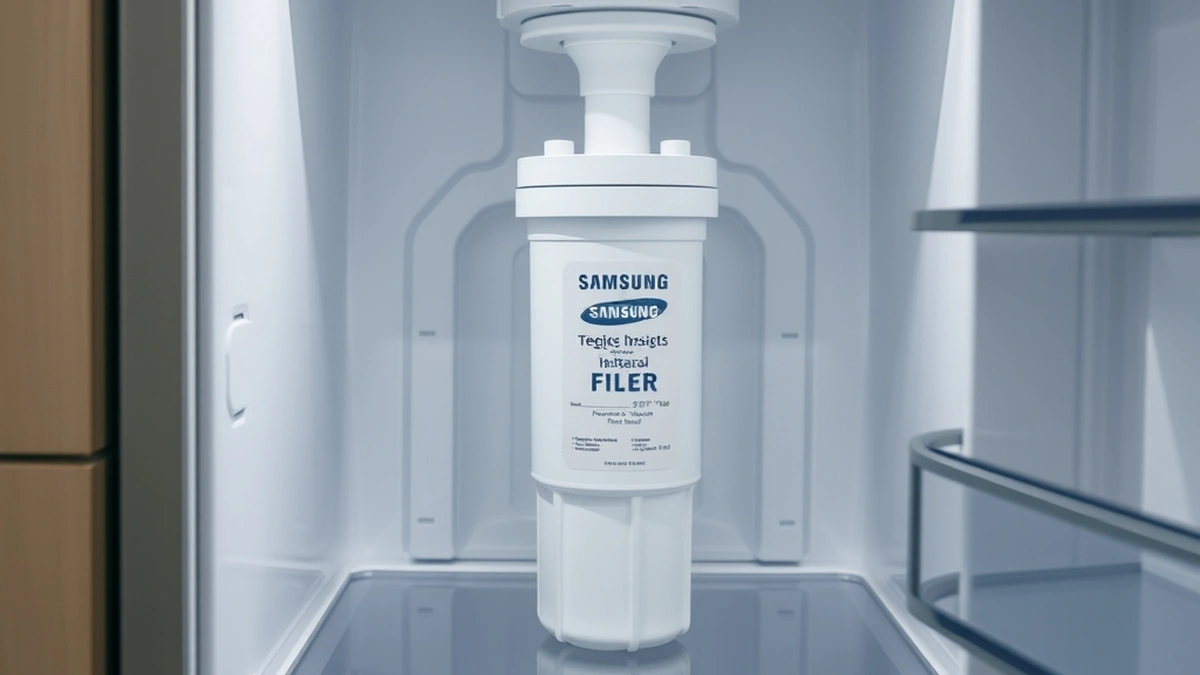
Samsung refrigerator filters are keyed cartridges in the HAF and DA29 families, costing $30 to $60 and lasting about six months or 300 gallons. Identify the exact part number from the old cartridge before buying, because the housings differ by model year.
- Common families
- HAF-CIN, DA29, HAF-QIN
- Cartridge cost
- $30 - $60
- Change interval
- About 6 months
- Volume rating
- 300 gallons
- Certification
- NSF/ANSI 42, some 53
Some links on this page are affiliate links.If you buy through them we may earn a commission at no extra cost to you. We do not accept payment for rankings. Read the full disclosure.
Samsung refrigerator filters are proprietary cartridges in the HAF and DA29 families. They cost $30 to $60, last about six months or 300 gallons, and are not interchangeable across model families even when they look alike. The part number on the old cartridge is the only reliable buying guide.
The Cartridge Families
| Part number | Fits | Notes |
|---|---|---|
| HAF-CIN | Many French-door models | Common in US |
| HAF-QIN | Newer models | Different keying |
| DA29-00020B | Older side-by-side | Widely available |
| DA29-00003G | Older models | Being phased out |
The naming looks arbitrary because it is: the codes come from Samsung’s internal parts system and from the original equipment supplier. Two cartridges with similar numbers can have different end fittings.
The practical rule is to match the full part number, not a prefix. A filter sold as “DA29 compatible” may fit one model and not another.
Finding the Right One
- Pull the old cartridge and read the full number printed on the label.
- Check the fridge label, usually inside the door or on the frame.
- Use the model plate inside the fresh food compartment with Samsung’s filter finder.
Photograph the old cartridge before you throw it away. It is the fastest reference if the new one does not fit.
What the Filter Does
A Samsung cartridge is a carbon block that reduces chlorine, taste, and odour, plus nominal particulate. Certified models add lead or cyst reduction.
| Contaminant | Standard | Certified models |
|---|---|---|
| Chlorine | Yes | Yes |
| Taste and odour | Yes | Yes |
| Particulate | Yes | Yes |
| Lead | No | Some |
| Cysts | No | Some |
| Nitrate | No | No |
| Hardness | No | No |
| Bacteria | No | No |
The last three rows are the boundary. A fridge filter is not a softener, not a reverse osmosis membrane, and not a disinfectant.
If the lab report shows hardness above 7 GPG, the fridge filter changes nothing about the scale in the kettle or the film on the shower glass. If it shows nitrate near 10 mg/L, the dispenser is not the place to fix it.
When to Change It
Six months or 300 gallons. Three signs say sooner.
- Flow slows. A restricted cartridge is loading up.
- Taste changes. Chlorine breaking through means the carbon is spent.
- Ice smells or looks cloudy. The ice maker uses the same filter.
Samsung fridges typically show a filter indicator on the display. It is a timer, not a sensor, so treat it as a reminder rather than a measurement.
The volume rating assumes average use: a household drawing a few glasses a day and making ice. A household that fills water bottles for four people, or runs a lot of ice through a summer party schedule, will pass 300 gallons well before six months. In that case change on volume, which is harder to track, or simply change every four months and accept the small extra cost. A spent carbon cartridge does not fail loudly; it just stops removing chlorine, and the first sign is usually ice that tastes like the tap.
Cost and Value
OEM cartridges run $35 to $60, certified aftermarket $20 to $35. Two changes a year is $40 to $120.
At 300 gallons per cartridge, OEM cost per gallon is $0.12 to $0.20. That is cheaper than bottled water and roughly five times the cost per gallon of an under-sink carbon filter.
| Option | Cost per gallon | Capacity |
|---|---|---|
| Samsung OEM | $0.12 - $0.20 | 300 gallons |
| Certified aftermarket | $0.07 - $0.12 | 300 gallons |
| Under-sink carbon | $0.02 - $0.08 | 500 - 1,500 gallons |
| Bottled | $0.50 - $2.00 | As bought |
The premium buys convenience, and for water at the door it is a reasonable one.
Five Steps to Replace
- Locate the housing, usually inside the fridge at the top right, or in the base grille on some models.
- Remove the old cartridge by turning a quarter turn and pulling, or by pressing the release.
- Seat the new cartridge fully and turn until it locks; a partial seat leaks or bypasses.
- Flush 2 to 3 gallons through the dispenser to clear air and carbon fines.
- Reset the indicator by holding the filter reset button for three seconds.
Troubleshooting
No water after a change. Air in the line. Flush longer and check the cartridge is locked.
Water tastes worse. Flush more, or the cartridge is not certified for the model and is bypassing internally.
Leak at the housing. The O-ring is missing, pinched, or the cartridge is not fully seated.
Indicator will not reset. Some models require the button to be held for five seconds, or the reset is in a menu rather than on a button.
A leak that appears a day after a change is almost always the O-ring. Pull the cartridge, inspect the ring for a nick, reseat it with a thin film of water, and turn it firmly. Do not use petroleum jelly on the ring; it can degrade the rubber. If the ring is damaged, a replacement ring costs a few dollars and is far cheaper than a new housing.
When to Bypass It
If a whole-house carbon filter or an under-sink RO already treats the water feeding the fridge, the fridge cartridge is redundant. Samsung fridges accept a bypass plug in place of the cartridge, which saves $40 to $120 a year.
That only makes sense if the upstream treatment is real and maintained. Bypassing a fridge filter on untreated water leaves the dispenser and ice maker with no treatment at all.
For the GE equivalent, see General Electric water filter for fridge. For the format comparison, filter refrigerator water filter covers the cost per gallon, and under sink water filter covers the step up in capacity.
Frequently asked questions
How do I find my Samsung fridge filter model?
Check the old cartridge for a part number such as DA29-00020B or HAF-CIN, then confirm it against the label inside the fridge door or the model plate.
How often should a Samsung water filter be changed?
About every six months or 300 gallons, whichever comes first, and sooner if the dispenser flow slows or the ice tastes different.
Are Samsung fridge filters interchangeable?
No. HAF and DA29 cartridges use different keying and are not interchangeable across model families, even when they look similar.
Do Samsung filters remove lead?
Some models are certified to NSF/ANSI 53 for lead reduction; many standard cartridges carry only 42 certification for taste and chlorine.
Can I use a third-party filter in a Samsung fridge?
Yes if it is certified for the specific Samsung model and states that certification; otherwise fit and internal bypass are risks.
Why does my Samsung fridge not dispense water after a filter change?
Air in the line is the usual cause; flush 2 to 3 gallons through the dispenser, and check that the cartridge is fully seated and locked.
Sources
Some links are affiliate links.If you buy through them we may earn a commission at no extra cost to you. We do not accept payment for rankings. Read the full disclosure.


