
How Do Water Softeners Work: Resin, Brine, Regeneration
A softener swaps calcium and magnesium for sodium on resin beads, then recharges with brine. See the full cycle, the settings, and the sizing math.
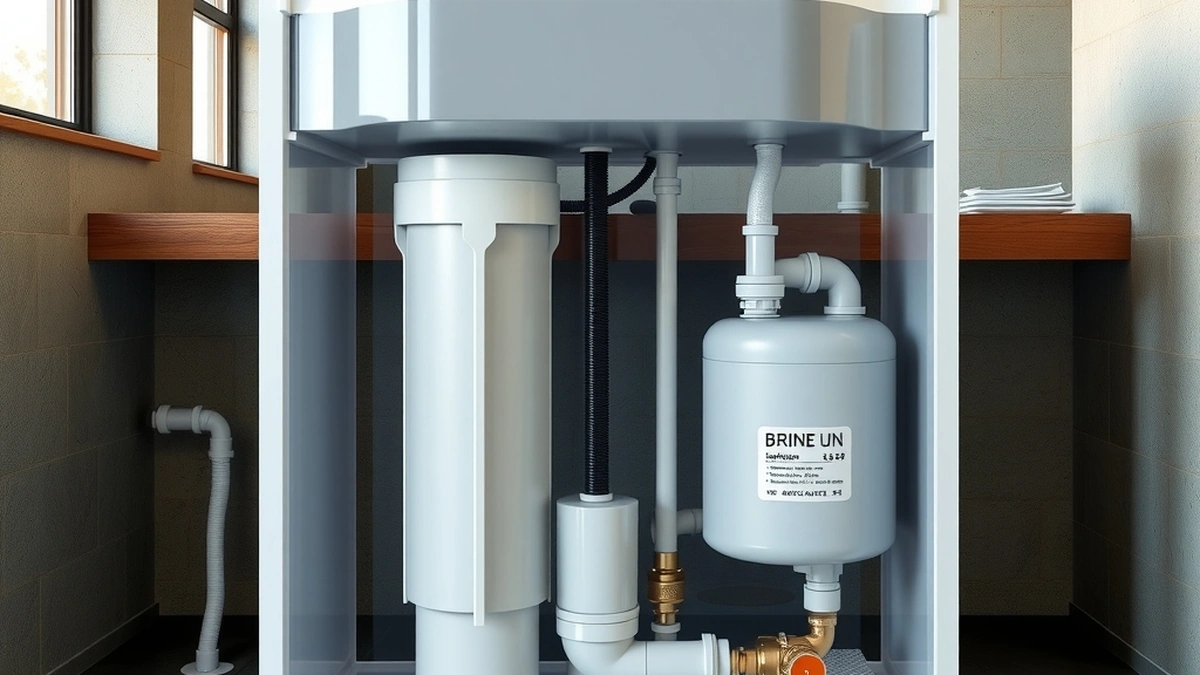
Water softeners work by ion exchange: water passes through resin beads that swap calcium and magnesium for sodium. When the beads are saturated, a brine cycle flushes the captured minerals to the drain and recharges the resin with sodium.
- Capacity
- 24,000 - 64,000 grains
- Resin life
- 8 - 12 years
- Salt per regeneration
- 8 - 12 lb
- Regeneration water
- 20 - 60 gallons
- Installed cost
- $1,200 - $4,500
Some links on this page are affiliate links.If you buy through them we may earn a commission at no extra cost to you. We do not accept payment for rankings. Read the full disclosure.
Water softeners work by ion exchange. Hard water passes through a bed of resin beads that hold sodium ions; calcium and magnesium bind to the beads and sodium releases into the water. When the bed is saturated, a brine cycle washes the captured minerals to the drain and recharges the resin.
The Resin Bed
The resin is a bed of polystyrene beads, each roughly 0.5 millimeters across, with sulfonate groups that attract positively charged ions. In the sodium form, each bead holds sodium ions on its surface.
As hard water flows past, calcium and magnesium, which have a stronger charge, displace the sodium and bind to the bead. The sodium goes into the water. The hardness minerals stay on the resin.
The exchange is reversible, which is what makes the process repeatable for years. The resin does not consume itself; it is recharged, and the same bed can run thousands of cycles.
The Service Cycle
In service, water enters the top of the resin tank, flows down through the bed, and exits softened. The pressure drop across a clean bed is small, typically a few PSI.
The valve monitors flow or time and tracks how much capacity has been used. When the remaining capacity approaches the reserve, the valve schedules a regeneration, usually at night when no one is drawing water.
A metered valve counts gallons and calculates grains removed from the hardness setting. That is why the hardness number programmed into the valve matters: a unit set for 8 GPG in a 16 GPG house will regenerate too late.
The Regeneration Cycle
| Stage | What happens | Duration |
|---|---|---|
| Backwash | Water flows upward, lifting and cleaning the bed | 5 - 15 minutes |
| Brine draw | Brine is drawn through the resin, displacing hardness | 30 - 60 minutes |
| Slow rinse | Residual brine is pushed through the bed | 20 - 40 minutes |
| Fast rinse | High-flow rinse clears the remaining brine | 5 - 10 minutes |
| Brine refill | Water refills the brine tank for the next cycle | 5 - 15 minutes |
The whole cycle uses 20 - 60 gallons of water and 8 - 12 pounds of salt. It runs unattended, and the only household symptom is a brief pressure drop if a tap is opened mid-cycle.
Backwash matters more than it looks. It lifts the bed and flushes out sediment and broken beads. A unit that never backwashes correctly will channel, and channeling lets hard water pass through untreated.
Capacity and Sizing
Capacity is measured in grains, typically 24,000 - 64,000 for a residential unit. The rating assumes a specific salt dose; a lower dose delivers fewer grains per cycle, which is why the same tank appears under different capacity labels.
Sizing is hardness times daily gallons. A family of four using 250 gallons a day at 12 GPG carries 3,000 grains daily and 21,000 weekly. A 32,000-grain unit regenerating at 24,000 grains covers that with a 3,000-grain reserve.
A larger household at 18 GPG can reach 31,500 grains a week, which pushes toward 48,000 or 64,000 grains. Undersizing shows up as hard water at the end of the cycle; oversizing wastes salt.
Salt and the Brine Tank
The brine tank holds salt and a shallow water layer. Water fills the tank on schedule, dissolves salt until the solution is saturated, and the valve draws that brine during regeneration.
The tank is not full of water. Salt sits above a brine level, and water dissolves it from below. That is why a tank can look dry while holding 200 pounds of salt.
Salt costs $120 - $400 a year. A salt bridge, a hard crust above the water line, is the most common reason a working softener stops softening. Break the crust and stir the bed.
What Softening Does Not Do
A softener removes calcium and magnesium. It does not remove nitrate, arsenic, lead, chlorine, sediment, or bacteria.
Iron and manganese are partly removed, but only up to about 2 - 3 PPM. Above that, resin fouls faster than salt can clean it, and an iron filter at $800 - $2,500 installed belongs ahead of the softener.
That limit is why the lab report matters. A softener sized and installed for hardness alone will fail on water with high iron, and the household will conclude the equipment is defective when the design was incomplete.
Costs and Maintenance
Equipment runs $600 - $2,500, installation adds $500 - $1,500, and the installed total is $1,200 - $4,500. Resin lasts 8 - 12 years with a rebed at $300 - $600, and the valve and tanks last 10 - 15 years.
Maintenance is simple: check the salt monthly, clean the brine tank yearly, and test the treated water quarterly. Most service calls trace to salt, settings, or the brine draw rather than to the resin.
One more part deserves mention: the injector and the brine line. The injector is a small venturi that pulls brine out of the tank, and it clogs with salt or sediment over time. A softener that regenerates on schedule but leaves hard water is often suffering from a partly blocked injector, not a failed resin bed. Cleaning or replacing the injector is a $20 - $60 part and a common service item.
- Test the raw water for hardness and iron.
- Size the unit by daily grain load with reserve.
- Confirm the service flow matches peak demand.
- Install with a bypass, drain, and grounded outlet.
- Program the hardness and capacity, then run a manual regeneration.
- Test the treated water and record the result.
For the shorter explanation, see how does a water softener work. For sizing, see water softener sizing. For salt, see salt for water softeners. For costs, see water softener cost.
Frequently asked questions
What do the resin beads actually do?
They hold sodium ions on their surface. As hard water passes, calcium and magnesium bind to the beads and sodium releases into the water, which softens it.
How often does a softener regenerate?
A metered unit regenerates when its capacity is used, often every three to ten days depending on hardness and household size. Timer units run on a fixed schedule.
Why does a softener need salt?
Salt makes the brine that recharges the resin. The sodium in the brine displaces the captured calcium and magnesium, which flush to the drain.
Does softening remove minerals entirely?
No. It removes calcium and magnesium and leaves sodium. Other dissolved solids, including nitrate and arsenic, pass through unchanged.
How much water does regeneration use?
Typically 20-60 gallons per cycle, depending on the unit and settings. Metered valves reduce the number of cycles compared with timer valves.
How long does a softener last?
The equipment lasts 10-15 years. Resin typically lasts 8-12 years before a rebed at $300-$600 restores capacity.
Sources
Some links are affiliate links.If you buy through them we may earn a commission at no extra cost to you. We do not accept payment for rankings. Read the full disclosure.


