
Salt for Water Softeners: Which Type and How Much
Pellets, crystals, blocks, and potassium chloride all work in a softener. Compare price per pound, residue, and how much salt a year your home needs.
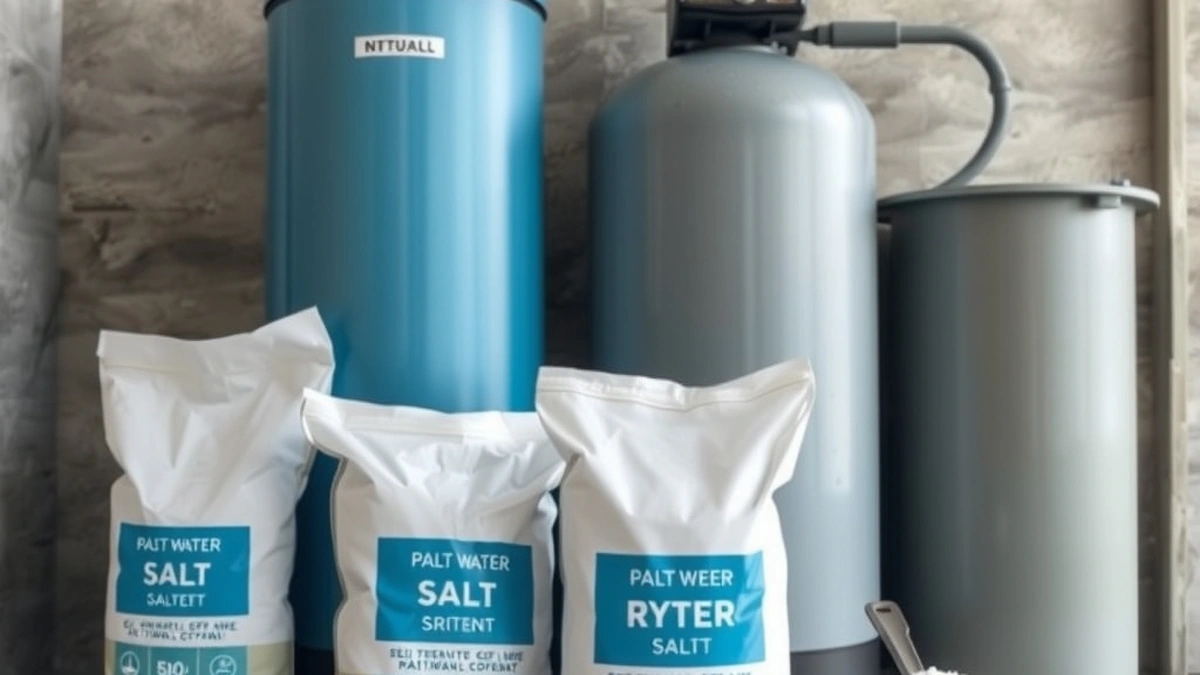
Salt for water softeners comes as pellets, solar crystals, blocks, and potassium chloride, priced $7 - $12 per 40-pound bag for sodium chloride. A typical home uses 800 - 1,200 pounds a year, or 20 - 30 bags, at a cost of $120 - $400.
- Pellets, 40 lb
- $7 - $12
- Solar crystals, 40 lb
- $6 - $10
- Potassium chloride
- $25 - $40
- Annual use
- 800 - 1,200 lb
- Annual cost
- $120 - $400
Some links on this page are affiliate links.If you buy through them we may earn a commission at no extra cost to you. We do not accept payment for rankings. Read the full disclosure.
Salt for water softeners is sodium chloride, sold as pellets, solar crystals, blocks, or potassium chloride. Plain pellets at $7 - $12 per 40-pound bag suit most homes. A typical household uses 800 - 1,200 pounds a year, which is 20 - 30 bags and $120 - $400.
The Four Forms
Pellets are compressed solar salt, roughly 99.5 percent pure, formed under pressure into small pillows. They dissolve evenly, produce clear brine, and leave little tank residue.
Solar crystals are coarse salt from evaporation ponds, dried and graded but not compressed. They cost less per bag and dissolve faster, with more fines that settle as sludge.
Blocks are pressed slabs, common in European softeners and rare in US homes. They dissolve slowly and need a tank designed for them.
Potassium chloride is a different salt entirely. It works in the same softener with a setting change and adds potassium instead of sodium to the water, at roughly three times the price.
Price Per Pound
| Form | Bag price | Price per lb | Residue |
|---|---|---|---|
| Pellets | $7 - $12 | $0.18 - $0.30 | Low |
| Solar crystals | $6 - $10 | $0.15 - $0.25 | Moderate |
| Blocks | $8 - $14 | $0.20 - $0.35 | Very low |
| Potassium chloride | $25 - $40 | $0.63 - $1.00 | Low |
Price per pound is the fair comparison, because bag sizes vary. A 25-pound bag at $8 costs $0.32 per pound, more than a 40-pound bag at $11.
The cheapest salt per pound is not always the cheapest year. Crystals leave more sludge, which means more tank cleaning, and rock salt can bridge and starve the brine draw. The labor is not free even when you do it yourself.
How Much Salt You Need
Salt use follows hardness and water consumption. A softener draws 8 - 12 pounds per regeneration, and regeneration frequency follows the daily grain load.
A family of four at 10 GPG uses about 250 gallons a day, which is 2,500 grains daily. A 32,000-grain unit regenerating near 24,000 grains cycles roughly every nine days, or about 40 times a year. At 10 pounds per cycle, that is 400 pounds, or 10 bags, for $70 - $120.
At 18 GPG the same household lands near 720 pounds, or 18 bags, for $126 - $216. A five-person home at 20 GPG can reach 1,200 pounds and $300 - $400. The published $120 - $400 range covers the realistic spread.
If your use is far outside that range, check the valve settings before buying more salt. A unit set to regenerate every night will burn through salt without improving the water.
Which Salt to Buy
Buy pellets if the softener is in a humid basement or garage, if the tank has a narrow fill opening, or if you want to clean the tank less often. That covers most homes.
Buy crystals if the tank is in a dry utility room, the fill opening is wide, and price per bag is the deciding factor. Plan on cleaning the tank more often.
Buy potassium chloride only if sodium in drinking water is a concern and you have priced the difference. At $25 - $40 per bag, a household using 20 bags a year spends $500 - $800 instead of $140 - $240.
Avoid rock salt unless the manual specifically allows it. It carries more insolubles and is the usual cause of a tank full of sludge.
Additives: When They Help
Some bags include a resin cleaner or rust inhibitor, at $3 - $5 more per bag. They help when the water test shows 1 - 2 PPM iron and the softener is the only iron treatment installed.
They do not replace an iron filter. Resin tolerates about 2 - 3 PPM of dissolved iron before fouling accelerates, and no additive changes that ceiling. Above that level, an iron filter at $800 - $2,500 installed belongs ahead of the softener.
Buying and Storing
- Measure bag use for two months before buying in bulk.
- Buy three to six bags at a time to limit moisture exposure.
- Stack bags on a pallet, off concrete and away from damp walls.
- Keep the tank half to two-thirds full and check monthly.
- Break up crusts with a clean tool and never tamp the salt down.
- Clean the brine tank once a year, removing sludge before refilling.
Sales in spring and fall cut $1 - $2 per bag. A pallet bought on sale saves $25 - $50 a year if storage is dry. A pallet in a damp garage saves nothing once the bottom bags fuse.
Buying salt is the smallest line in the softener budget and the one that causes the most service calls. Most of those calls are preventable with a dry storage spot, a tank that is never overfilled, and a monthly look at the salt level. The equipment does the rest.
One last piece of arithmetic for the year: 20 - 30 bags at 40 pounds is 800 - 1,200 pounds, and that is a pallet and a half at the warehouse store. Most passenger cars carry six to eight bags comfortably, which is why buyers who use 25 bags a year usually make three trips or order a delivery. Plan the transport before the sale ends, not after.
None of this changes the water. Salt is the fuel the softener burns to regenerate, and the brand, form, and price affect convenience and cost rather than the softening result. Buy a clean, dry product at a fair price and spend the saved money on an annual test.
For the form-by-form comparison, see softener salt types. For brand-specific detail, see Diamond Crystal water softener salt and Morton water softener salt. For annual pricing, see water softener salt cost.
Frequently asked questions
What is the best salt for a water softener?
Plain pellets suit most homes because they dissolve evenly and leave little residue. Crystals cost less per bag but need more tank cleaning, and potassium chloride is for sodium-restricted households.
How many bags of salt do I need per year?
Most homes use 20-30 bags of 40 pounds, or 800-1,200 pounds, depending on hardness, occupancy, and regeneration settings.
Can I use rock salt in a water softener?
Rock salt works but carries more insoluble material and is more likely to cause bridging and sludge. Pellets or solar crystals are the better residential choice.
Is potassium chloride worth the extra cost?
It avoids adding sodium to the water, which matters for sodium-restricted households. At $25-$40 per bag against $7-$12, it costs roughly three times as much to run.
Why is my salt not dissolving?
Common causes are a salt bridge, an overfilled tank, high humidity, or a brine line clog. Break the crust and check the brine draw before replacing anything.
How full should the brine tank be?
Keep it between half and two-thirds full. Overfilling reduces air circulation and increases the chance of caking, especially in humid spaces.
Sources
Some links are affiliate links.If you buy through them we may earn a commission at no extra cost to you. We do not accept payment for rankings. Read the full disclosure.


