
Morton Water Softener Salt: Forms, Additives, Cost
Morton sells pellets, solar crystals, and rust-remover salt for softeners. Compare forms, additives, and annual cost before you fill the brine tank.
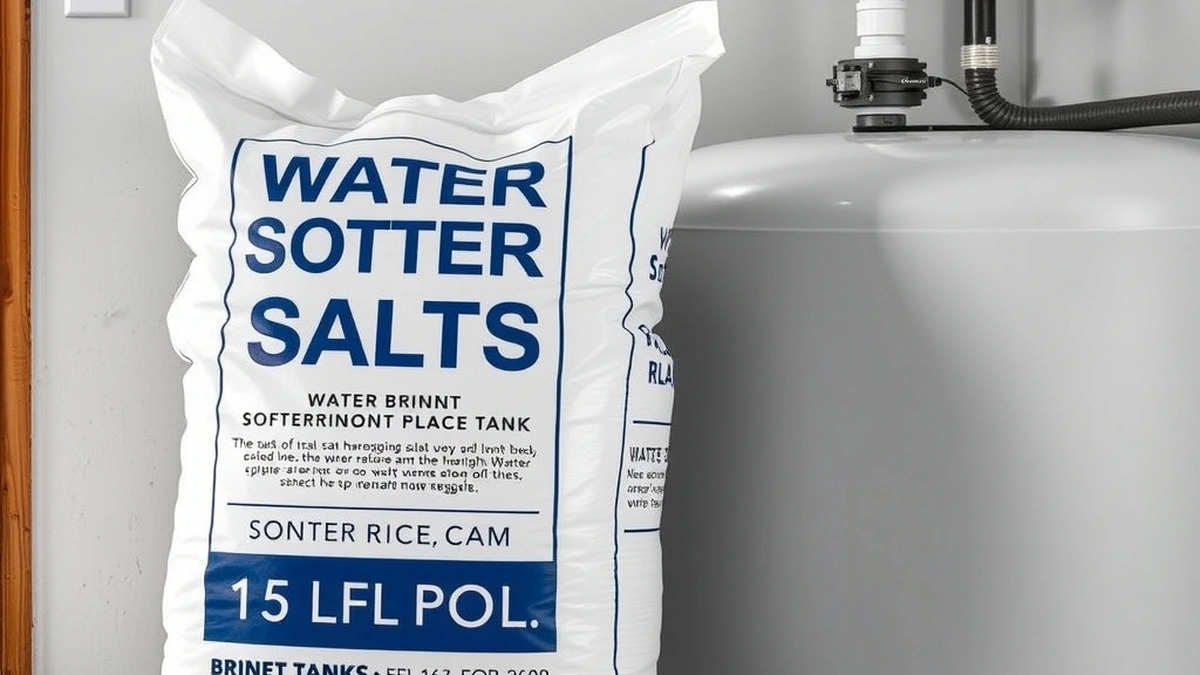
Morton water softener salt comes as pure pellets, solar crystals, and additive pellets for iron or resin cleaning, at roughly $7 - $12 per 40-pound bag. Buy plain pellets for clean water and reserve the additive formulas for a confirmed iron or fouling problem.
- 40 lb bag price
- $7 - $12
- Additive bags
- $10 - $16
- Salt per regeneration
- 8 - 12 lb
- Annual salt use
- 800 - 1,200 lb
- Annual salt cost
- $120 - $400
Some links on this page are affiliate links.If you buy through them we may earn a commission at no extra cost to you. We do not accept payment for rankings. Read the full disclosure.
Morton water softener salt is sold in 40-pound bags as pure pellets, coarse solar crystals, and pellet blends with resin-cleaning or rust-removing additives. Plain pellets at $7 - $12 per bag handle most homes; the additive formulas cost $10 - $16 and are worth it only when a water test shows iron or the resin is already fouled.
The Morton Lineup
Morton is a K+S brand, and its softener salt shelf divides into three groups. Pure pellets, sold as All Natural or Pure and Natural depending on region, are compressed sodium chloride at roughly 99.5 percent purity. Solar crystals are coarse sun-dried salt with a wider particle size and a lower price per bag. The specialty pellets carry additives: Clean and Protect includes a resin cleaning compound, and Rust Remover targets iron staining.
The pellet manufacturing process is the same across brands. Salt is compressed into small pillows under high pressure, screened, and bagged. Compression removes fines, which is why pellets produce clearer brine and less tank sludge than loose crystals.
Additives are the only meaningful product differentiation. A resin cleaner is usually a weak acid or a chelating agent that lifts iron and hardness deposits off the resin beads during regeneration. It helps in water with measurable iron. In iron-free water it adds cost without changing performance.
What the Additives Do and Do Not Do
A softener resin bead exchanges calcium and magnesium for sodium. Iron behaves similarly but binds more tightly, and over months it coats the bead surface until capacity drops. A cleaning additive slows that fouling. It does not remove iron from the water before it reaches the resin, and it does not raise the 2 - 3 PPM ceiling that most softeners tolerate.
That distinction matters when you read the bag. Rust remover salt is not an iron filter. If your raw water tests at 5 PPM iron, salt with an additive will not solve it; you need iron treatment ahead of the softener, typically an air-injection or greensand filter. Iron filters run $800 - $2,500 installed.
Use additive salt when the test shows 1 - 2 PPM iron and the softener is the only iron treatment in the house, or when a resin bed has already discolored and you want to slow further loss. Otherwise buy plain pellets and spend the difference on a proper test.
Pellets vs Crystals vs Additive Pellets
| Form | Price per 40 lb | Residue | Best use |
|---|---|---|---|
| Pure pellets | $7 - $12 | Low | Default for most homes |
| Solar crystals | $6 - $10 | Moderate | Dry rooms, lowest cost per pound |
| Clean and Protect pellets | $10 - $16 | Low | Low-level iron, resin maintenance |
| Rust Remover pellets | $10 - $16 | Low | Visible iron staining, stubborn resin |
The price gap between plain and additive pellets is roughly $3 - $4 per bag. At 25 bags a year, that is $75 - $100 extra. It is worth paying when iron is present and the alternative is a $800 - $2,500 iron filter. It is wasted money when the water test is clean.
Crystals trade cleanliness for price. They dissolve faster and cost a dollar or two less per bag, but the fines settle into the brine tank and the salt surface can crust over in humid air. In a dry utility room, crystals are a reasonable budget choice. In a damp basement, pellets prevent callbacks.
The Annual Salt Arithmetic
Salt consumption is set by hardness and water use, not by brand. Each regeneration draws 8 - 12 pounds, and regeneration frequency follows the daily grain load.
A family of four using 250 gallons per day at 12 GPG carries 3,000 grains per day, or 21,000 per week. A 32,000-grain softener set to regenerate at 24,000 grains of use will cycle roughly every eight days, about 45 times a year. At 10 pounds per cycle, that is 450 pounds, or 11 bags. At $9 per bag, the annual cost is $99.
A larger household at 18 GPG can double that load and land at 900 - 1,000 pounds, or 23 - 25 bags, for $200 - $225. The $120 - $400 annual range covers both cases. If your use is far outside it, check the valve settings before blaming the salt.
Filling and Maintaining the Brine Tank
- Confirm the softener is in bypass or between regenerations before opening the tank.
- Fill to about two-thirds capacity, leaving room for the salt to settle as it dissolves.
- Never let the salt drop below the brine line; running dry can pull air into the injector.
- Break up crusts monthly with a clean tool, and stir the bed if the salt looks fused.
- Once a year, empty the tank, remove sludge, rinse, and refill with fresh pellets.
Bridging looks like a salt shortage but is not one. A hard shelf forms above the water and the softener regenerates with weak brine, so the water stops feeling soft while the tank still looks full. Push a broom handle through the crust and check the float and brine line. The full diagnostic is in salt bridge in softener.
Buying in Quantity and Storing It
Salt is heavy and cheap, which makes storage the real constraint. A year of pellets is 20 - 30 bags, or 800 - 1,200 pounds. Stack bags on a wooden pallet, not directly on concrete, because the slab wicks moisture into the bottom layer. Keep the stack off exterior walls and away from any floor drain that could back up.
Retail sales cluster in spring and fall, and bag prices drop by $1 - $2 during promotions. Buying a pallet at the sale price can save $25 - $50 a year. Do not buy more than a year’s supply unless the storage is genuinely dry, because humid air will turn pellets into a solid block given enough time.
For a cross-brand comparison of forms, see softener salt types. For pricing by retailer and region, see water softener salt cost. If the unit is consuming salt but the water stays hard, read softener regenerating every night before replacing anything.
Frequently asked questions
What is Morton Clean and Protect salt?
It is a pellet salt blended with a resin cleaning additive intended to help prevent iron and mineral buildup on the softener resin over time.
Do I need rust remover salt every time?
No. Use it when a water test shows dissolved iron above about 1 PPM, or when the resin has already stained. Plain pellets are fine for iron-free water.
How many 40-pound bags will I use in a year?
Most households use 20-30 bags per year, based on 800-1,200 pounds of salt, with hardness and occupancy driving the difference.
Are Morton solar crystals safe for all softeners?
Yes. Coarse solar salt works in any brine tank, though it dissolves less evenly than pellets and leaves more tank residue to clean.
Can I switch brands without changing settings?
Yes. Salt is salt to the softener. Only the form and purity affect dissolving behavior, not the capacity or hardness settings.
Why does my softener use more salt than the label says?
Hardness, household size, and regeneration frequency drive salt use. A 20 GPG supply with five occupants can double the consumption of a two-person home at 6 GPG.
Sources
Some links are affiliate links.If you buy through them we may earn a commission at no extra cost to you. We do not accept payment for rankings. Read the full disclosure.


