
How Does a Water Softener System Work End to End
Follow the water from the main line through the resin, valve, and brine tank. See how each component behaves and where failures usually start.
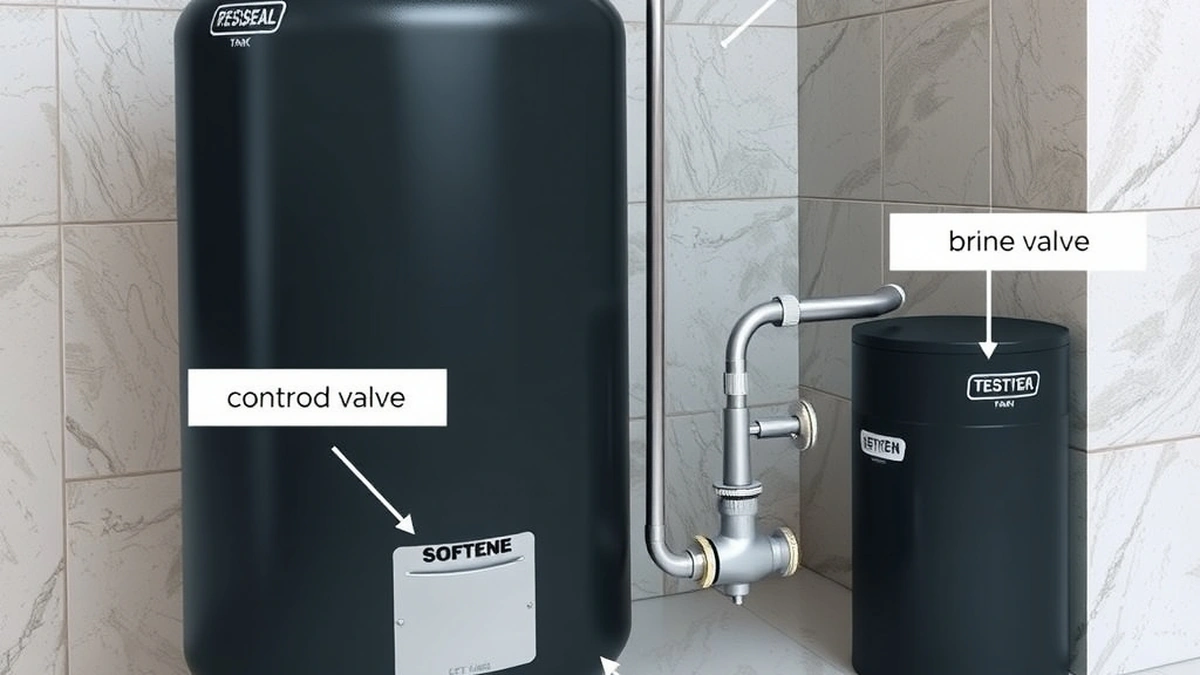
A water softener system takes water from the main line, passes it through a resin bed that swaps calcium and magnesium for sodium, and returns it to the house. A valve schedules regeneration, and a brine tank supplies the salt water that recharges the resin.
- Main components
- Resin tank, brine tank, valve
- Capacity
- 24,000 - 64,000 grains
- Regeneration water
- 20 - 60 gallons
- Salt per cycle
- 8 - 12 lb
- Installed cost
- $1,200 - $4,500
Some links on this page are affiliate links.If you buy through them we may earn a commission at no extra cost to you. We do not accept payment for rankings. Read the full disclosure.
A water softener system is a loop on the main water line: water enters the resin tank, passes through a bed that swaps calcium and magnesium for sodium, and exits to the house. A valve watches the flow, and a brine tank supplies the salt water that recharges the bed.
The Flow Path in Service
Water leaves the meter or pressure tank and reaches the softener inlet. It enters the top of the resin tank through a distributor, flows down through the bed, and exits at the bottom into the house line.
The resin beads hold sodium ions. As hard water passes, calcium and magnesium bind to the beads and sodium releases into the water. The water leaves soft, and the beads hold the hardness minerals.
A bypass valve sits around the unit. In the normal position, water goes through the softener; in bypass, it goes around. That valve is what lets a plumber service the unit without shutting off the house.
The Control Valve
The valve is the system’s brain. It measures flow with a meter or tracks time, calculates remaining capacity, and starts regeneration when the capacity approaches the reserve.
During regeneration, the valve changes the flow direction and sequence: backwash lifts the bed, brine draw pulls salt water through the resin, slow rinse pushes the brine out, fast rinse clears the line, and refill resets the brine tank.
The valve is also the most common failure point. Seals wear, pistons score, and injectors clog. A valve that sticks mid-cycle can leave the house on hard water or run water to the drain continuously.
The Brine Tank
The brine tank holds salt and a shallow water layer. Water fills the tank on schedule, dissolves salt until the solution is saturated, and the valve draws that brine during regeneration.
The tank is not full of water. Salt sits above a brine level, and water dissolves it from below. A tank can look dry while holding 200 pounds of salt.
Salt is consumed, not the tank. A household uses 800 - 1,200 pounds a year, or 20 - 30 bags, at a cost of $120 - $400.
The Drain and Bypass
| Component | Function | Failure sign |
|---|---|---|
| Resin tank | Holds the exchange bed | Hard water, low capacity |
| Brine tank | Stores salt, makes brine | Weak brine, bridging |
| Control valve | Meters and runs cycles | Sticking, leaking, no draw |
| Bypass | Isolates the unit | Leak, stiff handle |
| Drain line | Carries discharge away | Backup, air gap missing |
| Prefilter | Catches sediment | Falling pressure |
The drain line carries 20 - 60 gallons per regeneration to a standpipe or floor drain. It must end with an air gap, or a backed-up drain can siphon wastewater into the softener and the supply.
The bypass is a maintenance feature, not an optional extra. Without it, every repair means shutting off water to the entire house.
Where the System Sits
The softener goes after the meter or pressure tank and before the water heater. Softening hot water is pointless, and a unit downstream of the heater sees higher temperatures than the resin is rated for.
On a well system, the order is pressure tank, then sediment filter, then iron or sulfur treatment if needed, then softener, then carbon, then UV. Each stage protects the next.
Space matters. Two tanks plus a brine tank need roughly 4 by 3 feet of floor and 5 feet of height, plus clearance to remove the valve head and pour a bag of salt.
Commissioning and Settings
The installer sets the hardness and capacity in the valve, based on the lab report. A unit programmed for the wrong hardness regenerates at the wrong time, which shows up as hard water at the end of a cycle or wasted salt.
A manual regeneration follows, then a hardness test at a cold tap downstream. A reading of 0 - 2 GPG confirms the system is working.
Record the settings, the install date, and the model number. When the unit needs service in five years, that note saves an hour of diagnosis.
A Troubleshooting Map
Hard water with salt in the tank points to the brine side: a bridge, a clogged injector, a failed draw, or a wrong setting.
Hard water with no salt in the tank is a supply problem, not a system problem. Fill it and run a manual regeneration.
Water running to the drain continuously points to a stuck valve or a failed seal. Shut off the unit at the bypass and call for service.
Low pressure after the install points to a clogged prefilter or an undersized unit. Check the pressure drop across the softener before assuming the pump is failing.
Startup Sequence
- Confirm the bypass is closed and the inlet and outlet valves are open.
- Open the nearest cold tap to purge air from the tank.
- Run a manual regeneration to draw brine and rinse the bed.
- Test hardness at a cold tap downstream of the unit.
- Record the reading, the date, and the valve settings.
- Set the regeneration time for 2 a.m., when demand is lowest.
Air in the lines after a new install is normal. It clears in a minute or two and sounds like sputtering at the tap. If it persists, check the connections for a leak on the suction side.
The manual regeneration is the commissioning step most often skipped. It draws brine through new resin, flushes manufacturing fines, and confirms the injector and drain are working before the household relies on the unit.
For the chemistry, see how do water softeners work. For sizing, see what size water softener do i need. For the regeneration schedule, see how often should a water softener regenerate.
Frequently asked questions
What are the parts of a water softener system?
A resin tank, a brine tank, a control valve, a bypass valve, and a drain line. Some systems add a sediment prefilter or a carbon filter ahead of the softener.
How does water move through the system?
Water enters the resin tank from the main line, flows down through the bed, and exits softened to the house. During regeneration, the flow reverses for backwash and brine draw.
What does the control valve do?
It meters water use, decides when to regenerate, and runs the cycle: backwash, brine draw, rinse, and refill. It is the part that most often needs service.
Why is there a brine tank if the resin does the work?
The brine tank stores salt and makes the concentrated salt water that recharges the resin. Without it, the resin would exhaust after one cycle.
What is a bypass valve for?
It isolates the softener so the house can run on hard water during service or repair, and it lets the installer commission the unit without shutting off the supply.
Where does the regeneration water go?
It discharges to a drain through an air gap, typically a standpipe, floor drain, or laundry sink. The air gap prevents backflow into the softener.
Sources
Some links are affiliate links.If you buy through them we may earn a commission at no extra cost to you. We do not accept payment for rankings. Read the full disclosure.


