How Often to Add Salt to a Softener
A practical guide to salt refill frequency, brine tank levels, and what affects how much salt a water softener uses.
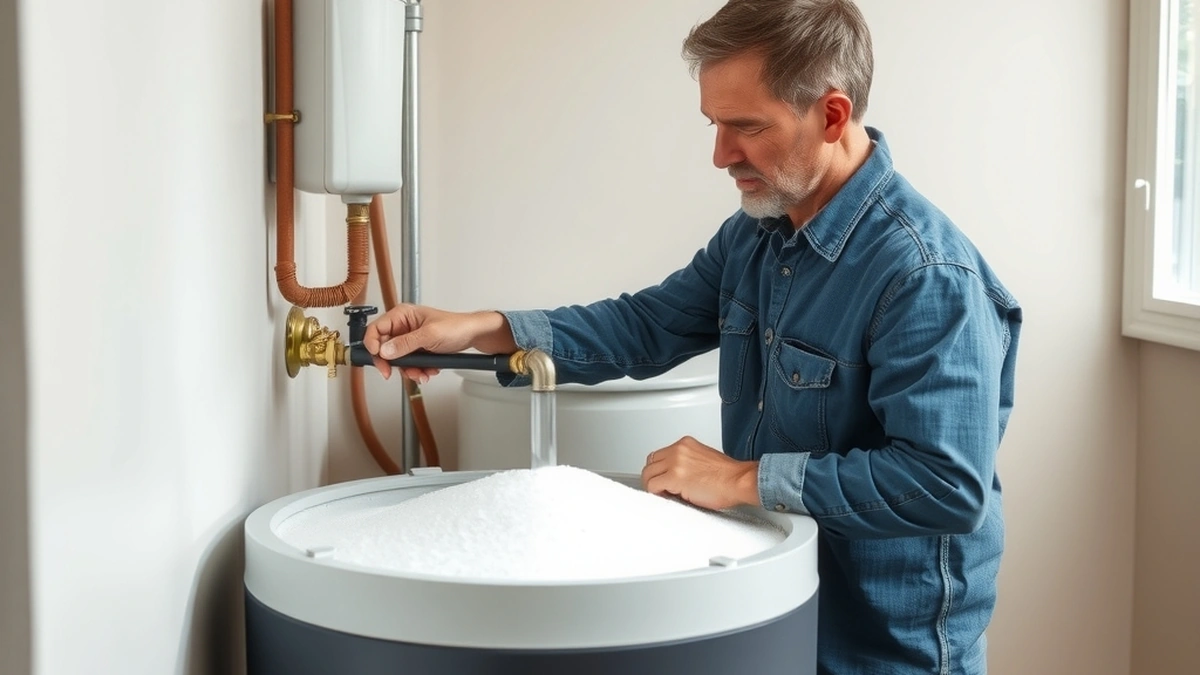
Most residential softeners need salt added every 6 to 8 weeks, but actual frequency depends on water hardness, household usage, and salt dose per regeneration.
- Typical refill interval
- Every 6–8 weeks
- Salt per regeneration
- 8–12 lbs
- Annual salt cost
- $120–$400
- Brine tank fill level
- 1/3 to 2/3 full
Some links on this page are affiliate links.If you buy through them we may earn a commission at no extra cost to you. We do not accept payment for rankings. Read the full disclosure.
Most residential water softeners need salt added every 6 to 8 weeks. The exact interval depends on your water hardness, daily water usage, and how many pounds of salt the valve draws per regeneration. Checking the brine tank monthly is the most reliable way to stay ahead of an empty tank.
What Salt Does in a Softener
A softener removes hardness minerals by passing water through resin beads charged with sodium ions. Over time, those beads fill with calcium and magnesium and must be regenerated. During regeneration, the control valve pulls brine—water mixed with salt—from the brine tank and flushes it through the resin tank to recharge the beads. Without salt in the tank, the system cannot make brine, and the resin stays exhausted.
Typical softeners use 8 to 12 pounds of salt per regeneration. A common 32,000-grain system might regenerate once every 7 to 14 days in an average household, which works out to roughly 40 to 80 pounds of salt per month. That is only an estimate; your actual usage can fall above or below that range based on the factors below.
Factors That Change Refill Frequency
Salt consumption is not fixed. Several variables determine how quickly the brine tank empties:
- Water hardness in grains per gallon (GPG): Harder water requires more frequent regeneration. Water above 10 GPG is considered very hard and will drive salt use higher than water in the 3 to 7 GPG moderate range.
- Household water usage: More people, more laundry, and more showers mean more gallons processed between regenerations.
- System capacity: Softeners are commonly sized from 24,000 to 64,000 grains. A larger capacity tank can run longer between regenerations, all else equal.
- Salt dose setting: The installer or owner sets how many pounds of salt the valve draws per cycle. A higher dose improves hardness removal efficiency up to a point but consumes more salt.
- Iron in the water: Dissolved iron can foul resin and may require more frequent regeneration or a dedicated iron filter. Softeners are generally limited to roughly 2 to 3 ppm of iron depending on the model.
You can estimate your own interval with simple arithmetic. If your softener uses 10 pounds of salt per regeneration and regenerates once every 10 days, it uses about 3 pounds of salt per day on average. A 40-pound bag would last roughly 13 days. If regeneration happens every 20 days, the same bag lasts about 26 days. Most homeowners find that tracking one or two bags reveals their real-world pace.
How to Check the Brine Tank
Open the brine tank cover and look at the salt level. The salt should sit above the water line, and the tank should generally be between one-third and two-thirds full. Letting it run completely dry means the next regeneration uses plain water, which does not recharge the resin.
If you see a hard crust or empty space above the salt with no salt touching the water, you may have a salt bridge. A bridge prevents loose salt from falling into the water and making brine. Carefully break the crust with a broom handle or similar tool, then add salt as needed.
Avoid filling the tank to the very top. Overfilling can promote bridging and makes it harder to inspect the water level. Adding one or two 40-pound bags at a time is usually sufficient for most tanks.
What Salt Costs Per Year
Annual salt cost is a small but recurring part of softener ownership. Based on typical usage, expect roughly $120 to $400 per year for salt. That range reflects differences in household size, water hardness, local salt prices, and regeneration frequency.
For context, here is how salt fits into the broader cost picture of softener ownership:
| Cost Item | Typical Range (USD) |
|---|---|
| Softener equipment | $600–$2,500 |
| Installation | $500–$1,500 |
| Total installed | $1,200–$4,500 |
| Salt per year | $120–$400 |
| Resin rebed | $300–$600 |
These figures are estimates. Equipment life is typically 10 to 15 years, and resin life is roughly 8 to 12 years before a rebed may be needed. If you are comparing softeners to other treatment options, salt-free conditioners typically install for $500 to $1,800, while whole-house filters run about $500 to $1,800 installed. Whole-house reverse osmosis is far more expensive, usually $3,000 to $8,000 installed.
You can read more about equipment pricing in our guide to how much a water softener costs and installation pricing in water softener installation cost. For salt-specific pricing, see water softener salt cost.
Signs You Need Salt Sooner Than Expected
Several symptoms suggest the softener is not regenerating properly or is using salt faster than normal:
- Hard water returns: Spots on glassware, soap that does not lather, or scale buildup on fixtures can mean the resin is exhausted.
- Brine tank is empty or nearly empty: Obvious, but easy to miss if the tank is in a basement or utility closet.
- Salt bridge or mushing: A crust at the top or a soggy mass at the bottom prevents proper brine formation.
- Frequent regeneration: If the valve runs regeneration cycles much more often than it used to, something may have changed in your water quality or usage patterns.
If you add salt and hardness symptoms persist after a regeneration cycle, the issue may be the resin, the valve settings, or a change in your water supply. A lab water test typically costs $40 to $150 and can confirm whether hardness or iron levels have shifted.
When to Call a Professional
Routine salt addition is a homeowner task. You should consider professional service if the brine tank overflows, the control valve displays an error code, regeneration does not start automatically, or you suspect a leak in the brine line. A technician can also verify the salt dose setting and regeneration frequency against your water test results.
If your water contains iron above the softener’s typical limit of 2 to 3 ppm, or if you have sulfur or other contaminants, a softener alone may not be the right tool. An iron filter typically installs for $800 to $2,500, while a sulfur filter can run $1,000 to $3,000 installed. Whole-house filtration costs are detailed in whole house water filter cost, and well-specific treatment is covered in well water treatment cost.
Keeping a Simple Schedule
The most practical approach is a monthly visual check. Mark the date you add salt and note how many pounds you used. After two or three refills, you will have a reliable interval for your household. Some homes need salt every four weeks; others can go three months. There is no universal schedule that fits every softener, which is why checking the tank matters more than following a generic reminder.
Set a calendar alert for the first of each month. Open the brine tank, confirm salt is above the water line, and top it off if it is below one-third full. Record the date and bag count. Over a year, that log will show your annual salt usage and help you budget the $120 to $400 typical range with confidence.
Frequently asked questions
How often should I add salt to my softener?
Most households add salt every 6 to 8 weeks, but heavy water use or very hard water can shorten that interval to 4 weeks or less.
What happens if the brine tank runs out of salt?
The softener cannot regenerate properly, so hard water bypasses the resin until salt is added and a regeneration cycle runs.
How full should the brine tank be?
Keep the tank roughly one-third to two-thirds full; filling it to the top can cause salt bridging and wasted salt.
Does water hardness change salt usage?
Yes. Harder water and higher daily usage require more frequent regenerations, which consumes salt faster.
Can I use any kind of salt?
Use the salt type recommended in your owner's manual, typically evaporated pellets or solar crystals suited to your softener model.
How much does softener salt cost per year?
Expect roughly $120 to $400 per year depending on usage, local salt prices, and your system's grain capacity.
Sources
Some links are affiliate links.If you buy through them we may earn a commission at no extra cost to you. We do not accept payment for rankings. Read the full disclosure.