How to choose a salt-free water softener
Choose a salt-free softener by flow rate and scale goal, not by hardness removal. See media types, sizing, and the $500-$1,800 installed range.
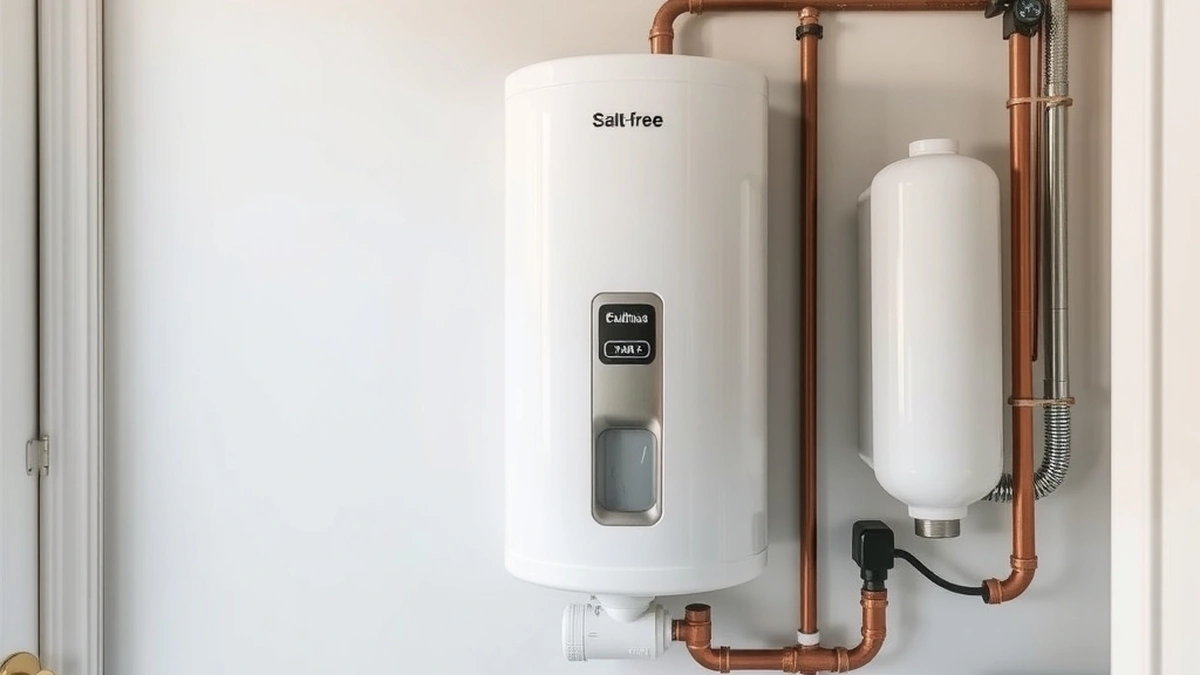
Choose a salt-free softener by peak flow and scale behavior, not by hardness removal. Size for 8-15 GPM of household peak demand, expect to spend $500-$1,800 installed, and test the water first.
- Installed cost
- $500 - $1,800
- Sizing basis
- Peak flow in GPM
- Typical flow
- 8 - 15 GPM
- Media life
- 3 - 5 years
- Hardness removed
- None
Some links on this page are affiliate links.If you buy through them we may earn a commission at no extra cost to you. We do not accept payment for rankings. Read the full disclosure.
Choose a salt-free softener by peak flow and by what you actually want to change. It will not lower a hardness reading, so if the goal is soft water for soap and appliances, this is the wrong category. If the goal is less scale adhesion with no salt and no drain, size it for 8-15 GPM.
Decide what problem you are solving
A salt-free water softener is a point-of-entry conditioner that alters how calcium and magnesium crystallize, so scale is less likely to stick to pipes and heating elements. It does not remove those minerals.
That single fact decides whether the product fits. Spotted glasses, stiff laundry, and soap that will not lather are hardness symptoms, and no conditioner fixes them. Scale on a tankless heater’s heat exchanger is a different problem, and conditioning can help.
Write the goal down before shopping. A salesman who promises a hardness drop is selling either a softener or a misunderstanding.
The three formats
| Format | Cost | Plumbing | Best for |
|---|---|---|---|
| Media tank | $500 - $1,800 | Bypass cut-in | Whole house, 8-15 GPM |
| Cartridge descaler | $200 - $600 | Housing cut-in | Smaller homes, point of use |
| Electronic descaler | $100 - $300 | None | Rentals, no plumbing access |
A media tank is the only format that treats full household flow with a meaningful contact time. A cartridge handles lower flow and needs replacement every 6-12 months. An electronic unit wraps a coil on the pipe and has the weakest evidence base of the three.
That ranking is about capability, not price. The cheapest unit is cheapest because it does the least.
Sizing by flow, not by house size
Flow is the sizing number. Whole-house conditioners typically support 8-15 GPM, and a three-bathroom home peaks near 6-8 GPM with two showers and laundry running.
Count fixtures that can run simultaneously and add 2 GPM of headroom. A home with two showers, a dishwasher, and a washing machine can draw 8-10 GPM at once, which puts it in a 2-cubic-foot tank.
A 1.5-cubic-foot tank handles most single-family homes. A 2.5-cubic-foot tank is for higher flow or very hard water where more contact time is wanted.
Undersizing is the common error. A conditioner that sees 12 GPM when it was sized for 6 does not fail loudly; it just stops doing much of anything.
Media type and life
Template-assisted crystallization media is the most common. Some units use a catalytic or polymer media with similar intent. The differences between brands are smaller than the differences between formats.
Media life is 3-5 years, and replacement runs $150-$400. A tank that has to be replaced rather than refilled costs more but avoids handling media in a crawlspace.
Ask two questions before buying: what does replacement media cost, and is it stocked. A $700 unit with proprietary media at $350 every three years costs more than a $900 unit with commodity media at $200.
Install constraints
A media conditioner needs a bypass, a level base, and 12 inches of clearance above the tank. It does not need a drain, an outlet, or salt storage, which is why it fits closets and crawlspaces where a softener cannot go.
Freeze protection matters. A tank full of water that freezes cracks, and warranty coverage usually excludes freeze damage.
If the main line is inaccessible, a cartridge unit at a point of use is the fallback. Salt-free water softener installation covers the cut-in either way.
The honest comparison
A salt-free conditioner at $500-$1,800 installed costs less than a softener at $1,200-$4,500 and has no salt bill. Over ten years it saves roughly $3,000-$3,500.
What it gives up is hardness removal. Laundry still needs more detergent, glass still spots, and a hardness test still reads 10 gpg.
If both goals matter, the common solution is a softener for hardness and a carbon filter for taste, not a conditioner pretending to be both. Salt-based versus salt-free softener sets the trade out in numbers.
A buying sequence
- Test hardness, iron, and pH, and write down what you want to change.
- Measure peak flow by counting simultaneous fixtures.
- Choose a media tank if you need whole-house coverage.
- Confirm replacement media price and availability.
- Verify freeze protection and clearance at the install spot.
- Get a quote that lists media volume, not just tank dimensions.
What to ignore
Ignore “softens without salt” phrasing. It conditions, and the distinction is the whole purchase.
Ignore laboratory scale tests with no method description. Ask what was measured: mass of scale, adhesion, or appearance.
Ignore a unit sized only in gallons per day. Flow in GPM is what decides whether the media has contact time.
Ignore the claim that the media never needs replacing. Every media bed has a service life, and a seller who says otherwise is either misinformed or counting on you not asking. Ask for the replacement part number and the price before the unit ships.
One more question belongs on the list: who services it. A media tank has no electronics and any plumber can cut it in, but an electronic descaler that fails in year three is a warranty conversation with a seller who may no longer exist. Media you can buy from a water treatment supplier is the safer long-term position.
For the price bands by format, salt-free water softener cost covers equipment and labor, and softener versus conditioner explains the category boundary in more detail. “”
Frequently asked questions
What size salt-free softener do I need?
Size to peak household flow, typically 8-15 GPM for a single-family home. A three-bathroom house with two simultaneous showers peaks near 6-8 GPM, so a 1.5-cubic-foot tank is usually enough.
Does a salt-free softener actually work?
It changes how hardness minerals behave so scale is less likely to adhere. It does not remove calcium or magnesium, so a hardness test reads the same after installation.
How much does a salt-free softener cost installed?
Five hundred to one thousand eight hundred dollars installed, including equipment and 2-4 hours of labor. Cartridge and electronic formats sit at the bottom of that range.
How long does the media last?
Three to five years, then $150-$400 for replacement. Water volume and sediment load move that interval more than the calendar does.
Do I need a pre-filter with a salt-free conditioner?
A sediment pre-filter is worth adding on any well or older municipal line. It keeps grit out of the media bed and extends its life.
Can I use a salt-free softener with a tankless water heater?
Yes. It is a common pairing because scale reduction protects the heat exchanger, though it does not eliminate scale the way ion exchange does.
Sources
Some links are affiliate links.If you buy through them we may earn a commission at no extra cost to you. We do not accept payment for rankings. Read the full disclosure.