Salt-Free Water Softener Cost and What It Does Not Do
Installed salt-free conditioner cost, grain capacity limits, and what these systems do not remove compared with ion-exchange softeners.
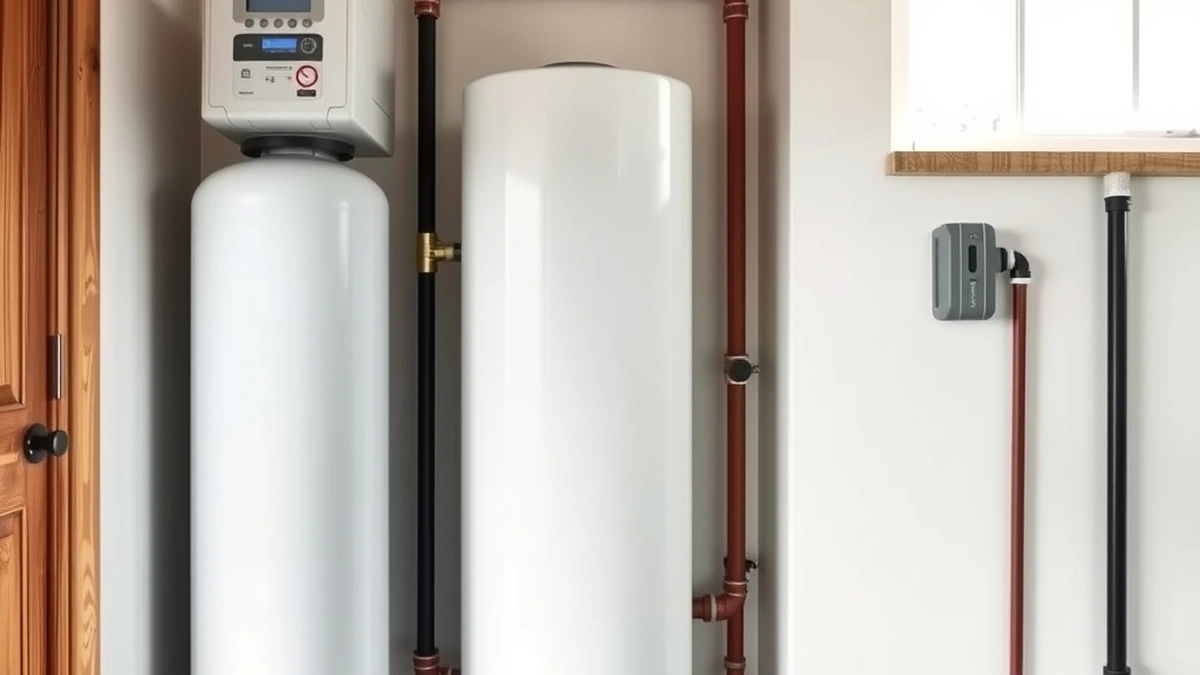
A salt-free conditioner typically installs for $500-$1,800 and does not remove hardness minerals; it only conditions them, so it will not lower grains-per-gallon readings.
- Salt-free conditioner installed
- $500-$1,800
- Ion-exchange softener installed
- $1,200-$4,500
- Softener salt per year
- $120-$400
- Softener resin life
- 8-12 years
- Water test lab
- $40-$150
Some links on this page are affiliate links.If you buy through them we may earn a commission at no extra cost to you. We do not accept payment for rankings. Read the full disclosure.
Salt-free water conditioners cost $500-$1,800 installed, but they do not soften water. They alter hardness minerals so scale is less likely to bind to pipes and fixtures, yet calcium and magnesium stay in the water. If your goal is lower grains-per-gallon hardness, a salt-free unit will not deliver it.
How Salt-Free Conditioners Work
Salt-free systems are conditioners, not softeners. They typically use template-assisted crystallization or similar media to change the structure of hardness minerals so they remain suspended rather than forming hard scale. Water passes through the media, and the minerals remain in solution.
That distinction matters for buying decisions. A salt-free conditioner does not remove hardness, so post-treatment water tests will show the same grains-per-gallon reading as untreated water. It also does not produce slippery-feeling water, reduce soap usage the way ion exchange can, or eliminate existing scale already inside plumbing.
Salt-Free vs. Ion-Exchange Cost
A conventional ion-exchange softener trades hardness minerals for sodium or potassium. Equipment runs $600-$2,500, installation adds $500-$1,500, and the installed total is typically $1,200-$4,500. Salt runs $120-$400 per year, and a resin rebed costs $300-$600 after roughly 8-12 years of resin life. Total system life is usually 10-15 years.
Salt-free conditioners avoid salt purchases, but the upfront installed price of $500-$1,800 is only part of the comparison. Media replacement schedules vary by manufacturer and water quality, and there is no grain capacity rating to size the unit against your hardness load.
Here is how the installed cost spread compares:
| System type | Equipment | Installation | Typical installed total |
|---|---|---|---|
| Salt-free conditioner | Varies | Included | $500-$1,800 |
| Ion-exchange softener | $600-$2,500 | $500-$1,500 | $1,200-$4,500 |
For more on conventional pricing, see how much does a water softener cost and water softener installation cost.
Sizing by Grains, Not by Pipe Size
Ion-exchange softeners are sized by grain capacity, commonly 24,000-64,000 grains. To estimate a weekly grain load, multiply grains-per-gallon hardness by daily water use in gallons, then by seven days. For example, a household using 300 gallons per day with 10 grains-per-gallon hardness produces:
300 gallons × 10 gpg × 7 days = 21,000 grains per week
A 32,000-grain softener would regenerate roughly every 1.5 weeks at that load, assuming 100% usable capacity. Real-world efficiency and reserve capacity change that number, but the arithmetic shows why grain capacity matters. Salt-free conditioners do not publish comparable grain removal ratings because they do not remove grains.
Regeneration salt use for conventional softeners typically runs 8-12 pounds per regeneration. At two regenerations per week, that is roughly 832-1,248 pounds of salt per year, which aligns with the $120-$400 annual salt cost range depending on local salt prices and usage. More detail is available at water softener salt cost.
What Salt-Free Does Not Do
A salt-free conditioner will not:
- Remove calcium and magnesium from water
- Lower grains-per-gallon hardness readings
- Produce soft-water feel or reduced soap scum
- Remove dissolved iron above typical softener limits of 2-3 ppm without pretreatment
- Treat nitrate, arsenic, bacteria, or other health-related contaminants
- Function as a whole-house filter for sediment, chlorine, or volatile organic compounds
If your water test shows hardness above 7 grains per gallon, or very hard water above 10 grains per gallon, a salt-free unit may reduce scaling but will not change the hardness classification. Iron above 2-3 ppm usually requires dedicated iron filtration before softening; see iron filter cost for context. Nitrate at or above 10 mg/L requires treatment such as reverse osmosis or anion exchange, not a conditioner.
When Carbon or Sediment Filtration Is Needed
Salt-free conditioners are often sold alongside carbon filters. A whole-house carbon filter installed typically costs $500-$1,800, with cartridges running $80-$300 per year and replacement every 6-12 months. Sediment cartridges usually need replacement every 3-6 months. Whole-house flow rates commonly run 8-15 gallons per minute, so check that the filter and conditioner together do not restrict pressure at peak household use.
Carbon addresses taste, odor, and chlorine; it does not remove dissolved hardness. If you need both carbon treatment and scale conditioning, the combined installed cost can approach the low end of conventional softener pricing without delivering ion-exchange softening.
Alternatives for Hardness and Drinking Water
Reverse osmosis removes dissolved minerals at a single tap. Under-sink RO equipment runs $200-$600, installed $300-$900, with annual running costs of $60-$150. Membranes last 2-3 years, and waste ratios are typically 3-4 gallons of wastewater per gallon of product, with rejection rates of 80-95 percent. RO is not a whole-house softening solution because of flow and waste limitations. Whole-house RO installed runs $3,000-$8,000 and is usually reserved for severe water quality issues.
For bacteria concerns, UV systems use lamps replaced every 12 months at $30-$90 per lamp. UV does not remove hardness, chemicals, or sediment, so it is paired with filtration, not used alone for hard water.
See whole house water filter cost and reverse osmosis system cost for equipment comparisons.
Start With a Lab Test
Before buying any equipment, test the water. A lab test costs $40-$150 and should confirm hardness in grains per gallon, iron, pH, and any other contaminants relevant to your supply. Well owners can reference EPA and CDC guidance on private well testing and treatment. Without numbers, you risk buying a conditioner that does not address the actual water quality problem.
If hardness is the only issue and you want true softening, an ion-exchange softener sized by grain capacity is the appropriate equipment. If scale reduction is the goal and you do not need lower hardness readings, a salt-free conditioner at $500-$1,800 installed may fit, provided you understand it does not remove hardness minerals.
Frequently asked questions
Does a salt-free system soften water?
No. It conditions hardness minerals so they are less likely to form scale, but it does not remove calcium and magnesium or lower grains-per-gallon hardness.
What does salt-free equipment cost installed?
Installed salt-free conditioners typically run $500-$1,800, while ion-exchange softeners installed run $1,200-$4,500.
How much does softener salt cost per year?
Softener salt typically costs $120-$400 per year, depending on water hardness, household usage, and regeneration frequency.
How long does softener resin last?
Softener resin typically lasts 8-12 years before a rebed costing $300-$600 may be needed.
Should I test water before buying?
Yes. A lab water test costs $40-$150 and confirms hardness, iron, and other contaminants before equipment is selected.
What removes hardness instead?
A conventional ion-exchange softener removes hardness minerals and is rated by grain capacity, typically 24,000-64,000 grains.
Sources
Some links are affiliate links.If you buy through them we may earn a commission at no extra cost to you. We do not accept payment for rankings. Read the full disclosure.