
Reverse osmosis filter in Hatfield PA
How under-sink reverse osmosis works for Hatfield homes, what to test first, and what installation and running costs look like locally.
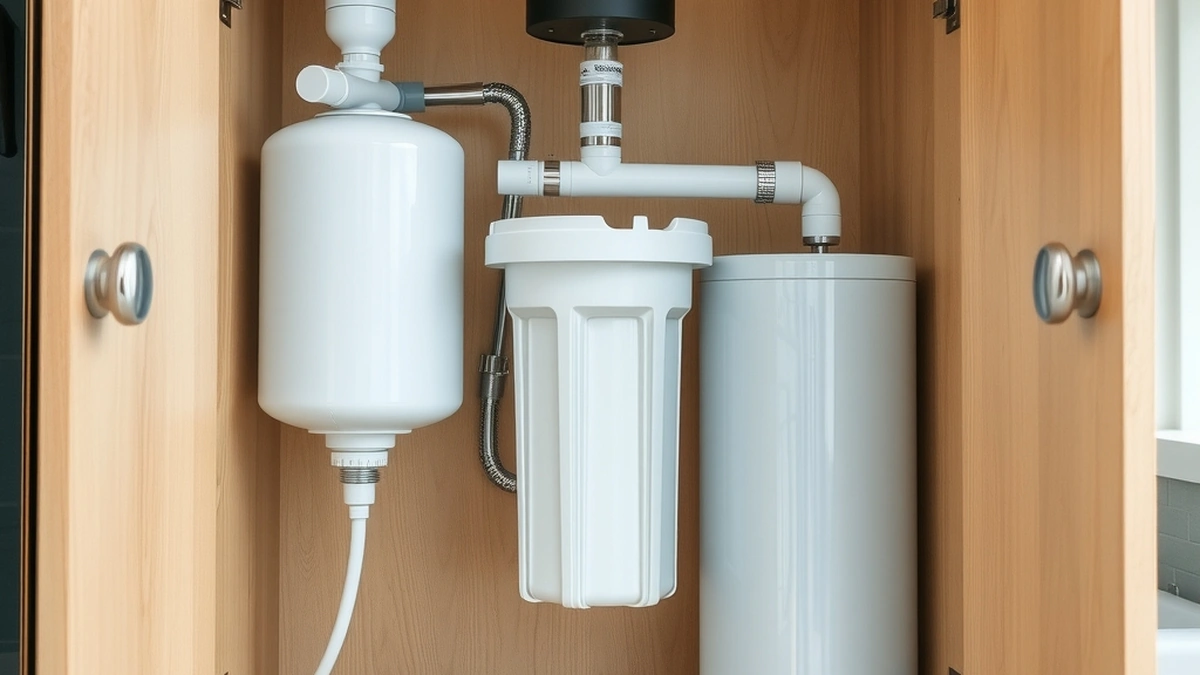
A reverse osmosis filter in Hatfield PA costs $300 to $900 installed under a kitchen sink, with $60 to $150 per year in filters and a membrane every 2 to 3 years. Test the water first, because RO is for drinking water and does not soften a whole house.
- Installed cost
- $300 - $900
- Running cost
- $60 - $150 per year
- Membrane life
- 2 - 3 years
- Waste ratio
- 3 - 4 gallons per gallon
- Rejection rate
- 80% - 95%
Some links on this page are affiliate links.If you buy through them we may earn a commission at no extra cost to you. We do not accept payment for rankings. Read the full disclosure.
A reverse osmosis filter in Hatfield PA costs $300 to $900 installed under a kitchen sink, with $60 to $150 per year in filters and a membrane replacement every 2 to 3 years. It treats drinking water at one tap. It does not soften a house, and it should be chosen after a water test rather than after a look at the shelf.
What an under-sink RO system does
Reverse osmosis pushes water through a semi-permeable membrane under pressure. The membrane rejects most dissolved solids, and the reject stream carries the concentrated minerals to the drain.
A typical system has three or four stages: a sediment pre-filter, one or two carbon stages, the RO membrane, and sometimes a polishing carbon filter. A pressure tank stores treated water so the tap flows at a usable rate.
Rejection rates for residential membranes run 80 to 95 percent, depending on the membrane and the feed water. That is why RO is used for drinking water rather than whole-house treatment.
Test the water first
Hatfield properties vary. Much of the borough and the surrounding townships are served by public water, while some outlying properties draw from private wells. The treatment decision follows the source.
A lab water test costs $40 to $150. It should report hardness, iron, manganese, pH, and, for a private well, bacteria and nitrate.
Hardness matters because a softener upstream protects the membrane. Iron matters because it fouls the membrane and shortens its life. If iron is above 2 to 3 ppm, most softeners will not handle it alone, and an iron filter at $800 to $2,500 installed belongs upstream.
If the water is chlorinated municipal supply, the carbon pre-filter protects the membrane from chlorine. If it is a private well with bacteria, RO is not a disinfection step and the well needs its own treatment.
What it costs
| Item | Typical range | Notes |
|---|---|---|
| Under-sink RO equipment | $200 - $600 | Three to five stages |
| Installation | $100 - $300 | Sink connection and drain |
| Total installed | $300 - $900 | Standard cabinet access |
| Filters per year | $60 - $150 | Pre-filter and carbon |
| Membrane | Every 2 - 3 years | Price varies by model |
A four-stage system at $450 in equipment plus $200 in labour is $650 installed, near the middle of the range. Add a permeate pump or a larger tank and the total moves toward the top.
Running cost is the filters. At $100 per year plus a membrane every three years, the annual average is roughly $130 to $150 depending on the model.
Water use and waste
RO systems send concentrate to the drain. A typical residential ratio is 3 to 4 gallons of waste for each gallon of treated water. A household producing 3 gallons of drinking water per day therefore sends 9 to 12 gallons to the drain.
That is a small share of total household use, but it matters in a metered home or on a septic system. A permeate pump can reduce the ratio, and some newer systems claim lower waste, which is worth checking rather than assuming. Ask for the tested ratio at your incoming pressure, because the number in the brochure is usually measured at a higher pressure than a household line delivers.
The drain connection must be correct. A poorly installed drain line can back up or leak inside the cabinet, and the damage is invisible until the cabinet floor swells.
Choosing a system
- Get the water test and note hardness, iron, and chlorine.
- Decide how much water you need per day; most households use 2 to 4 gallons for drinking and cooking.
- Choose a system with a pre-filter matched to sediment and a carbon stage matched to chlorine or chloramine.
- Check the certification for the specific claim, such as NSF/ANSI 58 for RO performance.
- Confirm the membrane and filter sizes are standard and easy to buy locally.
- Ask where the drain line will run and how the tank will fit under the sink.
Certification is the part buyers skip. A system claiming to reduce a contaminant should carry a listing that names the model and the reduction claim.
RO or a softener
| Problem | RO at the sink | Whole-house softener |
|---|---|---|
| Drinking water taste | Yes | Indirect |
| Hardness scale on fixtures | No | Yes |
| Water spots on dishes | No | Yes |
| Cost | $300 - $900 installed | $1,200 - $4,500 installed |
| Water waste | 3 - 4 gallons per gallon | Regeneration water |
A home with hard water usually needs both: a softener for the house and RO at the kitchen tap for drinking. Installing RO without a softener on 12 gpg water means the membrane is doing work it was not designed for, and the replacement interval shortens accordingly.
The order matters as much as the choice. Soften the water upstream, then run RO from the softened line. That protects the membrane from scale and keeps the pre-filters from loading with hardness, which is why the install cost is worth comparing as a pair rather than as two separate upgrades.
For the method detail, see how reverse osmosis works and reverse osmosis system cost. For the whole-house option, whole house reverse osmosis cost covers the larger systems.
Bottom line
An RO filter in Hatfield costs $300 to $900 installed and $60 to $150 a year to run. Test the water, protect the membrane with a pre-filter and a softener where hardness demands it, and confirm the drain line is right before the cabinet goes back together.
Frequently asked questions
How much does an RO filter cost in Hatfield PA?
An under-sink reverse osmosis system typically costs $300 to $900 installed, with $60 to $150 per year in replacement filters.
Do I need a water test before installing RO?
Yes. A test at $40 to $150 shows hardness, iron, and other parameters that affect membrane life and pre-filter choice.
Does reverse osmosis remove hardness?
It removes most minerals at the tap it serves, but it does not soften the whole house and is not a substitute for a softener.
How often does the membrane need replacing?
Typically every 2 to 3 years, depending on feed-water quality and the volume of water produced.
Where does the wastewater go?
The concentrate line runs to the sink drain or a dedicated drain, and a typical system sends 3 to 4 gallons to drain for each gallon produced.
Can I install RO in a rental?
Usually yes with landlord permission, because the connection is at the sink, though some leases restrict modifications to plumbing.
Sources
Some links are affiliate links.If you buy through them we may earn a commission at no extra cost to you. We do not accept payment for rankings. Read the full disclosure.


