
Reverse Osmosis Filters: Stages, Sizes, Replacement
RO filters run in four to five stages, each with its own replacement interval. Learn what each cartridge does and what a year of filters should cost.
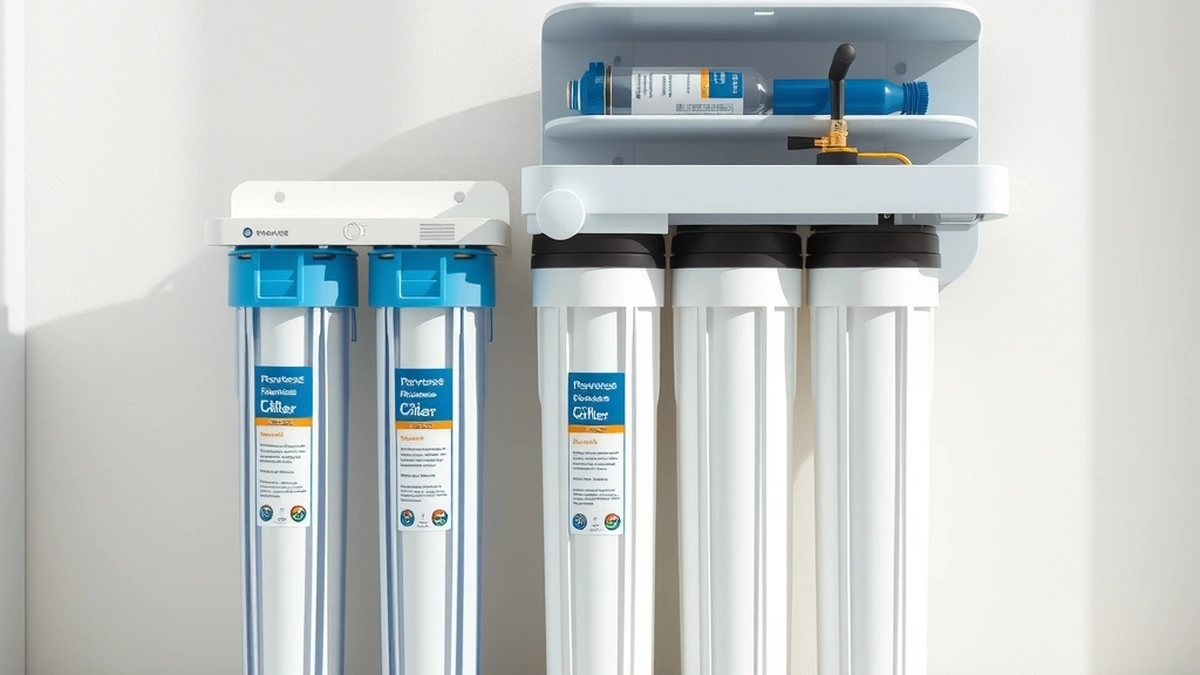
A reverse osmosis system uses a sediment prefilter, one or two carbon stages, the RO membrane, and a postfilter. Sediment and carbon cartridges change every 6 - 12 months, the membrane every 2 - 3 years, and a full year of filters costs $60 - $150.
- Sediment cartridge
- $5 - $20, every 6 - 12 months
- Carbon block
- $15 - $40, every 6 - 12 months
- RO membrane
- $40 - $120, every 2 - 3 years
- Annual filter cost
- $60 - $150
- Micron rating, sediment
- 1 - 5 micron
Some links on this page are affiliate links.If you buy through them we may earn a commission at no extra cost to you. We do not accept payment for rankings. Read the full disclosure.
Reverse osmosis filters are the cartridges inside an RO system, arranged in four to five stages: sediment, carbon, membrane, and postfilter. Sediment and carbon stages change every 6 - 12 months, the membrane every 2 - 3 years, and a year of filters costs $60 - $150 depending on whether the housings are standard or proprietary.
What Each Stage Does
A reverse osmosis filter is a cartridge that removes a specific class of material before the water reaches the next stage. The order matters, because each stage protects the one behind it.
The sediment prefilter catches sand, rust, and pipe debris. It is usually rated 1 - 5 micron and is the cheapest cartridge in the system. Its job is to stop particles from blinding the carbon block.
The carbon prefilter removes chlorine, taste, odor, and some organics. Chlorine is the membrane’s main enemy; a thin-film composite membrane degrades on contact, so the carbon stage is a sacrificial guard. Many systems use two carbon stages, one block and one granular, for longer contact time.
The membrane is the RO element itself. It rejects 80 - 95 percent of dissolved solids and passes water under pressure while sending the concentrated reject stream to the drain. It is the most expensive cartridge and the one that defines system performance.
The postfilter polishes taste after the storage tank. Water sitting in a tank can pick up a flat or plastic note, and the postfilter removes it. Some systems add a remineralization cartridge at this stage.
Replacement Intervals and Cost
| Stage | Typical life | Cost | Failure symptom |
|---|---|---|---|
| Sediment prefilter | 6 - 12 months | $5 - $20 | Falling flow, cloudy prefilter |
| Carbon block | 6 - 12 months | $15 - $40 | Chlorine taste, membrane damage |
| RO membrane | 2 - 3 years | $40 - $120 | Rising TDS, slow production |
| Postfilter | 6 - 12 months | $10 - $30 | Flat or odd taste at the faucet |
Add the annual numbers: two prefilters at $25 total, one postfilter at $15, and a membrane amortized over three years at $30 per year. That is $70 per year, inside the $60 - $150 range. Proprietary cartridges push toward the top; standard 10-inch cartridges sit at the bottom.
The intervals are guidance, not law. A household on unchlorinated well water with high sediment may need a prefilter every three months. A municipal supply that is clean and lightly chlorinated can stretch carbon to 12 months. Test the water and watch the pressure.
Standard vs Proprietary Cartridges
Standard cartridges follow nominal dimensions, most commonly 10 inches by 2.5 inches, and are sold by many manufacturers at commodity prices. Proprietary cartridges fit only their own housing and cost two to three times as much.
The price difference over five years is significant. Standard filters at $70 a year total $350. Proprietary filters at $180 a year total $900. The system with the cheaper housing is not always the cheaper system.
Before buying any RO unit, look up the replacement part numbers and price them. If the manufacturer does not publish part numbers, that is a warning. A $250 system with $200 annual filters costs more than a $450 system with $70 annual filters within three years.
How to Change Filters
- Shut off the water supply valve to the system and open the faucet to release pressure.
- Pull the system out from under the sink, or work in place if the lines allow.
- Twist or pull the old cartridges out, keeping a towel under the housing.
- Seat the new cartridges fully, lubricate O-rings with a food-grade silicone if the manufacturer specifies it, and close the housing hand-tight.
- Open the supply, check for leaks, and run the faucet for two to three minutes to flush carbon dust.
- Record the date on each cartridge with a marker.
Sanitize the system once a year if the manufacturer allows it. A little household bleach in the empty housing, circulated briefly and flushed, keeps the tank and lines from developing a biofilm. Follow the manual, because some membranes and postfilters cannot tolerate it.
When the Membrane Is the Problem
Falling flow and rising TDS point to the membrane, but the prefilters fail first and mimic the symptom. Change the sediment and carbon cartridges, run the system a day, and measure again.
A handheld TDS meter costs $15 - $30 and tells you the rejection rate. Compare the tap reading to the RO faucet reading. If the supply is 300 PPM and the product water is 150 PPM, rejection is 50 percent, well below the 80 - 95 percent a healthy membrane should deliver.
High reject flow with low product flow is another membrane signal. So is a membrane that has frozen or run dry. Replace it, and check that the flow restrictor and check valve are working, because a failed restrictor can waste water without affecting quality.
Matching Filters to Your Water
On municipal water, a four-stage system with a sediment prefilter, carbon block, membrane, and postfilter is enough. Chlorine is the main challenge, and the carbon stage handles it.
On well water, add capacity. Sediment loads are higher, iron and manganese can foul the membrane, and bacteria can colonize the tank. A softener or iron filter ahead of the RO protects the membrane and stretches cartridge life. Never put raw well water with visible sediment into an RO without a prefilter.
For the removal performance itself, see what reverse osmosis removes. For the maintenance calendar, see reverse osmosis maintenance. If the membrane is due, change RO membrane walks through the swap. For system pricing, see reverse osmosis system cost.
Frequently asked questions
How often should RO filters be replaced?
Sediment and carbon stages every 6-12 months, the membrane every 2-3 years, and the postfilter every 6-12 months, or sooner if taste and flow change.
Can I replace RO filters myself?
Yes on most systems. Cartridges twist or pull out, and the membrane slides into a housing. Shut off the supply and depressurize the tank first.
What happens if I skip a filter change?
Chlorine reaches the membrane and degrades it, sediment clogs the prefilter and drops pressure, and the postfilter can grow biofilm that affects taste.
Are all 10-inch RO cartridges interchangeable?
No. Standard 10-inch cartridges fit many systems, but proprietary housings require the manufacturer's part, so check the model before ordering.
How do I know the membrane needs replacing?
Falling production, rising reject water, or a jump in TDS readings after the membrane point to a spent membrane rather than clogged prefilters.
Does a higher stage count mean better water?
Not necessarily. Four well-maintained stages outperform six neglected ones. Extra stages mainly add capacity or remineralization, not a new removal mechanism.
Sources
Some links are affiliate links.If you buy through them we may earn a commission at no extra cost to you. We do not accept payment for rankings. Read the full disclosure.


