
Reverse osmosis system for home
Choose a home RO system by where it treats, what it must remove, and how much water you use. Costs, sizing, and the well-water prerequisites.
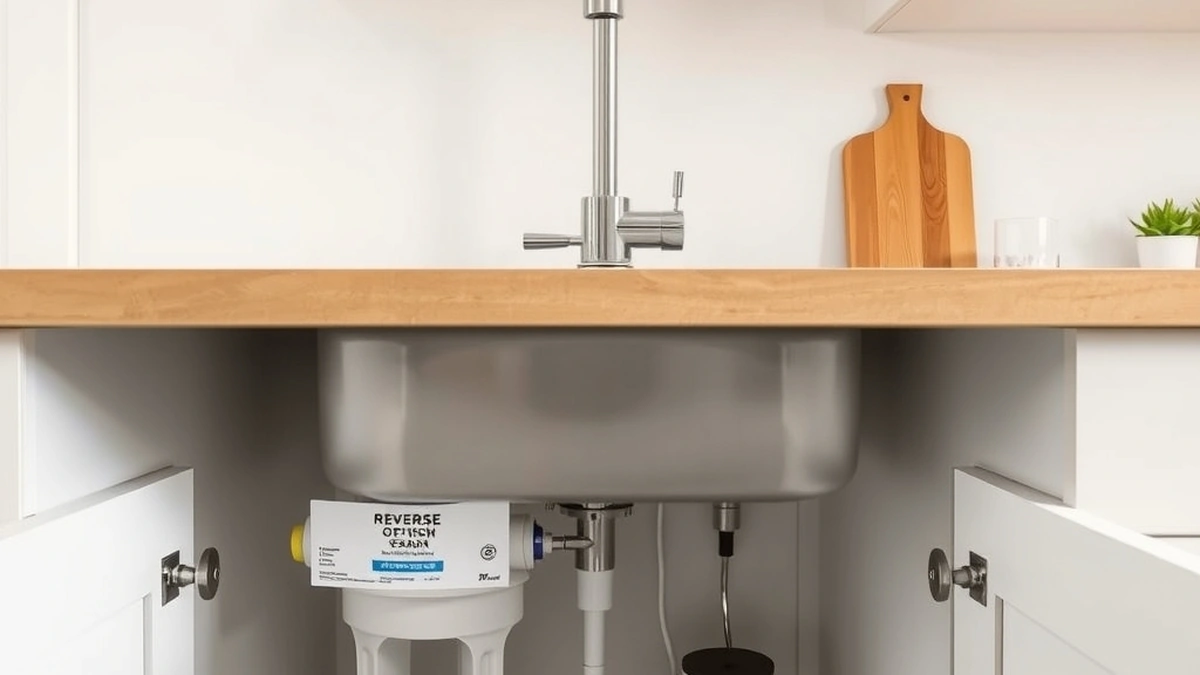
Most homes need an under-sink reverse osmosis system at the kitchen tap, costing $300 to $900 installed, not a whole-house unit at $3,000 to $8,000. Choose by the contaminants on your lab report and by daily drinking water use, then size the tank accordingly.
- Under-sink installed
- $300 - $900
- Whole-house installed
- $3,000 - $8,000
- Production
- 50 - 75 gallons per day
- Waste ratio
- 3 - 4:1
- Annual running
- $60 - $150
Some links on this page are affiliate links.If you buy through them we may earn a commission at no extra cost to you. We do not accept payment for rankings. Read the full disclosure.
A home reverse osmosis system is almost always an under-sink unit at the kitchen tap, not a whole-house installation. Under-sink systems cost $300 to $900 installed and produce 50 to 75 gallons a day, which is more than a household drinks and cooks with. Whole-house RO exists, costs $3,000 to $8,000, and is reserved for a specific problem.
Under-Sink vs Whole-House
| Feature | Under-sink | Whole-house |
|---|---|---|
| Installed cost | $300 - $900 | $3,000 - $8,000 |
| Water treated | 1 tap | Every fixture |
| Production | 50 - 75 gpd | 500 - 1,500 gpd |
| Pre-treatment | Cartridges | Softener, carbon, sediment tanks |
| Waste ratio | 3 - 4:1 | 3 - 4:1 on a much larger volume |
| Best for | Drinking water | A dissolved contaminant everywhere |
The whole-house case is narrow: brackish well water with high total dissolved solids, or a contaminant that cannot be treated selectively and affects the whole supply. For nitrate at 12 mg/L on municipal water, an under-sink unit at the kitchen solves the drinking water problem for $600, while whole-house RO would cost five figures to solve a problem that only matters in the glass.
Sizing a Home System
Three numbers decide the unit.
Daily drinking and cooking use. Most households draw 1 to 2 gallons a day. A 2 to 4 gallon storage tank buffers that comfortably.
Peak draw. Filling a stockpot takes 2 gallons at once. A small tank empties and the faucet trickles until the membrane catches up, which takes 1 to 2 hours.
Feed pressure. RO needs about 40 psi at the membrane. Below that, production falls and the tank refills slowly. A permeate pump or booster helps.
Tankless units change the arithmetic. They produce on demand with no storage tank, so there is no waiting for a refill and no bladder to fail. The trade is cost, a requirement for adequate pressure, and a production rate that must match the household’s peak draw. For a small kitchen with good pressure, a tank model is simpler and cheaper.
| Household | Daily draw | Tank size | Notes |
|---|---|---|---|
| 1 - 2 people | 1 gallon | 2 - 3 gallons | Standard unit fine |
| 3 - 4 people | 2 gallons | 3 - 4 gallons | Standard or larger tank |
| 5+ people | 3 gallons | 4 gallons or tankless | Consider higher production |
What the System Includes
A four-stage unit: sediment pre-filter, carbon block, TFC membrane, and post-carbon polishing filter. A fifth stage is optional, either a second carbon for chloramine or a remineralizer.
The membrane is the part doing the work. A TFC membrane rejects 80 to 95 percent of dissolved solids, and it is degraded by chlorine, which is why the carbon block ahead of it is mandatory rather than optional.
The pressure tank is a steel vessel with a bladder. It stores permeate under pressure so the faucet delivers at a usable rate. When the bladder fails, waterlogs, and the faucet runs slowly, the tank needs replacement, usually $40 to $80 for the part.
Two smaller parts are worth knowing because they fail quietly. The flow restrictor sets the waste ratio, and a mismatched restrictor either wastes water or shortens membrane life. The check valve on the permeate line keeps water from flowing backward into the membrane when the tank is full, and a failed check valve makes the system cycle repeatedly. Both are inexpensive to replace and both are frequently misdiagnosed as a failing membrane.
Well Water Prerequisites
RO on well water needs pre-treatment in a specific order.
- Sediment to protect the cartridges downstream.
- Iron removal if iron exceeds 2 to 3 ppm, because iron fouls both resin and membrane.
- Softening if hardness exceeds 7 GPG, because scale coats the membrane.
- Carbon to remove any oxidant and taste.
- RO at the kitchen tap.
Skipping the softener is the expensive mistake. A membrane rated for 2 to 3 years on soft water can fail in under a year on 15 GPG hard water, and the replacement cost plus labor erases any savings.
Cost Arithmetic
Under-sink, mid-range: $450 equipment, $350 installation, $800 total. Cartridges at $100 per year for five years is $500, plus one membrane at $60. Total $1,360 over five years, or $272 per year.
Whole-house at the low end: $3,000 installed, plus pre-treatment and larger cartridge volumes. A conservative $400 per year in consumables over ten years adds $4,000, for $7,000 total, or $700 per year.
The per-gallon comparison follows from use. Treating 2 gallons a day at $272 per year is about $0.37 per gallon. Treating 200 gallons a day at $700 per year is about $0.01 per gallon, which is why whole-house RO only makes sense when the whole supply genuinely needs it.
Five Steps to Choose
- Test the water with a lab panel at $40 to $150.
- Decide the scope from the report: one tap or the whole house.
- Check pressure at the kitchen line; below 40 psi, budget for a permeate pump.
- Measure the cabinet and confirm tank clearance.
- Verify certification to NSF/ANSI 58 and check cartridge pricing.
What to Avoid
Avoid units with proprietary cartridges that cost $60 each unless the vendor publishes a long-term supply commitment. Avoid “alkaline” stages sold as treatment rather than taste. Avoid any system sold without a sediment and carbon pre-filter, because the membrane will not survive.
Avoid installing RO before a softener on hard water. And avoid expecting an under-sink unit to fix hardness, iron, or bacteria at the shower. It treats one tap, and it does that well.
For the buying comparison, see best under-sink reverse osmosis, reverse osmosis system cost for the quote breakdown, and whole house reverse osmosis system for the equipment and pre-treatment train.
Frequently asked questions
Do I need a whole-house reverse osmosis system?
Usually not. Whole-house RO is for a dissolved contaminant affecting the entire supply; for drinking water at one tap, an under-sink unit does the job for a fraction of the cost.
How much does a home RO system cost installed?
Under-sink systems run $300 to $900 installed, while whole-house systems run $3,000 to $8,000 and require larger pre-treatment and drain capacity.
Can I install a home RO system myself?
Yes on most kitchens: a supply saddle valve, a drain adapter, and a faucet hole are the main steps, with leaks at push-fit fittings the usual risk.
Does a home RO system need a softener?
If hardness exceeds 7 GPG, yes, because scale on the membrane shortens its life from 2 to 3 years to months; the softener goes ahead of the RO.
How much water should I expect to use from an RO tap?
A household typically draws 1 to 2 gallons a day for drinking and cooking, so a 2 to 4 gallon storage tank covers demand with a refill buffer.
How long does a home RO system last?
The housings and tank last 10 years or more, the membrane 2 to 3 years, and the pre-filters 3 to 12 months depending on type and water quality.
Sources
Some links are affiliate links.If you buy through them we may earn a commission at no extra cost to you. We do not accept payment for rankings. Read the full disclosure.


