
Whole house reverse osmosis system
Whole-house RO costs $3,000 to $8,000 installed and needs softener, carbon, and sediment pre-treatment. See when it is justified and what it consumes.
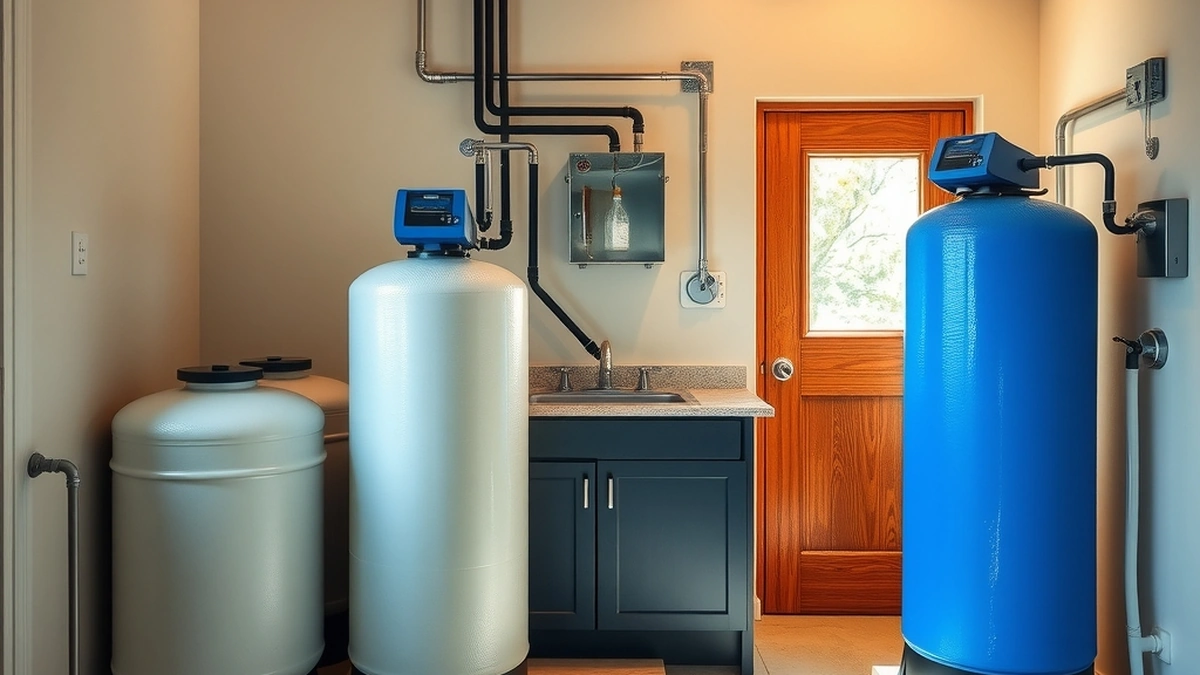
A whole house reverse osmosis system treats every gallon at the point of entry, costs $3,000 to $8,000 installed, and requires softening and carbon pre-treatment plus a large storage tank and drain. It is justified by brackish or high-TDS water, not by hardness or taste alone.
- Installed cost
- $3,000 - $8,000
- Pre-treatment
- Softener, carbon, sediment
- Storage
- Large atmospheric tank
- Waste ratio
- 3 - 4:1
- Best for
- Brackish or high-TDS supply
Some links on this page are affiliate links.If you buy through them we may earn a commission at no extra cost to you. We do not accept payment for rankings. Read the full disclosure.
A whole house reverse osmosis system treats every gallon entering the house, costs $3,000 to $8,000 installed, and needs a pre-treatment train plus a storage tank and a drain. It solves a narrow problem: water with dissolved contaminants that cannot be treated selectively, most often brackish well water with high total dissolved solids.
When It Is Justified
The case is specific. Whole-house RO makes sense when:
- Total dissolved solids are high enough that the water tastes salty or leaves residue everywhere
- A dissolved contaminant affects the whole supply and cannot be removed by selective media at reasonable cost
- The well is brackish, which is common in coastal areas and some inland formations
- Every fixture needs low-solids water, not just the kitchen tap
It is not justified by hardness alone. A softener at $1,200 to $4,500 installed removes hardness for a fraction of the cost and without the waste stream. It is not justified by chlorine taste, which carbon handles for $500 to $1,800. It is not justified by one contaminant you only drink, which an under-sink unit handles for $300 to $900.
The Pre-Treatment Train
An RO membrane is the most expensive component and the most easily destroyed part of the system.
| Stage | Purpose | Consequence of skipping |
|---|---|---|
| Sediment | Remove particles | Membrane surface fouls |
| Carbon | Remove chlorine and organics | Membrane oxidizes |
| Softener | Remove hardness | Membrane scales |
| Antiscalant | Control sparingly soluble salts | Scale at high recovery |
| RO membrane | Remove dissolved solids | The point of the system |
Every stage exists because the membrane cannot tolerate what it removes. A whole-house system without a softener on 20 GPG water will consume membranes, and each replacement is a significant part of the original equipment cost.
Storage and Pressure
A whole-house RO produces slowly relative to household demand, so it fills an atmospheric storage tank and a delivery pump pressurizes the house from there.
That adds components: a storage tank sized for a day or more of use, a repressurization pump, a level control, and usually a UV or carbon polishing stage after storage. The tank alone can occupy a corner of a mechanical room.
Sizing the tank is the step that gets underestimated. A household using 200 gallons a day needs a tank that can buffer peak demand plus a reserve, or the pump short-cycles and the house loses pressure when the RO is recovering.
What It Costs to Run
The install is the visible number; the running cost is the one that surprises people.
At a 3 to 4:1 waste ratio, 200 gallons a day of production sends 600 to 800 gallons to drain daily, or roughly 219,000 to 292,000 gallons a year. On a metered municipal supply that is a real bill. On a well, it is a real load on the pump and the aquifer.
Consumables add up too: sediment and carbon cartridges, softener salt, antiscalant, membrane cleaning chemicals, and eventual membrane replacement. A few hundred dollars a year is a reasonable planning figure, and it can be more.
Comparing the Options
| Approach | Installed | Treats | Best for |
|---|---|---|---|
| Softener only | $1,200 - $4,500 | Hardness | Hard water, normal TDS |
| Carbon plus softener | $2,000 - $5,500 | Taste, chlorine, hardness | Most well and city water |
| Under-sink RO | $300 - $900 | One tap, dissolved solids | Drinking water only |
| Whole-house RO | $3,000 - $8,000 | Every gallon | Brackish or high-TDS supply |
The table makes the decision clear in most cases. Whole-house RO is the last row for a reason: it is the most expensive way to solve a problem that the other rows solve for less, unless the problem genuinely affects every gallon.
Five Steps Before Committing
- Get a full lab panel including total dissolved solids, not just hardness and iron.
- Confirm the TDS number and whether a selective treatment exists for the specific contaminant.
- Price the pre-treatment train separately from the RO unit.
- Calculate the waste water volume against your supply and sewer costs.
- Confirm the electrical and drain capacity for the pump, controls, and reject line.
Maintenance Reality
A whole-house system has more parts than an under-sink unit and more ways to fail. The pump, the level control, the pre-treatment valves, and the membrane all need attention.
Annual service is not optional. Membranes need cleaning or replacement on a schedule, pre-filters need changing, and the softener needs salt. A household that ignores the system for two years will find a scaled membrane and a storage tank with biofilm.
That is the trade for whole-house treatment: every gallon is low in dissolved solids, and every component is your responsibility.
The Honest Alternative
If the problem is drinking water, treat drinking water. A softener at the entry plus an under-sink RO at the kitchen solves hardness and dissolved contaminants for $1,500 to $5,400 combined, treats 2 gallons a day to a high standard, and wastes proportionally less water.
Whole-house RO wins only when the whole supply is the problem. That is a real situation on brackish wells, and it is rare on municipal water. Reverse osmosis system for home covers the under-sink decision, well water filtration system covers the staged approach for well water, and reverse osmosis system cost covers how a quote is built.
Before committing, get a second opinion on the TDS number. A reading of 500 mg/L is unpleasant but treatable selectively for drinking water; a reading of 2,000 mg/L is a different category and may justify whole-house treatment. The threshold is not a single number, but the higher the figure, the stronger the case for treating everything rather than one tap.
Frequently asked questions
How much does a whole house reverse osmosis system cost?
Installed costs run $3,000 to $8,000, and that figure usually assumes pre-treatment is already in place; adding a softener and carbon can push the total higher.
Does a whole house RO system need pre-treatment?
Yes. Sediment, carbon, and usually softening are required, because particles, chlorine, and hardness will foul or destroy the membrane within months.
How much water does a whole house RO waste?
The same 3 to 4 to 1 ratio applies, but at whole-house volumes, so a household using 200 gallons a day may send 600 to 800 gallons to drain.
Is whole house RO worth it for hard water?
No. Hardness is treated far more cheaply with a softener; whole-house RO is for dissolved contaminants that softening cannot address, such as high total dissolved solids or brackish water.
What maintenance does a whole house RO need?
Pre-filter changes, softener salt, membrane cleaning or replacement, and pump service, with consumables typically running several hundred dollars a year.
Can whole house RO be added to a municipal supply?
It can, but it is rarely justified because municipal water is already treated; point-of-use RO at the kitchen is the usual approach for dissolved contaminants.
Sources
Some links are affiliate links.If you buy through them we may earn a commission at no extra cost to you. We do not accept payment for rankings. Read the full disclosure.


