
Reverse osmosis water filter
What an RO water filter is, how the membrane and pre-filters work together, what it removes, and the costs to install and run one at the sink.
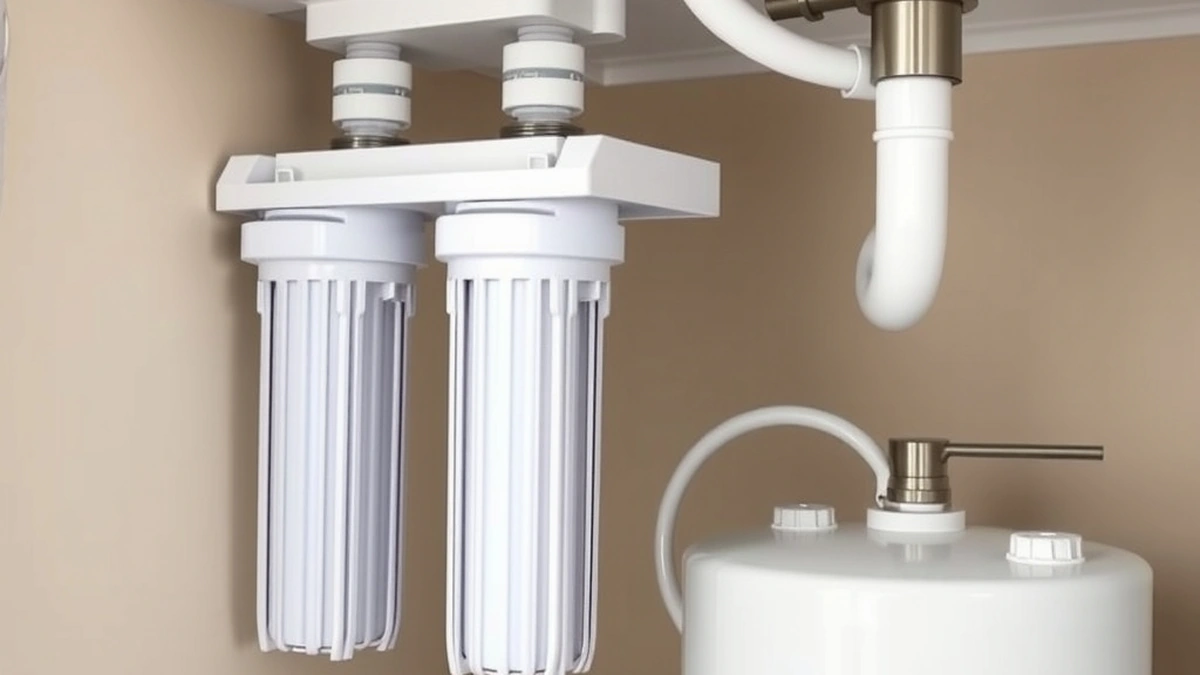
A reverse osmosis water filter pushes water through a semi-permeable membrane that rejects 80 to 95 percent of dissolved solids, with carbon pre-filters protecting the membrane from chlorine. Under-sink units cost $200 to $600 for equipment and $300 to $900 installed.
- Equipment
- $200 - $600
- Installed
- $300 - $900
- Rejection
- 80 - 95 percent
- Waste ratio
- 3 - 4:1
- Annual running
- $60 - $150
Some links on this page are affiliate links.If you buy through them we may earn a commission at no extra cost to you. We do not accept payment for rankings. Read the full disclosure.
A reverse osmosis water filter removes dissolved solids by forcing water through a membrane that passes water molecules and rejects most ions. It is the only common household filter that addresses nitrate, sodium, and a broad range of dissolved contaminants at the same time. Everything else in the unit exists to protect that membrane.
The Stages in Order
An RO filter is a short train of cartridges ending at the membrane.
- Sediment pre-filter. Catches particles so they do not foul the membrane surface. Usually 5 micron.
- Carbon block. Removes chlorine, which would otherwise degrade the membrane.
- RO membrane. The active barrier, rejecting 80 to 95 percent of dissolved solids.
- Post-carbon filter. Polishes taste and catches anything from the storage tank.
A fifth stage is optional: a second carbon block for chloramine, or a remineralizer that adds calcium and magnesium back for taste.
| Stage | Job | Change interval |
|---|---|---|
| Sediment | Particles | 3 - 6 months |
| Carbon block | Chlorine, taste | 6 - 12 months |
| Membrane | Dissolved solids | 2 - 3 years |
| Post-carbon | Taste polish | 6 - 12 months |
How the Membrane Works
Osmosis moves water across a semi-permeable membrane from low solute concentration to high. Reverse osmosis applies pressure to overcome that tendency, so water moves the other way, leaving dissolved solids behind.
The pressure required depends on the feed concentration and the membrane. Residential units run on household line pressure, typically 40 to 60 psi. Below about 40 psi, production drops and the tank takes much longer to fill.
The rejected solids are carried away by a continuous cross-flow, which is why the system sends 3 to 4 gallons to drain for every gallon produced. Remove that flow and the membrane scales in days.
What It Removes and What It Does Not
| Contaminant | RO performance |
|---|---|
| Sodium | High rejection |
| Nitrate | High rejection |
| Lead | High rejection |
| Arsenic | Depends on species and membrane |
| PFAS | Good with certified membrane |
| Hardness | High rejection, but scales the membrane |
| Chlorine | Not directly, needs carbon pre-filter |
| Bacteria | Not a reliable barrier |
| Sediment | Needs pre-filter |
The two rows people overestimate are the last two. RO is not a microbiological barrier; a pinhole or a loose O-ring defeats it. If bacteria are a concern, UV after the RO or a UV whole-house unit is the tool.
Hardness is the other trap. RO removes it, which sounds good, but the removed calcium precipitates on the membrane surface as scale. On water above 7 GPG, a softener ahead of the RO extends membrane life from months to years.
Cost to Own
Equipment runs $200 to $600 and installation $300 to $900. Consumables run $60 to $150 per year.
A five-year figure for a $450 unit with a DIY install: $450 + 5 × $100 cartridges + $60 membrane = $1,010, or about $202 per year. Add $400 for professional installation and it becomes $282 per year.
Compare with bottled water at $1 per gallon for 2 gallons a day: $730 per year. The RO system is cheaper from year one, before counting the convenience.
Where It Fits in a House
RO is a point-of-use device. It serves one tap, usually the kitchen, and does nothing for the shower or the washing machine. That is intentional: treating 2 gallons a day to a high standard is cheap, and treating 300 gallons a day that way is not.
Whole-house RO exists at $3,000 to $8,000 installed, and it is reserved for specific water chemistry rather than general improvement. For most homes the sensible stack is a softener and carbon at the entry, and RO at the sink.
The order matters on well water. Sediment first, then iron removal if the report shows more than 2 to 3 ppm, then softening, then RO at the tap. Putting RO ahead of a softener means the membrane absorbs the hardness and fails early. That sequence is laid out in well water system layout.
On municipal water the stack is simpler. A carbon filter at the entry handles chlorine for the whole house, and the RO unit at the sink handles dissolved contaminants for drinking water. If the report shows no nitrate or metals, the RO is a taste and preference purchase rather than a necessity.
Five Steps Before Buying
- Test the water with a $40 to $150 lab panel to see what the membrane will face.
- Check pressure at the kitchen cold line; below 40 psi, budget for a permeate pump.
- Measure the cabinet for height and tank footprint.
- Confirm cartridge availability and price a year of filters.
- Verify certification to NSF/ANSI 58 for RO performance.
Maintenance Keeps It Working
The membrane is only as good as the cartridges ahead of it. A neglected carbon pre-filter lets chlorine through and destroys the membrane months early, turning a $60 part into a $60 part plus a $60 membrane plus the labor.
Change sediment every 3 to 6 months, carbon every 6 to 12, and the membrane every 2 to 3 years. Check rejection annually with a TDS meter: (feed − product) ÷ feed × 100. Below 80 percent, the membrane is due.
If the tank fills slowly, the cause is usually pressure rather than the membrane. Permeate pumps covers that fix, reverse osmosis maintenance covers the schedule, and what reverse osmosis removes lists contaminants with rejection figures.
One last point on expectations. An RO filter is not a water softener and not a disinfectant. It removes dissolved solids at one tap, and it does that job well when the pre-filters are maintained. The systems that disappoint their owners are almost always the ones where the cartridges were left in for two years and the membrane was blamed for the result.
Frequently asked questions
What does a reverse osmosis water filter remove?
It rejects most dissolved ions and larger molecules at 80 to 95 percent, including sodium, nitrate, lead, arsenic in some forms, and many PFAS compounds, depending on the membrane and pre-filtration.
How many stages does an RO filter need?
Four is the practical minimum: sediment, carbon block, membrane, and post-carbon; a fifth stage adds either chloramine protection or remineralization.
How often do filters need changing?
Pre-filters and post-filters every 6 to 12 months, sediment every 3 to 6 months, and the membrane every 2 to 3 years under normal municipal water.
Does an RO filter need electricity?
Most under-sink units do not, because they run on line pressure; a booster pump or tankless unit may need power.
Can I drink RO water every day?
Yes, the water is safe; the membrane removes minerals along with contaminants, and any mineral intake concern is a diet question rather than a safety one.
Does RO water taste different?
It tastes flat to some people because dissolved minerals are removed, and many systems add a remineralizing cartridge to restore a rounder taste.
Sources
Some links are affiliate links.If you buy through them we may earn a commission at no extra cost to you. We do not accept payment for rankings. Read the full disclosure.


