
sediment filter installation: what it involves
Sediment filter installation takes 30-60 minutes and costs $80-$400. See housing types, micron ratings, pressure loss, and cartridge change intervals.
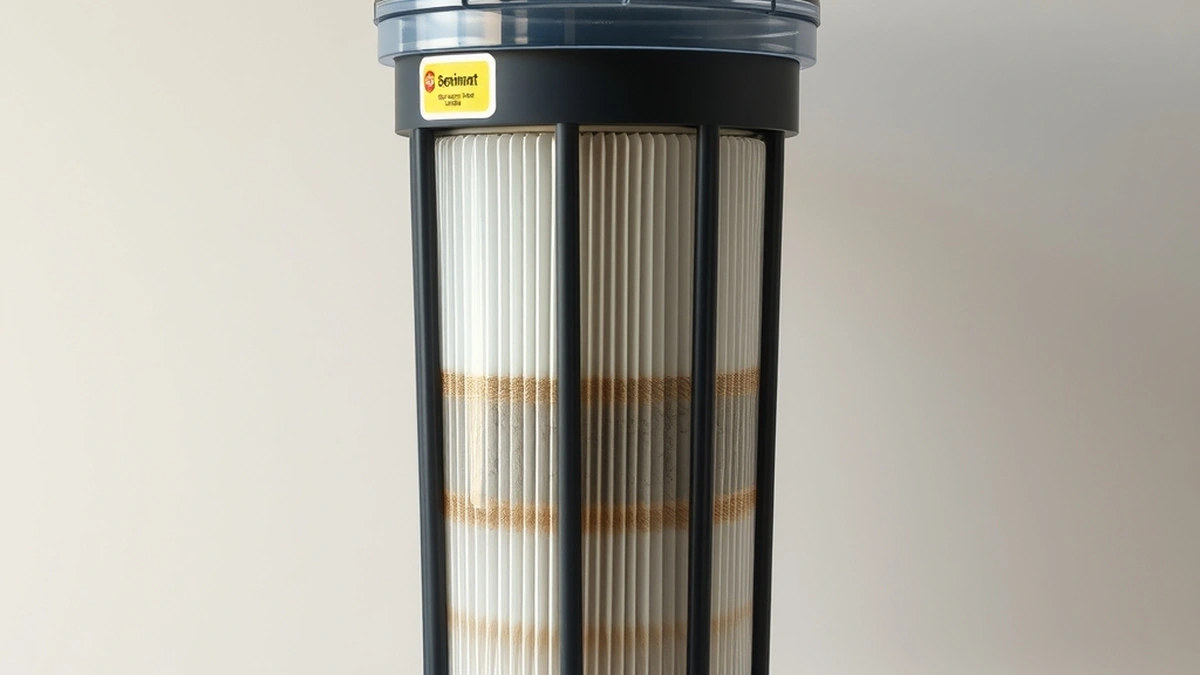
Sediment filter installation takes 30-60 minutes and costs $80-$400 in parts for a single housing. It is a cut-in on the main or a tee under a sink, with a 5 to 20 micron cartridge and no drain or power needed.
- Parts cost
- $80 - $400
- Labor time
- 30 - 60 minutes
- Micron range
- 1 - 50 micron
- Cartridge life
- 3 - 6 months
- Housing sizes
- 10 inch and 20 inch
Some links on this page are affiliate links.If you buy through them we may earn a commission at no extra cost to you. We do not accept payment for rankings. Read the full disclosure.
Sediment filter installation takes 30-60 minutes and costs $80-$400 in parts for a single housing. It is the simplest piece of water treatment hardware to install: a housing, a bracket, two fittings, and a cartridge. No drain, no power, no programming.
What a sediment filter is
A sediment filter is a mechanical filter that traps particles larger than its rated pore size, usually measured in microns. Sand, rust flakes, pipe scale, and grit are the targets. It does not remove dissolved minerals, chlorine, or metals.
The housing is a pressure vessel with a removable sump. Water enters the outside of the cartridge and exits through the center, leaving particles on the media. A pleated cartridge offers more surface area; a spun-bond cartridge offers depth loading and a lower price.
Two sizes cover most homes: 10-inch and 20-inch, both in a 4.5-inch diameter for whole-house flow. The 20-inch housing costs $30-$70 more and roughly doubles cartridge life.
Cartridge, backwashing, or both
| Type | Cost | Maintenance | Best for |
|---|---|---|---|
| 10-inch housing | $40 - $120 | Cartridge every 3-6 months | Under sink, light sediment |
| 20-inch housing | $80 - $250 | Cartridge every 4-8 months | Whole house, well water |
| Dual-gradient housing | $100 - $300 | Same as above | Heavy sand and rust |
| Backwashing tank | $600 - $1,500 | No cartridge, backwash cycle | Very heavy sediment loads |
| Spin-down pre-filter | $40 - $150 | Flush by hand | Irrigation, well screens |
A backwashing tank is the answer when cartridges clog weekly. It costs more up front but eliminates the cartridge habit. For most wells, a 20-inch housing with a 20-micron cartridge is enough.
Picking the micron rating
Micron rating is the whole decision. A 50-micron cartridge catches sand and large rust but passes fine silt. A 5-micron cartridge catches most visible turbidity and protects carbon blocks downstream. A 1-micron cartridge is for membrane protection and clogs fast.
Match the rating to the job, not to the marketing. A 1-micron cartridge on a municipal supply with no sediment problem just costs more and restricts flow. A 50-micron cartridge ahead of a 5-micron carbon block is a sensible two-stage stack.
On a well, start with 20 microns if the water is visibly dirty, then move to 5 once the load drops. Going straight to 1 micron means changing cartridges monthly and blaming the filter.
The sediment filter micron ratings guide has a table that maps particle size to rating, which is more useful than the package copy.
The install, step by step
- Shut off the main valve and drain the line through a low faucet.
- Mark the bracket location on a stud or a backing board, allowing 10 inches below for sump removal.
- Cut the pipe and fit tees or a compression adapter to match the housing threads.
- Wrap the housing threads with two to three turns of PTFE tape and hand-tighten plus a quarter turn.
- Install the cartridge, fill the sump with water to reduce air lock, and thread it on.
- Open the valve slowly, check for leaks, and flush for 2-3 minutes.
The most common error is over-tightening the sump. Hand-tight plus a quarter turn is enough; a wrench on a plastic sump cracks the threads and turns a $15 part into a $60 housing.
Pressure and placement
Every sediment filter costs pressure. A clean 10-inch cartridge drops 2-5 psi at 8 GPM. A loaded one can drop 15-20 psi, which shows at the far shower.
Place the housing where it can be isolated and where the sump has clearance below. Under a sink, that means mounting high in the cabinet. On a main line, it means a spot with 12 inches of drop below the housing.
If the house runs at 40 psi, a filter that drops 8 psi leaves 32 psi at the fixtures, which is marginal. A 20-inch housing or a 1-inch body reduces the drop without changing the cartridge.
Cost over five years
Take a 20-inch housing at $150 and a $15 cartridge changed every 4 months. That is 3 cartridges per year, or $45 annually. Over five years: $150 + ($45 × 5) = $375, plus $20 for a spare O-ring set.
A backwashing tank at $900 with no cartridges costs $900 up front and perhaps $100 in media over five years, or $1,000 total. The tank is cheaper only if cartridges would otherwise be changed monthly.
For a well with heavy sediment, that math can flip. At 12 cartridge changes per year at $15 each, annual cost is $180, and five-year cost is $1,050. That is when the tank makes sense.
Where it fits in the train
Sediment first, then carbon, then softener, then UV. Each stage protects the next. A sediment filter ahead of a softener keeps grit out of the valve and the resin bed; ahead of UV it keeps particles from shielding organisms from the lamp.
If the sediment is iron or manganese rather than sand, a mechanical filter is the wrong tool. A cartridge catches the particles those metals form, but it does nothing about the dissolved load upstream, so the cartridge clogs weekly while the real problem stays in the water. Sediment in well water explains how to tell the difference by looking at color, settling behavior, and a lab report, and iron filter installation covers the oxidation step that actually removes dissolved metals.
One last placement note: put the housing where a spill does no damage. A sump that fails under a finished ceiling costs more in drywall than the filter cost in parts.
Frequently asked questions
How much does it cost to install a sediment filter?
Parts run $80-$400 for a single housing, bracket, and fittings. A plumber adds $100-$250 in labor, so a hired install typically lands at $200-$600.
What micron rating should a sediment filter be?
Twenty to fifty micron for heavy sand and rust ahead of other equipment, five micron for general household use, and one micron only when a downstream membrane needs protection.
How often should a sediment cartridge be changed?
Every 3-6 months on most municipal water, and every 4-8 weeks on a well with visible sediment. Change it when the pressure gauge drops 10 psi from its clean baseline.
Does a sediment filter reduce water pressure?
A clean cartridge drops 2-5 psi. A loaded one can drop 15 psi or more, which is why a gauge on the downstream side is worth the $20.
Can a sediment filter go before a water softener?
Yes, and it should. Removing grit ahead of the resin protects the valve and keeps the bed from fouling, which extends the life of the more expensive equipment.
What is the difference between a sediment filter and a carbon filter?
A sediment filter traps physical particles by pore size. A carbon filter adsorbs dissolved chlorine, taste, and odor compounds. Many systems run sediment first, then carbon.
Sources
Some links are affiliate links.If you buy through them we may earn a commission at no extra cost to you. We do not accept payment for rankings. Read the full disclosure.


