
Solar Salt for Water Softeners: Sun-Dried and Cheap
Solar salt is evaporated from brine ponds, then graded for softeners. See how it differs from mined salt, what it costs, and where crystals beat pellets.
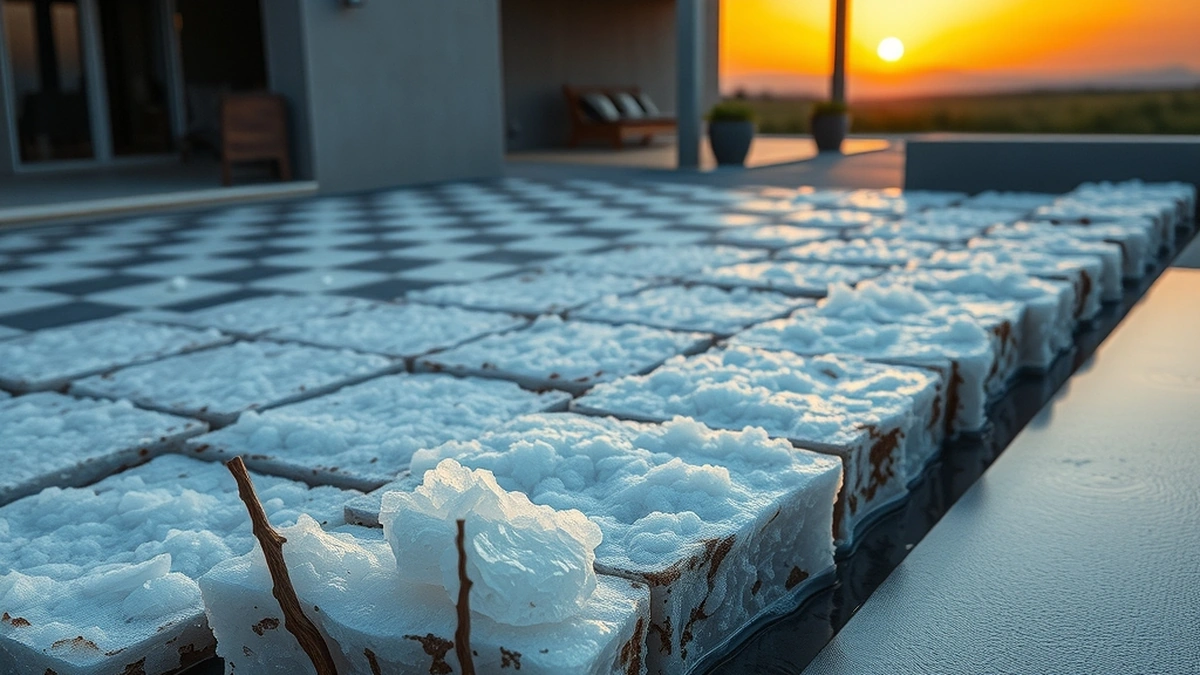
Solar salt is sodium chloride produced by evaporating brine in shallow ponds, then dried and graded for softeners. It costs $6 - $10 per 40-pound bag as coarse crystals, dissolves fast, and leaves more tank residue than compressed pellets.
- 40 lb crystals
- $6 - $10
- 40 lb pellets
- $7 - $12
- Purity
- About 99 - 99.5 percent
- Residue
- Moderate
- Annual salt cost
- $120 - $400
Some links on this page are affiliate links.If you buy through them we may earn a commission at no extra cost to you. We do not accept payment for rankings. Read the full disclosure.
Solar salt for a water softener is sodium chloride made by evaporating brine in shallow ponds, then washing, drying, and grading the crystals. It costs $6 - $10 per 40-pound bag, dissolves quickly, and leaves more tank residue than compressed pellets. The softener treats it exactly like any other salt.
How Solar Salt Is Produced
Brine, either seawater or a solution pumped from underground salt deposits, is channeled into shallow ponds. Sun and wind evaporate the water over weeks, and the salt crystallizes on the pond floor.
The crystals are harvested with mechanical scrapers, washed to remove mud and other salts, and dried. Screening separates the product into coarse and fine grades.
That process is low-energy compared with mining and compression, which is why solar salt costs less per bag. It also leaves more trace minerals in the product, and those traces are the source of the tank sludge that solar salt users know well.
Solar Salt vs Mined Rock Salt
| Feature | Solar salt | Rock salt |
|---|---|---|
| Source | Evaporated brine | Underground mine |
| Purity | About 99 - 99.5 percent | 95 - 98 percent |
| Insolubles | Low to moderate | High |
| Tank residue | Moderate | Heavy |
| Bag price | $6 - $10 | $5 - $8 |
| Softener use | Good | Not recommended |
Rock salt is the cheapest and the crudest. It carries clay, gypsum, and other minerals that do not dissolve, and those settle into a sludge layer that covers the brine intake.
Solar salt is a middle option: cheaper than pellets, cleaner than rock salt. For a household with a dry utility room and a willingness to clean the tank annually, it is a reasonable choice.
Crystals vs Pellets
Solar salt is usually sold as coarse crystals. Pellets are made from solar salt that has been compressed under pressure into small pillows.
Compression removes fines, which is why pellets produce clearer brine and leave less residue. It also costs more, which is why pellets sit $1 - $3 higher per bag.
Both dissolve into saturated brine, and the resin removes the same amount of hardness from either. The difference is maintenance: crystals need more tank cleaning and bridge more readily in humid air.
Where Solar Salt Works Best
Solar salt fits a dry utility room, a wide tank opening, and a household that checks the salt level monthly. The fast dissolve rate is an advantage in a home that runs the softener hard, because the brine reaches saturation quickly.
It also costs less per pound than pellets in most markets, and the gap widens on sale. A household that cleans the tank once a year and keeps the room dry can run crystals indefinitely without a problem.
The one place crystals clearly lose is a narrow-fill cabinet softener. The coarse grains bridge at the opening, and the user ends up scooping salt out of a funnel. Pellets flow where crystals jam.
It fits poorly in a damp basement or garage. Coarse crystals absorb moisture, the fines stick together, and a crust forms above the water line. That is a salt bridge, and it starves the brine draw while the tank still looks full.
If the tank sits in a humid space, pellets are worth the extra dollar or two per bag. The cost of one service call for a bridged tank is $100 - $250, which is more than a year of the pellet premium.
Cost Over a Year
A household using 25 bags a year at $8 per bag spends $200. The same household using pellets at $10 per bag spends $250. The difference is $50, which is inside the $120 - $400 annual salt range.
The arithmetic changes if crystals cause a bridging call. One $150 service visit erases three years of savings. That is the calculation to make, not the shelf price alone.
Buying in bulk helps either form. A pallet at a seasonal sale drops the price by $1 - $2 per bag, and 40 bags covers about 18 months for a typical home.
Using It Correctly
- Fill the brine tank to two-thirds at most.
- Pour slowly and break up clumps as they fall.
- Never tamp or pack the salt.
- Keep the level above the brine line and below the overflow.
- Check monthly and stir the bed if a crust forms.
- Clean the tank annually, removing sludge before refilling.
Store unopened bags on a pallet off the concrete. A bag that sits against a damp wall will absorb moisture and harden, and hardened salt is difficult to pour and slow to dissolve.
What the Purity Number Means
A bag labeled 99.5 percent pure is 99.5 percent sodium chloride by weight. The remaining half percent is water, calcium sulfate, magnesium salts, and insoluble matter.
That sounds trivial, and in a residential tank it mostly is. A 40-pound bag at 99.5 percent carries about 3.2 ounces of non-salt material. Over 25 bags a year, that is roughly 5 pounds of sludge, which is why the tank needs an annual clean-out.
Higher purity matters in two places. Steam humidifiers and appliances that boil water can scale from the impurities, and some commercial or laboratory applications require a specific grade.
For a softener, the difference between 99 and 99.9 percent is not worth a premium. Buy a clean, dry product and spend the difference on a water test.
For the crystal-versus-pellet comparison, see water softener salt crystals and water softener salt pellets. For brand detail, see Diamond Crystal water softener salt. For annual costs, see water softener salt cost.
Frequently asked questions
What is solar salt made from?
It is sodium chloride harvested from brine ponds, where sun and wind evaporate the water. The remaining salt is collected, washed, dried, and screened.
Is solar salt better than rock salt?
Yes, for softeners. Solar salt is evaporated and washed, so it carries fewer insoluble impurities than mined rock salt and produces less tank sludge.
Can I use solar salt crystals in any softener?
Yes. Coarse solar crystals work in any brine tank, though they dissolve unevenly and bridge more readily in humid spaces than pellets.
Why is solar salt cheaper than pellets?
Evaporation uses sun and wind rather than compression and screening. The lower processing cost shows up in the bag price.
Does solar salt soften water as well as pellets?
Yes. Both produce saturated brine, and the resin removes the same hardness. The form affects dissolving and residue, not capacity.
How should solar salt be stored?
On a pallet, off concrete, away from damp walls, and covered loosely. Coarse crystals absorb moisture and can fuse into a block.
Sources
Some links are affiliate links.If you buy through them we may earn a commission at no extra cost to you. We do not accept payment for rankings. Read the full disclosure.


