What a Water Distiller Costs: Unit, Power, Per Gallon
Countertop distillers run $150 - $500, but electricity dominates the cost. See per-gallon math, cleaning, and when RO is the cheaper choice.
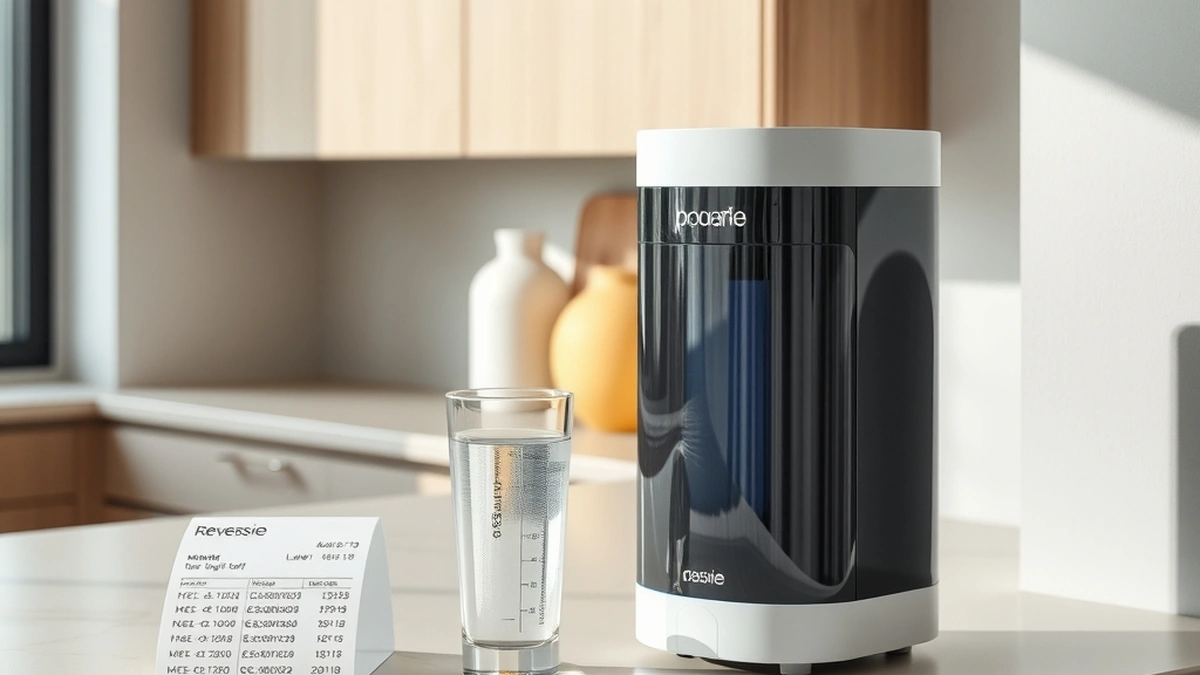
A countertop water distiller costs $150 - $500 and uses about 0.5 - 1 kWh per gallon, which is $0.08 - $0.20 per gallon at 15 cents per kWh. A household drinking a gallon a day spends $30 - $75 a year on electricity.
- Unit price
- $150 - $500
- Power per gallon
- 0.5 - 1 kWh
- Cost per gallon
- $0.08 - $0.20
- Annual electricity
- $30 - $75
- Ten-year total
- $500 - $1,300
Some links on this page are affiliate links.If you buy through them we may earn a commission at no extra cost to you. We do not accept payment for rankings. Read the full disclosure.
A countertop water distiller costs $150 - $500 and uses about 0.5 - 1 kWh per gallon. At 15 cents per kWh, that is $0.08 - $0.20 per gallon, or $30 - $75 a year for a household drinking a gallon a day.
The Unit Price
A basic 1-gallon countertop distiller sells for $150 - $250. It has a boiling chamber, a condenser coil, and a collection carafe.
A larger or faster unit sells for $250 - $400. It may produce 2 - 4 gallons a day and include a carbon postfilter.
A stainless unit with a glass carafe and a timer sells for $400 - $500. The materials last longer and the timer reduces the chance of boiling dry.
There is no installation cost. The unit sits on a counter and plugs into a standard outlet.
Electricity Is the Real Cost
Distillation boils water, and boiling takes energy. A unit producing a gallon uses roughly 0.5 - 1 kWh, depending on insulation and condenser design.
At 15 cents per kWh, a gallon costs $0.08 - $0.20 in electricity. A household using a gallon a day spends $29 - $73 a year.
Compare that with a reverse osmosis system at $60 - $150 a year in filters. RO is cheaper to run in most markets, and distillation’s advantage is removal breadth rather than cost.
A $250 unit producing 1 gallon a day for five years makes 1,825 gallons.
Electricity at $0.14 per gallon is $256. Cleaning supplies at $20 a year are $100. Total five-year cost: $250 + $256 + $100 = $606, or $0.33 per gallon.
Bottled water at $1 per liter is $3.79 per gallon. The distiller is roughly one-tenth the cost.
Cleaning and Consumables
Mineral scale builds in the boiling chamber. Cleaning every few batches with vinegar or citric acid is the routine, and a neglected chamber loses efficiency and eventually fails.
A carbon postfilter, where fitted, costs $10 - $30 and changes every 1 - 3 months. That adds $40 - $120 a year.
Cleaning supplies run $15 - $40 a year. A spare carafe or gasket costs $15 - $40 when it breaks.
Cost Table
| Item | Cost | Interval |
|---|---|---|
| Unit | $150 - $500 | Once |
| Electricity | $0.08 - $0.20 per gallon | Continuous |
| Carbon postfilter | $10 - $30 | 1 - 3 months |
| Cleaning supplies | $15 - $40 per year | Annual |
| Replacement carafe | $15 - $40 | As needed |
The table shows why the unit price is a small part of ownership. Electricity and consumables dominate over five years.
Distiller vs RO
| Feature | Distiller | Reverse osmosis |
|---|---|---|
| Upfront | $150 - $500 | $300 - $900 installed |
| Annual | $30 - $75 electricity plus filters | $60 - $150 filters |
| Water waste | Minimal | 3 - 4 gallons per gallon |
| Speed | Slow, 1 - 4 gallons a day | 50 - 100 gallons a day |
| Removal | Very broad | 80 - 95 percent TDS |
A distiller is slower and more energy-intensive. RO is faster and wastes water. Both remove dissolved solids, and the choice comes down to volume and patience.
Steps to Decide
- Estimate daily drinking and cooking volume.
- Check the local electricity rate.
- Calculate the annual electricity cost at 0.5 - 1 kWh per gallon.
- Add filter and cleaning costs.
- Compare with an RO system’s filters and water waste.
- Choose the system that matches the volume.
What the Cost Does Not Include
A whole-house softener if hardness is high, because scale in the boiling chamber is the distiller’s main maintenance burden.
A prefilter if sediment is present, because particles foul the chamber and the condenser.
A water test at $40 - $150, which should come before either system is purchased.
Distillation removes nearly all dissolved solids, including contaminants that RO may pass at low levels. For a household with a specific contaminant concern, that breadth is the reason to choose it.
It also produces no reject water, which matters in a drought or a house with a limited supply.
The tradeoff is speed and electricity, and both are predictable from the numbers above.
RO produces far more water per day, which suits a family that cooks and drinks several gallons.
It uses less electricity and no boiling, so the kitchen stays cooler and the unit runs quietly under the sink.
For most households, RO is the practical choice and distillation is a specialty tool.
Electricity at $0.14 per gallon is $256, cleaning supplies at $20 a year are $100, and the total is $250 + $256 + $100 = $606, or $0.33 per gallon. Bottled water at $1 per liter is $3.79 per gallon, so the distiller is roughly one-tenth the cost.
Distillation wins on removal breadth and on water waste. It removes nearly all dissolved solids, including contaminants that RO may pass at low levels, and it produces no reject stream. RO wins on volume, speed, and electricity, producing 50 - 100 gallons a day quietly under a sink. For most households, RO is the practical choice and distillation is a specialty tool for a specific contaminant or a limited supply.
One more cost to note is time. A 1-gallon distiller takes 3 - 5 hours per batch, so a household drinking a gallon a day is running the unit most of the day. That is not a dollar figure, but it is a reason households with high volume choose RO.
A distiller also heats the kitchen, which matters in summer, and it needs a stable counter spot near an outlet. Those practical limits rarely appear in a cost table and they decide whether the unit gets used.
For the RO comparison, see reverse osmosis vs distilled water and reverse osmosis system cost. For the distiller category, see water distiller vs reverse osmosis.
Frequently asked questions
How much does a water distiller cost?
A countertop unit costs $150-$500. There is no installation, but electricity and cleaning supplies add to the annual cost.
How much electricity does a distiller use?
Roughly 0.5-1 kWh per gallon, depending on the unit. At 15 cents per kWh, that is $0.08-$0.20 per gallon.
Is distilled water cheaper than bottled?
Yes. At $0.08-$0.20 per gallon plus the unit cost, distilled water is far cheaper than bottled water at $1-$2 per liter.
How often does a distiller need cleaning?
Every few batches, or weekly for daily use. Mineral scale builds in the boiling chamber, and cleaning vinegar is the usual remover.
Does a distiller remove minerals?
Yes. Distillation removes nearly all dissolved solids, including calcium, magnesium, and metals, along with most contaminants.
Is a distiller or RO cheaper to run?
RO is usually cheaper to run at $60-$150 a year in filters plus water waste. A distiller's electricity is the dominant cost.
Sources
Some links are affiliate links.If you buy through them we may earn a commission at no extra cost to you. We do not accept payment for rankings. Read the full disclosure.