
water distiller installation: what it involves
Water distiller installation needs no plumbing at all: 10 minutes to unpack and fill. See power draw, cost per gallon, and the cleaning routine.
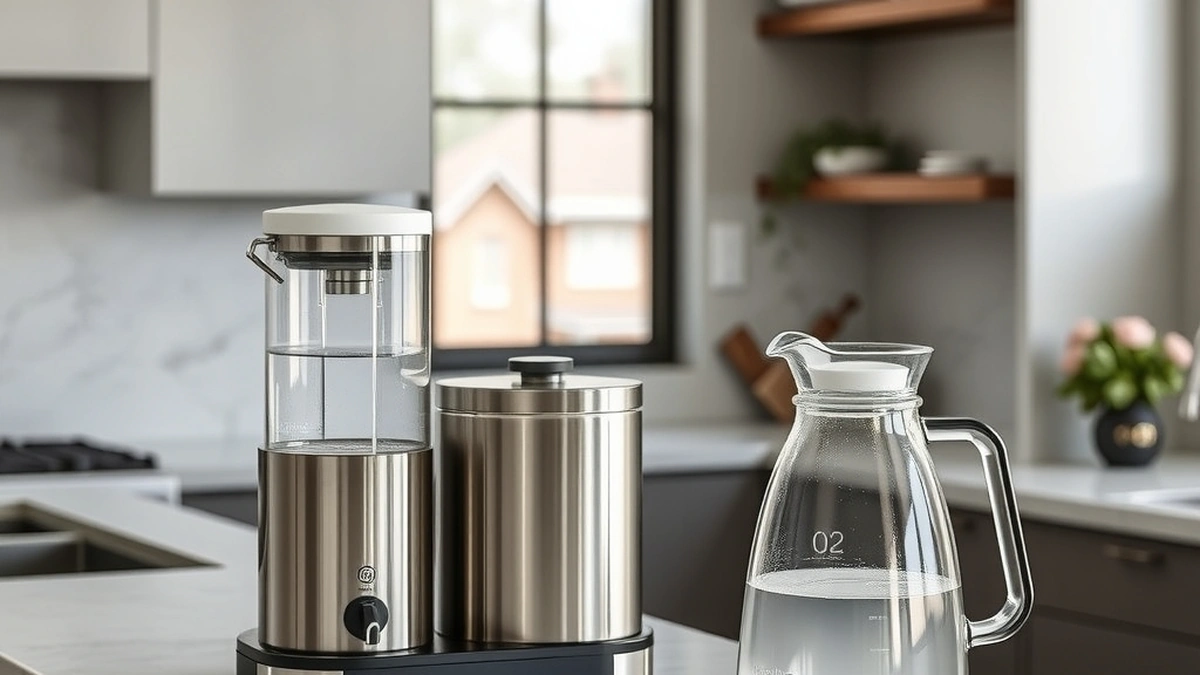
Water distiller installation needs no plumbing: 10 minutes to unpack, fill the boiler, and plug into a 120V outlet. A countertop unit costs $150-$500 and uses roughly 0.5-1 kWh per gallon, or $0.08-$0.20 in electricity.
- Setup time
- 10 minutes
- Unit cost
- $150 - $500
- Power draw
- 500 - 800 watts
- Output
- 0.75 - 1 gallon per batch
- Batch time
- 3 - 5 hours
Some links on this page are affiliate links.If you buy through them we may earn a commission at no extra cost to you. We do not accept payment for rankings. Read the full disclosure.
Water distiller installation needs no plumbing at all: 10 minutes to unpack, rinse the boiler, fill it, and plug into a 120V outlet. A countertop unit costs $150-$500 and produces about 0.75-1 gallon per batch in 3-5 hours. The installation is trivial; the electricity and cleaning are the real commitments.
What the machine does
A water distiller is a batch appliance that boils water, captures the steam, and condenses it into a separate container, leaving dissolved solids and most contaminants behind in the boiler. It is the same process as a laboratory still, scaled to a kitchen counter.
That process removes nearly everything dissolved: minerals, metals, nitrate, and most organics. It does not reliably remove volatile organic compounds with boiling points below water, which is why some units include a carbon filter on the outlet.
The hardware is simple: a stainless boiler, a heating element, a condenser coil or fan, a carafe, and a cord. No supply line, no drain, no filter housing to mount.
Setting it up
- Unpack and remove all packing from the boiler and condenser.
- Wash the boiler, carafe, and lid in warm soapy water, then rinse.
- Run one batch and discard it to remove manufacturing residue.
- Place the unit on a heat-safe counter with 6 inches of clearance on all sides.
- Plug into a grounded 120V outlet that is not shared with a high-draw appliance.
- Fill to the marked line, seat the lid, and start the cycle.
Clearance matters more than people expect. The fan exhausts warm, humid air, and a unit pushed against a cabinet wall will run hotter and slower. Keep it away from the refrigerator’s intake and out of direct sun.
Power and heat
| Spec | Typical range |
|---|---|
| Power draw | 500 - 800 watts |
| Batch time | 3 - 5 hours |
| Output per batch | 0.75 - 1 gallon |
| Energy per gallon | 0.5 - 1 kWh |
| Electricity cost per gallon | $0.08 - $0.20 |
| Counter footprint | 9 - 12 inches |
The arithmetic: 700 watts for 4 hours is 2.8 kWh, which produces about 1 gallon, so 2.8 kWh per gallon at 16 cents is $0.45. That is higher than the range above because efficiency varies; a well-designed unit with a condenser fan uses closer to 0.5-0.7 kWh per gallon.
The honest number for planning is $0.25-$0.50 per gallon including the heat the unit dumps into your kitchen. That is 10-50 times the cost of tap water, which is the trade you make for batch distillation.
Cost per gallon over a year
A household using 1 gallon per day needs 365 gallons per year. At $0.35 per gallon in electricity, that is $128 per year. Add a $15 carbon post-filter changed every 6 months ($30) and $10 in vinegar for descaling.
Total annual: $128 + $30 + $10 = $168, plus the $150-$500 purchase price in year one. Over five years a $300 unit costs $300 + ($168 × 5) = $1,140.
Compare an under-sink RO at $300-$900 installed with $60-$150 per year in filters: five-year cost of $600 + ($105 × 5) = $1,125. The two land in the same place, which is why the choice comes down to water chemistry and tolerance for batch labor.
Distiller versus reverse osmosis
A distiller removes a broader range of dissolved solids than RO, including nitrate and most metals, and it does not send a concentrate stream to the drain. An RO system rejects 80-95 percent of dissolved solids and discharges 3-4 gallons per gallon produced.
The trade is throughput and effort. RO delivers water on demand from a faucet. A distiller delivers a gallon every 4 hours and requires filling, emptying, and descaling.
For a household with a specific contaminant RO handles poorly, distillation is the stronger tool. For everyday drinking water, RO wins on convenience and cost per gallon at volume. Water distiller versus reverse osmosis covers the contaminant-by-contaminant comparison.
Cleaning, the part that decides lifespan
Scale is the enemy. Every batch leaves minerals in the boiler, and a coated element runs hotter and takes longer. Descale after every 3-5 batches with a 50/50 white vinegar and water soak for 30 minutes, then rinse.
The condenser needs attention too. A dusty fan and a scaled coil cut output noticeably. Wipe the fan intake monthly and check that the carafe seal is intact; a leaking seal loses steam and wastes a batch.
Replace the carbon post-filter every 6 months if the unit has one. That filter is what catches volatile compounds the boiling step did not separate.
Where it falls short
Output is capped by batch size and time. A family using 2 gallons per day needs two cycles, which means planning rather than pouring.
Heat and noise are constant. A distiller runs for hours at 700 watts and makes a fan hum, which is noticeable in a small kitchen.
Taste is flat. Distilled water has almost no minerals, and most people prefer the taste of water with some. A mineral cartridge or a splash of tap water fixes it, but that is an extra step.
If you are deciding between batch and on-demand treatment, point of use versus point of entry frames the categories, and reverse osmosis system installation shows what the plumbed alternative involves.
Frequently asked questions
Does a water distiller need plumbing?
No. You fill the boiler from the tap, plug the unit in, and it produces distilled water into a carafe or bottle. There is no supply line and no drain connection.
How much electricity does a water distiller use?
Most countertop units draw 500-800 watts and run 3-5 hours per gallon, which works out to roughly 0.5-1 kWh per gallon. At 16 cents per kWh that is $0.08-$0.16.
How long does it take to distill a gallon of water?
Three to five hours for a countertop unit producing about 0.75-1 gallon per batch. Larger units with fans and better condensers finish closer to three hours.
How often does a distiller need cleaning?
After every 3-5 batches, or weekly with daily use. Mineral scale builds on the boiler bottom and reduces efficiency; a vinegar soak removes it in 30 minutes.
Can a distiller be installed under a sink?
Only a dedicated under-sink distiller, which is a different and much more expensive product with a drain and a vent. Countertop units belong on a counter near an outlet.
Does distilled water need remineralization?
Distillation removes nearly all dissolved minerals, so the water tastes flat. Many households add a mineral cartridge or blend it with tap water for taste, which is a preference rather than a requirement.
Sources
Some links are affiliate links.If you buy through them we may earn a commission at no extra cost to you. We do not accept payment for rankings. Read the full disclosure.


