water softener salt maintenance schedule
Salt maintenance is a level check every 4-6 weeks, a bridge break at each refill, and a brine tank clean yearly. See costs and the signs of trouble.
Water softener salt maintenance is a level check every four to six weeks, a crust break at each refill, and a full brine tank cleaning once a year. Salt costs $120-$400 annually and the cleaning takes about an hour.
- Level check
- Every 4 - 6 weeks
- Brine clean
- Yearly
- Annual salt cost
- $120 - $400
- Dose per regen
- 8 - 12 pounds
- Tank capacity
- 200 - 400 pounds
Some links on this page are affiliate links.If you buy through them we may earn a commission at no extra cost to you. We do not accept payment for rankings. Read the full disclosure.
Water softener salt maintenance is a level check every four to six weeks, a crust break at each refill, and a full brine tank cleaning once a year. Salt costs $120-$400 annually. The cleaning is the task people skip, and it is the one that prevents most brine failures.
Why the tank needs attention at all
Salt does not simply dissolve and disappear. It leaves behind insoluble material, and that material accumulates as sludge at the bottom of the tank.
The sludge blocks the brine pick-up, which means the valve draws weak brine and the resin never fully recharges. The tank still looks full, so the homeowner adds more salt and the problem continues.
A second failure mode is the bridge: a crust across the top of the salt with an empty space beneath. The tank looks full and draws nothing.
The maintenance calendar
| Interval | Task | Cost |
|---|---|---|
| Every 4 - 6 weeks | Check level, break crust, refill | $10 - $35 |
| Every 3 months | Confirm regeneration is running | $0 |
| Every 6 months | Test hardness at a cold tap | $0 - $15 |
| Annually | Empty, clean, and refill brine tank | $5 |
| Annually | Inspect brine line and float | $0 |
| Every 8 - 12 years | Resin rebed | $300 - $600 |
A household using 40 pounds a month spends $120-$300 per year on pellets, which sits inside the $120-$400 band depending on hardness and household size.
Checking and refilling
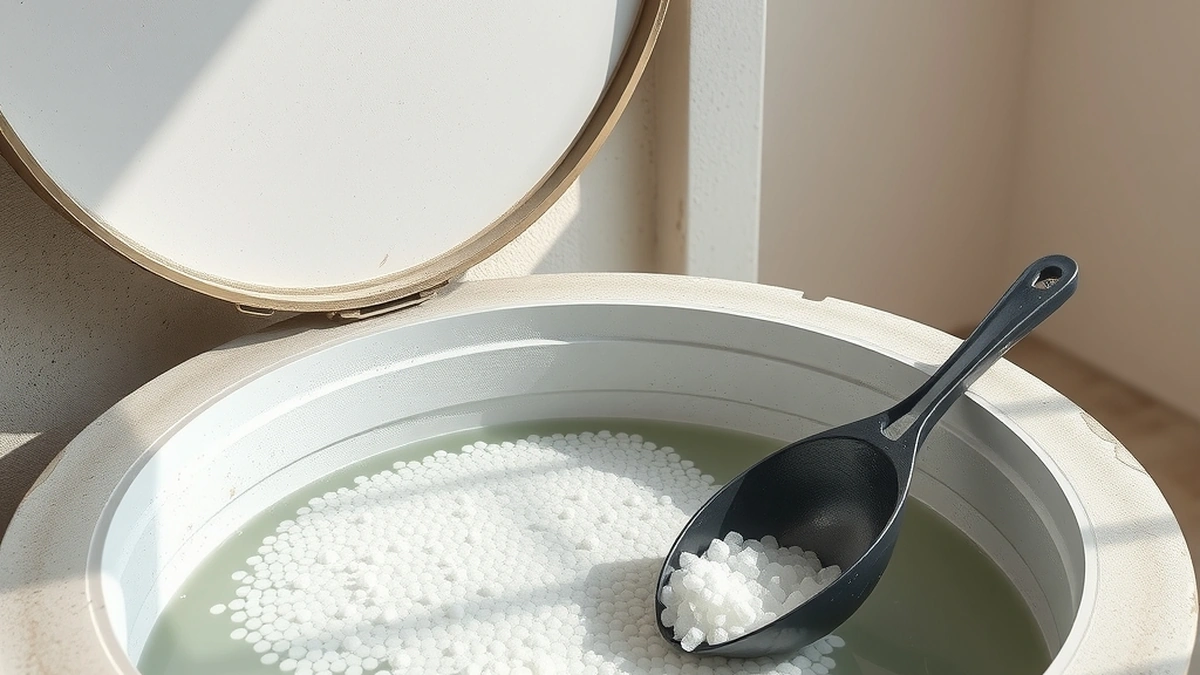
Open the lid and look. The salt should be a few inches above the water line and below the maximum mark.
If there is a crust, break it with a clean stick or a broom handle before adding salt. Pouring fresh salt on a bridge makes the bridge thicker.
Pour 40-pound bags in until the level reaches three-quarters. Keep salt away from the brine well and the float assembly.
Close the lid and note the date. A date on the bag or the calendar turns a vague sense of “it’s been a while” into a schedule.
Breaking a bridge properly
Push the stick down through the crust until it reaches the water. If it drops easily, there was a void and the bridge was real.
Run a manual regeneration after breaking it. The resin has been running on weak brine, and one cycle restores capacity.
If bridging recurs every few months, the room is too humid or the salt type is wrong. Pellets bridge less than solar salt in damp basements.
The annual cleaning
Empty the tank. A wet-dry vacuum makes this a 15-minute job instead of an hour with a scoop.
Scoop out the sludge at the bottom and scrub the walls with warm water and a little dish soap. Rinse until the water runs clear.
Check the brine well and the float while the tank is empty. The float should move freely, and the brine line should be clear.
Refill with fresh pellets and run a manual regeneration. That confirms the system draws brine after reassembly.
Salt choice and cost
Pellets at $8-$15 per 40 pounds are the default. Solar salt at $6-$12 works but leaves more residue. Rock salt at $5-$10 clogs injectors and is a false economy.
Potassium chloride at $25-$45 is the alternative for sodium-sensitive households, and it costs two to three times as much per year.
Buy two spare bags rather than a pallet. Salt stored in a damp garage cakes before it is used, and caked salt is the raw material for a bridge.
When the schedule changes
A household that adds a second bathroom or a teenager who showers twice a day will use more water and more salt. Recheck the level monthly for a few months after any change.
A well with iron shortens the interval between cleanings. Iron fouls the resin and the brine tank sludge turns rust-colored.
A softener that suddenly uses twice the salt has a programming or brine problem, not a maintenance problem. Softener regenerating every night covers the likely causes.
Warning signs between cleanings
Salt use that doubles without a change in household size. Hard water returning before the next regeneration. A brine tank that stays full. Slight sulfur or rotten-egg smell from the brine tank.
Any of those warrant opening the tank and looking, rather than waiting for the annual date.
A refill routine worth copying
Four steps, in this order, every time you open the tank.
- Break the crust across the surface before adding anything.
- Look at the water line and confirm the salt is above it.
- Pour bags in until the level reaches three-quarters.
- Note the date and the number of bags on the calendar.
The fourth step is the one that turns maintenance into data. Twelve bags a year is a normal household; six bags a year on the same water means the valve is regenerating less often than it should, and eighteen means the opposite. Either is worth knowing before the water turns hard.
If the tank is in a garage, check it after the first cold snap. Salt dissolves more slowly in cold water, and a tank that was fine in October can bridge in January.
Cost over five years
Sixty bags of pellets at $11 is $660. Cleaning supplies at $10 per year is $50. One resin rebed at $450 in year ten is outside this window.
Total: $710 over five years, or $142 per year, which is the honest cost of keeping a softener fed and clean.
For the salt buying decision, how to choose water softener salt compares grades, and water softener salt cost covers the arithmetic in more detail. “”
Frequently asked questions
How often should I check the salt level?
Every four to six weeks for most households. A family of four regenerating weekly uses about 40 pounds a month, so a monthly check keeps the tank ahead of demand.
How full should the brine tank be?
Three-quarters full at most, and always below the manufacturer's maximum mark. An overfilled tank compacts and bridges under its own weight.
How do I clean a brine tank?
Empty the salt, scoop out the sludge, scrub the walls with a mild solution, rinse, and refill. Once a year is enough unless the water carries iron.
What causes a salt bridge?
High humidity, overfilling, and impure salt. A crust forms across the top while the space beneath empties, so the tank looks full but draws nothing.
Should I use salt pellets or solar salt?
Pellets for most valves because they dissolve cleanly. Solar salt is cheaper and works but leaves more sludge, so it needs the annual cleaning more.
How much does salt maintenance cost per year?
One hundred twenty to four hundred dollars in salt, plus a few dollars for cleaning supplies. Labor is free if you do it, or $100-$200 for a service visit.
Sources
Some links are affiliate links.If you buy through them we may earn a commission at no extra cost to you. We do not accept payment for rankings. Read the full disclosure.