water test kit maintenance schedule
Test kit maintenance is calibration quarterly, strips replaced yearly, and reagents checked for expiry. See the schedule and how to keep results valid.
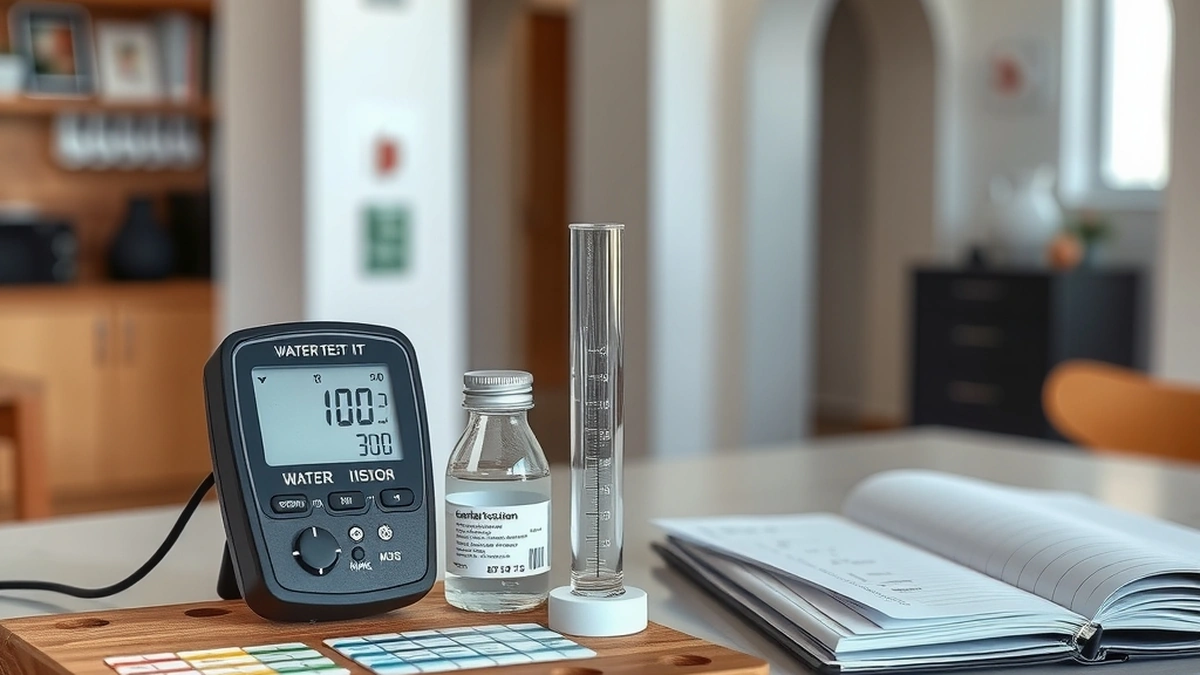
Water test kit maintenance is meter calibration every 3 months, strips replaced once a year or at expiry, reagents stored dry and dark, and a fresh lab panel every 2-3 years. Most kits need $20-$60 a year to stay accurate.
- Meter calibration
- Every 3 months
- Strip replacement
- Annually
- Reagent check
- Each use
- Lab panel
- Every 2 - 3 years
- Annual cost
- $20 - $60
Some links on this page are affiliate links.If you buy through them we may earn a commission at no extra cost to you. We do not accept payment for rankings. Read the full disclosure.
Water test kit maintenance is meter calibration every three months, strips replaced once a year or at expiry, reagents stored dry and dark, and a fresh lab panel every two to three years. Keeping a kit accurate costs $20-$60 a year, which is cheap next to sizing equipment on a bad reading.
Why a kit needs maintenance at all
A water test kit is a measuring instrument, and instruments drift. A pH meter’s electrode ages, a TDS probe collects film, strips absorb humidity, and drop-count reagents degrade in heat.
The failure mode is quiet. A kit that reads hardness two grains low does not announce itself; it just produces a softer number, and the softener you buy is undersized by a size.
That is the argument for treating the kit like the equipment it is measuring. Calibration and storage are the two levers, and both take minutes.
The maintenance calendar
| Interval | Task | Cost |
|---|---|---|
| Before each use | Check reagent dates and strip container seal | $0 |
| Every 3 months | Calibrate pH meter with fresh buffer | $5 - $15 |
| Every 3 months | Clean TDS probe with distilled water | $0 |
| Annually | Replace strips, retire opened reagents | $15 - $40 |
| Every 2-3 years | Replace pH electrode or meter | $30 - $120 |
| Every 2-3 years | Full lab panel for comparison | $40 - $150 |
A household that tests quarterly and runs a lab panel every three years spends about $40 per year on average. That is the cost of knowing what the equipment is actually seeing.
Calibrating a meter
- Let the buffer solutions and the meter reach room temperature.
- Rinse the electrode with distilled water and blot it dry.
- Dip into pH 7 buffer, stir gently, and adjust to 7.00.
- Rinse, dip into pH 4 or 10 buffer, and adjust the slope.
- Rinse again and store the electrode wet in storage solution.
Never store a pH electrode dry. A dry electrode drifts for hours after rehydration, and repeated drying shortens its life to months.
For a TDS meter, calibration is less formal: rinse the probe, check against a known standard if the meter supports it, and keep the probe free of film. A reading that jumps between samples usually means the probe needs cleaning, not that the water changed.
Storing strips and reagents
Strips belong in their original container with the desiccant, lid tight, in a cupboard rather than a bathroom. Humidity is the enemy, and a bathroom cabinet is the most humid cupboard in the house.
Do not touch the pads on the strip. Finger oils change the color reaction, and the error is not obvious on the chart.
Reagents belong out of sunlight and out of the refrigerator unless the label says otherwise. Condensation from repeated warming and cooling contaminates bottles.
Write the opening date on every bottle. A reagent opened two years ago is a reagent you cannot trust, regardless of the printed expiry.
Sampling routine that keeps results comparable
Test at the same tap, at the same time of day, with the same flush routine. A sample drawn from the kitchen cold tap after a two-minute flush is comparable to the last one; a sample from a bathroom tap after overnight sitting is not.
For wells, test raw water at a bypass tap and treated water at the kitchen tap. Label both. Mixing them up produces a number that describes neither.
Record temperature if the kit asks for it. Hardness and pH both shift with temperature, and a winter sample can read differently from a summer sample with no change in the water.
When to stop trusting the kit
A strip that reads the same color across every sample is expired or saturated. A meter that will not hold calibration needs a new electrode.
A drop-count kit where the color change happens after two drops instead of twelve has a contaminated reagent or a dirty vial. Rinse the vial with distilled water and repeat.
If two kits disagree, the lab panel settles it. That is the reason to run one every few years even when the home kit seems fine.
Cost over five years
Strips at $25 per year is $125. Buffer solution at $10 per year is $50. One replacement electrode at $60 is $60. Two lab panels at $80 is $160. Total: $395 over five years, or $79 per year.
That is less than a single unnecessary softener upgrade, and it is the difference between buying equipment sized to your water and buying equipment sized to a guess. How to read a water test report explains what each number means once you have a trustworthy one, and water testing cost covers lab pricing. “”
A log that makes the numbers useful
A single test result is a snapshot. A log turns it into a trend, and the trend is what tells you whether equipment is working.
Keep four columns: date, parameter, value, and what changed since last time. Fill it in the same way every time, and keep it with the kit rather than in a phone app you will stop opening.
Three entries are enough to spot a pattern. Hardness climbing two grains over a year on a softened supply means the resin is fading. Iron rising on a filtered supply means the bed is exhausting.
The log also settles arguments with installers. A written history of raw and treated numbers is more persuasive than a recollection that the water “used to be better.” Best water test kit compares panels if you are starting from nothing, and water test kit installation covers the sampling routine that keeps entries comparable.
Frequently asked questions
How often should a water test kit be calibrated?
Every three months for a pH or TDS meter, and before the first use of a new meter. Strips and drop-count kits are not calibrated but do expire and should be replaced annually.
How should test strips be stored?
In the sealed container they came in, away from humidity, heat, and light. A strip left in a bathroom cabinet absorbs moisture and reads low, and the error is invisible.
Do water test reagents expire?
Yes. Most drop-count reagents carry a one to two year shelf life from opening, and an expired hardness reagent can read several grains low, which undersizes a softener.
How often should a home water test be repeated?
Bacteria and nitrate annually on a private well, a full lab panel every two to three years, and a retest any time taste, color, pressure, or a fixture's behavior changes.
Why does my TDS meter read differently each time?
Temperature, probe contamination, and insufficient rinsing between samples all shift the reading. Rinse with distilled water, let the sample reach room temperature, and stir gently.
Can I trust a strip result to size a softener?
No. Strip hardness bands are wide, often 25-50 ppm, which is not precise enough to choose between a 32,000 and 48,000 grain unit. Use a lab panel or a drop-count kit.
Sources
Some links are affiliate links.If you buy through them we may earn a commission at no extra cost to you. We do not accept payment for rankings. Read the full disclosure.