
Water Wells and Pumps: How a Private System Works
A private system is a well, casing, submersible pump, pressure tank, and switch. See how each part works and what sizing decisions drive the cost.
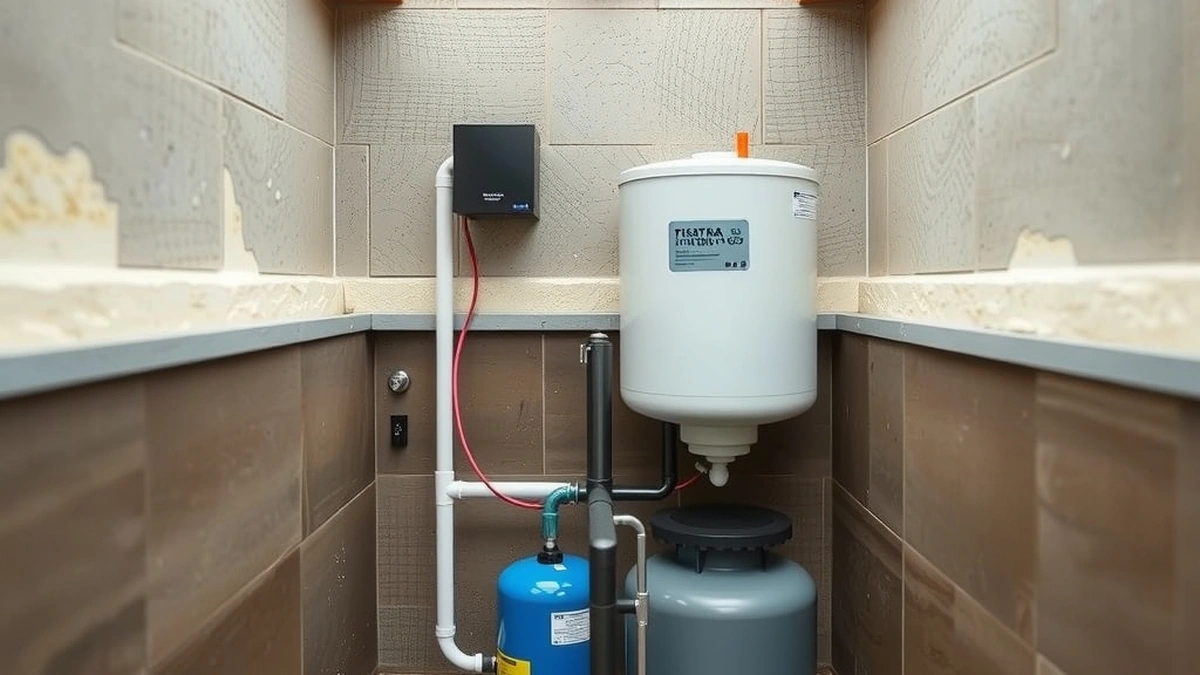
A private water system is a well, a casing, a submersible pump at the bottom, a drop pipe, a pressure tank, and a pressure switch. The pump pushes water up, the tank buffers flow, and the switch cycles the pump between set pressures.
- Typical well depth
- 100 - 500 feet
- Pump size
- 1/2 - 2 HP
- Pressure tank
- 20 - 80 gallons
- Flow target
- 8 - 15 gallons per minute
- Lab water test
- $40 - $150
Some links on this page are affiliate links.If you buy through them we may earn a commission at no extra cost to you. We do not accept payment for rankings. Read the full disclosure.
Water wells and pumps form a closed system: a borehole reaches the aquifer, a casing keeps it open, a submersible pump pushes water up a drop pipe, a pressure tank stores a buffer, and a switch cycles the pump. Depth sets the pump size, and the pump sets the tank size.
The Parts of a Private Well
A drilled well starts with a borehole, usually 6 - 8 inches in diameter, lined with steel or PVC casing. The casing extends from above grade down to the water-producing zone, and grout seals the space outside it to keep surface water out.
At the bottom, a screen or an open rock interval lets water in while holding back sand and gravel. The pump hangs below the water level on a drop pipe, with a torque arrester and a safety rope on deeper installations.
At the top, a pitless adapter carries the water line through the casing below the frost line, and a sealed cap covers the wellhead. The line runs to the house, where it meets the pressure tank, gauge, switch, and treatment equipment.
How the Pump and Tank Work Together
A submersible pump is a multistage centrifugal unit. Water enters at the bottom, passes through impellers that add pressure stage by stage, and exits into the drop pipe. A check valve at the pump outlet holds the water column when the pump stops, so the pump does not have to lift the same water twice.
The pressure tank is a steel vessel with a bladder or diaphragm. Air on one side is compressed as water enters the other. That air charge is what pushes water to the fixtures and what keeps the pump from starting every time a faucet opens.
When pressure falls to the cut-in point, the switch starts the pump. When pressure reaches cut-out, the switch stops it. The tank’s usable drawdown is the volume between those two pressures, and a tank that has lost its air charge has almost none.
Sizing Decisions
| Household demand | Pump flow | Tank size | Notes |
|---|---|---|---|
| 1 - 2 people | 5 - 8 GPM | 20 - 32 gallons | Small cabin or condo |
| 3 - 4 people | 8 - 12 GPM | 40 - 50 gallons | Standard home |
| 5+ people | 12 - 15 GPM | 60 - 80 gallons | Multiple baths |
| Irrigation added | 15 - 20 GPM | 80+ gallons | Zone the irrigation |
Flow is measured against peak demand, not average. A house with two showers, a dishwasher, and a washing machine can draw 12 - 15 GPM at once. A well that produces 5 GPM cannot meet that peak directly, and the system relies on the tank and on staggered use.
Pump horsepower follows depth and flow. A 1/2 HP pump suits a shallow well with modest demand. A 1 HP or 1.5 HP pump is typical at 200 - 400 feet. A 2 HP unit handles deep wells and high flow. Oversizing wastes energy and shortens life; undersizing leaves fixtures starved.
What the System Costs
Well drilling runs $25 - $65 per foot, so a 200-foot well is $5,000 - $13,000 before equipment. A submersible pump costs $400 - $1,500, and installation adds $500 - $1,500 for pulling, setting, and wiring.
The pressure tank runs $300 - $800, the switch $20 - $60, and the pitless adapter $100 - $250. Add the lab test at $40 - $150 and a permit at $50 - $500.
A complete 200-foot system: $9,000 drilling plus $1,800 casing and grout plus $1,000 pump plus $900 installation plus $500 tank plus $150 test plus $200 permit equals $13,550. That is an estimate for a mid-range installation, and local rock conditions move it substantially.
Water Quality and Treatment
Raw well water is not automatically clean. It can carry hardness, iron, manganese, sulfur, sediment, bacteria, nitrate, arsenic, or PFAS, and each has a different treatment.
Hardness above 7 GPG justifies a softener at $1,200 - $4,500 installed. Iron above 2 - 3 PPM needs an iron filter at $800 - $2,500 before the softener. Sulfur odor needs a sulfur filter at $1,000 - $3,000. Sediment needs a cartridge or backwashing filter. Bacteria need shock chlorination and possibly UV, with a lamp every 12 months at $30 - $90.
A whole-house filter flows 8 - 15 GPM, which should match the pump’s peak output. A filter rated below the pump flow becomes a bottleneck, and the shower pressure drops when the washing machine runs.
Maintenance Routine
- Check the pressure gauge weekly and note the cut-in and cut-out readings.
- Test the water annually for bacteria and nitrate, and every three to five years for metals.
- Inspect the wellhead cap and the ground grade each spring.
- Listen for short cycling, which signals a tank losing its air charge.
- Record pump install dates and any service calls; a pump log is worth more than memory at resale.
Do not open the well casing to look inside. The seal exists to keep contaminants out, and a cap left loose is the most common route for coliform bacteria.
Freeze protection belongs on the list in cold climates. The line from the pitless adapter to the house should run below the frost line, and any exposed pipe in a crawl space needs insulation or heat tape. A frozen line mimics a pump failure: the pump runs, the pressure gauge does not move, and no water reaches the fixtures.
Keep a written record of the pump model, the setting depth, and the install date. When the pump finally fails, that record tells the contractor what to bring and keeps the crew from pulling the pump twice.
For the control side, see water well pressure switch. For pump replacement, see submersible well water pump. For treatment selection, see well water purification system and well water treatment cost.
Frequently asked questions
How does a submersible pump get water out of the well?
The pump sits below the water level and pushes water up a drop pipe under pressure. A check valve holds the column of water when the pump stops.
What size pressure tank do I need?
Size by pump flow and drawdown. A 10 GPM pump typically pairs with a 40-80 gallon tank, and a 20 GPM pump needs more, so the pump does not cycle on every tap.
How long does a well pump last?
A submersible pump typically lasts 10-15 years, depending on water quality, cycling, and whether it runs dry. Hard water and sediment shorten life.
What is a pitless adapter?
It is a fitting that passes the water line through the casing below the frost line, so the pipe exits underground and the wellhead stays sealed.
Why does my well pump cycle so often?
Rapid cycling points to a waterlogged pressure tank, a bad check valve, or a switch set with too narrow a differential.
How many gallons per minute should a well produce?
A typical household needs 8-15 GPM at peak demand. A well producing 3-5 GPM can still work with a storage tank and a booster pump.
Sources
Some links are affiliate links.If you buy through them we may earn a commission at no extra cost to you. We do not accept payment for rankings. Read the full disclosure.


