
Submersible Well Water Pump: Sizing and Replacement
A submersible pump sits down the well and pushes water up. See how horsepower, depth, and flow are matched, plus replacement cost and failure signs.
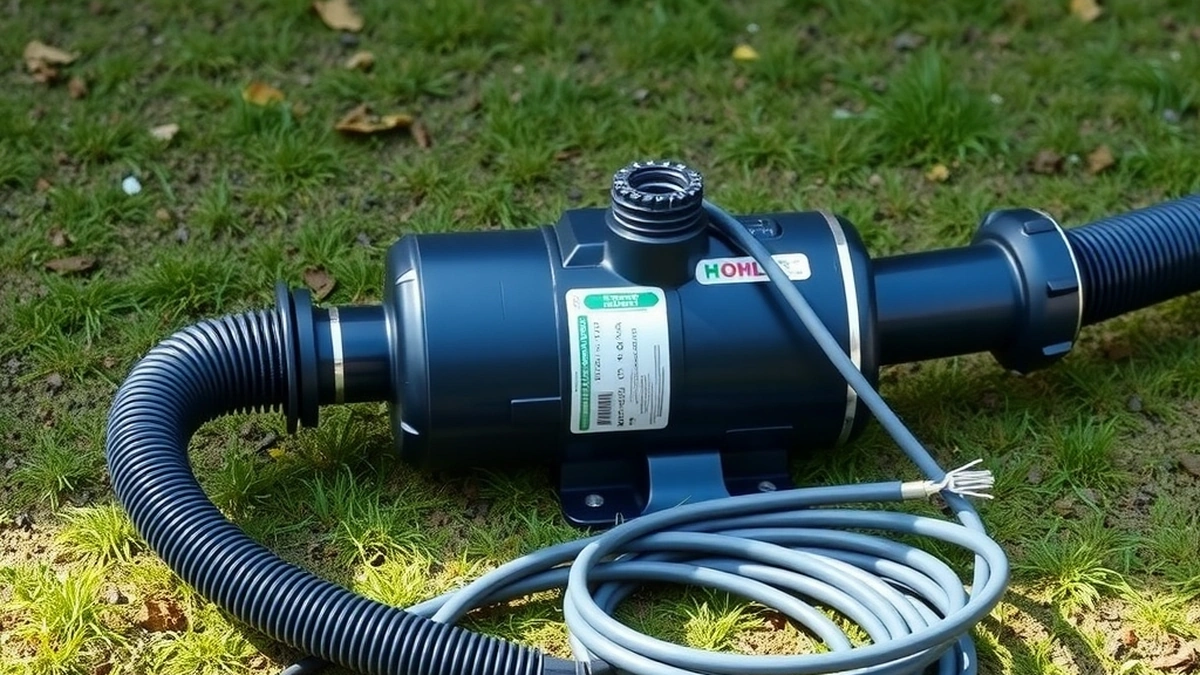
A submersible well water pump is a multistage centrifugal pump that hangs below the water line and pushes water up a drop pipe. Pumps cost $400 - $1,500, installation adds $500 - $1,500, and horsepower is matched to depth and flow, typically 1/2 to 2 HP.
- Pump price
- $400 - $1,500
- Installation
- $500 - $1,500
- Horsepower range
- 1/2 - 2 HP
- Typical life
- 10 - 15 years
- Flow target
- 8 - 15 GPM
Some links on this page are affiliate links.If you buy through them we may earn a commission at no extra cost to you. We do not accept payment for rankings. Read the full disclosure.
A submersible well water pump is a sealed multistage centrifugal pump that hangs below the water line inside the casing and pushes water up a drop pipe to the pressure tank. Pumps cost $400 - $1,500, installation adds $500 - $1,500, and the correct horsepower depends on lift and flow.
How the Pump Works
A submersible pump has a motor at the bottom and a stack of impellers above it. Each impeller adds pressure, and the number of stages determines how high the pump can push water.
Water enters through a screened intake, passes stage by stage, and exits into the drop pipe. A check valve at the outlet holds the column of water when the pump stops, so the pump does not have to re-lift it on every cycle.
The motor is oil-filled and sealed, cooled by the water around it. That is why a pump run dry overheats quickly: water is the cooling medium, and no water means no cooling.
Sizing by Depth and Flow
Pump selection starts with total dynamic head: the vertical lift from the water level, the pressure the tank requires, and the friction loss through pipe and fittings.
| Well depth | Water level | Flow needed | Typical HP |
|---|---|---|---|
| 50 - 100 ft | 30 - 60 ft | 8 - 10 GPM | 1/2 HP |
| 100 - 200 ft | 60 - 120 ft | 10 - 12 GPM | 3/4 - 1 HP |
| 200 - 350 ft | 120 - 200 ft | 10 - 15 GPM | 1 - 1.5 HP |
| 350 - 500 ft | 200 - 300 ft | 12 - 15 GPM | 1.5 - 2 HP |
The static water level matters more than the drilled depth. A 300-foot well with water at 40 feet is an easier lift than a 150-foot well with water at 120 feet, and the pump is sized to the water level, not the hole.
Flow is set by peak demand. A house with two bathrooms, a dishwasher, and a washing machine can draw 12 - 15 GPM. A well that produces only 5 GPM needs a storage tank and a booster pump rather than a larger submersible.
What Replacement Costs
| Item | Cost |
|---|---|
| Pump, 1/2 - 1 HP | $400 - $900 |
| Pump, 1.5 - 2 HP | $800 - $1,500 |
| Pull and reset labor | $500 - $1,500 |
| Drop pipe and fittings | $100 - $400 |
| Torque arrester and rope | $50 - $150 |
| Pressure switch | $20 - $60 |
| Tank, if replaced | $300 - $800 |
A typical replacement with a 1 HP pump: $700 pump plus $900 labor plus $200 drop pipe plus $80 accessories plus $40 switch equals $1,920. Add a tank at $500 and the total is $2,420. That is an estimate; deep wells and difficult access push toward the top of the ranges.
Signs the Pump Is Failing
The first sign is usually pressure. The shower weakens, the pump runs longer to recover, or the gauge climbs slowly. A pump that runs continuously and never reaches cut-out is losing efficiency.
The second is noise. A grinding or rumbling from the wellhead suggests bearing wear. A clicking relay at the control box suggests a failing start capacitor or overload.
The third is sediment. A sudden burst of sand or grit at the faucets can mean the pump is sitting too low or the screen has failed. Grit also destroys pump stages quickly, so it is a pull-the-pump symptom.
The fourth is electrical. A pump that trips the breaker, blows a fuse, or draws locked-rotor current is failing. Measure amp draw against the nameplate rating before assuming the pump is bad; a bad capacitor or control box can mimic a seized motor.
Replacement Sequence
- Shut off the breaker and tag it, then confirm the circuit is dead.
- Disconnect the drop pipe at the pitless adapter and attach a hoist.
- Pull the pump slowly, watching for the safety rope and the electrical cable.
- Inspect the drop pipe, cable, and check valve, and replace anything worn while access is open.
- Set the new pump at a depth that keeps it above any predicted drawdown.
- Reconnect the cable, test the insulation resistance, and run the pump through several cycles.
- Shock chlorinate the well and retest the water after the chlorine clears.
Depth setting deserves care. A pump set too high can run dry during a heavy draw; one set too low can sit in sediment. The well log and the yield test tell you where the water sits under load.
Protecting the New Pump
Frequent cycling is the main killer. A waterlogged tank, a switch with too narrow a differential, or an undersized tank makes the pump start dozens of times a day. Check the tank charge at 2 PSI below cut-in and size the tank to the pump flow.
Sediment and iron shorten life too. A prefilter ahead of the pressure tank, or an iron filter on high-iron water, keeps grit out of the pump and the fixtures.
Lightning and voltage spikes are an underrated cause of premature failure. A pump on a long drop cable with no surge protection can lose its motor windings in a single storm. A whole-house surge protector at the panel or a pump-specific device costs $100 - $300 and is cheap next to a $1,500 replacement.
Finally, keep the wellhead accessible. A pump pull needs room for a hoist and a clear path for the drop pipe, and a deck built over the casing turns a $900 job into a $2,000 one.
For the system view, see water wells and pumps and water well pressure switch. For service pricing, see water well service near me. If the water is hard, well water treatment covers the treatment side.
Frequently asked questions
How long does a submersible well pump last?
Typically 10-15 years. Hard water, sediment, and frequent cycling shorten life, while a correctly sized pump in clean water often reaches the upper end.
How much does it cost to replace a well pump?
The pump runs $400-$1,500 and installation adds $500-$1,500, for a typical total of $900-$3,000 depending on depth and horsepower.
What size pump do I need for a 200-foot well?
A 200-foot well with a 100-foot static water level and 10 GPM demand usually needs a 3/4 to 1 HP pump. The exact size depends on total lift and friction loss.
Can I replace a submersible pump myself?
It is possible but not advisable. The pump sits on a drop pipe with electrical connections, a safety rope, and a torque arrester, and a mistake can drop the assembly down the well.
Why does my pump run but deliver no water?
Check for a tripped breaker, a failed capacitor, a broken drop pipe, a stuck check valve, or a water level below the pump intake before pulling the pump.
What is the difference between 2-wire and 3-wire pumps?
A 2-wire pump has the start components built in and needs no control box. A 3-wire pump uses an external control box, which is easier to service but adds a component.
Sources
Some links are affiliate links.If you buy through them we may earn a commission at no extra cost to you. We do not accept payment for rankings. Read the full disclosure.


