
Waterdrop water filter
Waterdrop sells under-sink RO systems and fridge cartridges, often at lower prices than OEM. See the stage layout, running costs, and certification checks.
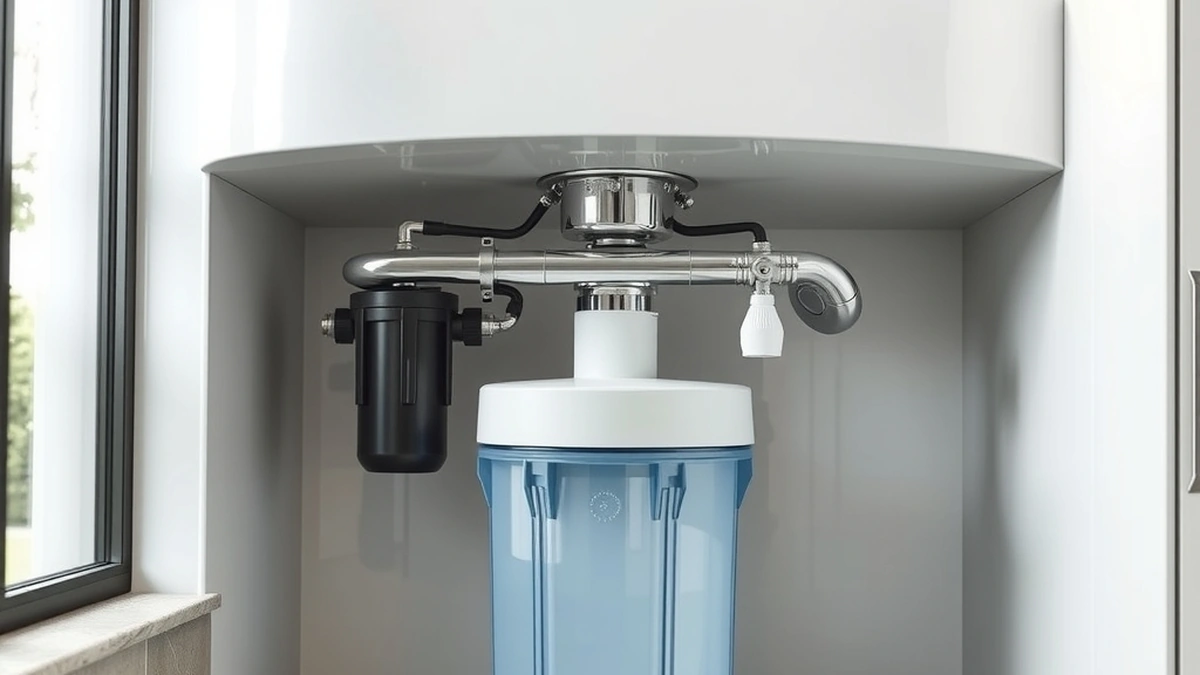
Waterdrop makes under-sink reverse osmosis systems and replacement fridge cartridges. RO units run $200 to $500 for equipment with $60 to $150 a year in filters, and their fridge cartridges compete with OEM on price if the certification lists your model.
- RO equipment
- $200 - $500
- RO installed
- $300 - $900
- Annual filters
- $60 - $150
- Fridge cartridge
- $15 - $35
- Waste ratio
- 3 - 4:1
Some links on this page are affiliate links.If you buy through them we may earn a commission at no extra cost to you. We do not accept payment for rankings. Read the full disclosure.
Waterdrop sells two things: under-sink reverse osmosis systems and replacement refrigerator cartridges. The RO units run $200 to $500 for equipment, which is below the premium brands, and the fridge cartridges compete with OEM prices. Both are worth considering if the certification lists your model.
The RO Product Range
Waterdrop’s RO line covers tank and tankless formats, with three to five stages.
Tank models. A conventional layout: sediment, carbon block, membrane, post-carbon, plus a 2 to 4 gallon pressure tank. Cheaper and simpler.
Tankless models. No storage tank, producing on demand. Smaller under the cabinet, higher price, and dependent on adequate supply pressure.
Countertop models. A self-contained unit that sits on the counter and needs no plumbing, useful for renters.
| Format | Equipment | Installed | Best for |
|---|---|---|---|
| Tank RO | $200 - $400 | $300 - $800 | Standard kitchens |
| Tankless RO | $350 - $500 | $450 - $900 | Tight cabinets |
| Countertop | $250 - $400 | DIY | Rentals |
Stage Layout and What Each Does
The stage order is the same as any RO system, and it matters more than the brand.
- Sediment pre-filter. Particles, so the membrane surface stays clean.
- Carbon block. Chlorine, which would otherwise destroy the membrane.
- RO membrane. Dissolved solids at 80 to 95 percent rejection.
- Post-carbon. Taste polish and a final catch.
- Optional fifth stage. A second carbon for chloramine or a remineralizer.
Skipping the carbon stage is not an option on a TFC membrane. Chlorine attacks the polyamide layer and the damage is permanent, which is why the pre-filter schedule is the single most important maintenance task.
Tankless models add a pump and a flow sensor, which is more to fail but removes the storage tank and the pressure loss that comes with it. On a kitchen with 28 inches of cabinet height, the tankless format is often the only one that fits.
What It Costs to Run
Filters run $60 to $150 per year, and the membrane every two to three years at $40 to $80.
| Item | Cost | Interval |
|---|---|---|
| Sediment | $8 - $20 | 3 - 6 months |
| Carbon block | $15 - $35 | 6 - 12 months |
| Post-carbon | $10 - $25 | 6 - 12 months |
| Membrane | $40 - $80 | 2 - 3 years |
Five-year arithmetic for a $350 unit with DIY install and $100 per year in filters: $350 + $500 + $60 = $910, or $182 per year. Add $350 for a plumber and it becomes $252 per year.
That is competitive with any brand using standard cartridges and cheaper than proprietary systems, which is the main argument for the brand.
The five-year number is also the right way to compare against bottled water. At 2 gallons a day, bottled water costs roughly $730 a year, so the system pays back inside the first year even with professional installation.
The Fridge Cartridges
Waterdrop also sells replacement cartridges for Samsung, GE, Frigidaire, and Whirlpool fridges at $15 to $35, below OEM prices of $40 to $70.
The question is always fit and certification. A cartridge that fits loosely lets water bypass the media, and the dispenser still runs normally, so the failure is invisible.
Look for the model number on the listing and the NSF standard number. If the listing names your fridge model and the standard, it is a legitimate substitute. If it says “compatible with” and shows no certification, it is a gamble.
Where the Brand Sits
Waterdrop competes on price against both premium RO brands and OEM fridge cartridges. It is not a premium product, and the differences show up in fittings, documentation, and support rather than in the water.
| Brand tier | RO equipment | Cartridge access | Support |
|---|---|---|---|
| Budget | $150 - $300 | Mixed | Minimal |
| Mid (Waterdrop) | $200 - $500 | Standard and proprietary | Online |
| Premium | $500 - $900 | Often proprietary | Phone and dealer |
For a DIY install on municipal water, the mid tier is a sensible place to be. For a household that wants someone to call, the premium tier is what the extra money buys.
The fittings are where the tiers differ most in practice. Standard push-fit connectors are serviceable with a $10 tool and replacement parts from any hardware store. Proprietary manifolds look tidier and become unserviceable when the manufacturer changes the model.
Five Checks Before Buying
- Confirm certification to NSF/ANSI 58 for the RO model.
- Check cartridge availability and price a year of filters.
- Measure cabinet space for the tank or tankless unit.
- Test supply pressure; below 40 psi, budget for a permeate pump.
- Read the fitting type and confirm replacements are standard push-fit.
Maintenance Reality
The system is only as good as its pre-filters. A neglected carbon block lets chlorine through and kills the membrane months early, turning a $20 part into a $60 membrane plus labor.
Change sediment every 3 to 6 months, carbon every 6 to 12, and check rejection annually with a TDS meter. Below 80 percent, the membrane is due.
If production slows but rejection is fine, the problem is hydraulic: pressure, a clogged pre-filter, or a waterlogged tank. That split saves a lot of unnecessary part swapping.
Is It the Right Purchase
It is the right purchase for a household on treated municipal water that wants low-solids drinking water at one tap without paying a premium brand price. It is the wrong purchase for well water with hardness or iron, because the membrane needs pre-treatment that the unit does not include.
If the water is hard, soften first. If iron is present, filter it first. Then the RO unit does what it is designed to do.
A membrane rated for two to three years on soft water can fail in under a year on 15 GPG water, and the replacement cost plus labor erases the savings from buying a cheaper system. Pre-treatment is not optional on a well.
For the broader buying guide, see best under-sink reverse osmosis and iSpring versus Waterdrop. For the cost breakdown, reverse osmosis system cost covers the install.
Frequently asked questions
Is Waterdrop a good brand for reverse osmosis?
It is a mid-market brand selling standard multi-stage RO systems and tankless units at prices below premium brands, with the usual trade-off in fittings and documentation.
How much does a Waterdrop RO system cost to run?
Expect $60 to $150 per year in cartridges plus a membrane every two to three years, depending on the model and the feed water quality.
Do Waterdrop fridge filters fit Samsung and GE fridges?
Some models are made for specific Samsung, GE, and Frigidaire cartridges, but fit and certification are model-specific, so check the listing for your exact fridge.
Are Waterdrop filters certified?
Many are certified to NSF/ANSI 42 and some to 53, but certification is per model; look for the standard number and the specific model on the listing.
Does a Waterdrop RO system need a drain?
Yes, all reverse osmosis systems send reject water to drain, so a drain connection or saddle drain is required.
How long do Waterdrop RO membranes last?
Two to three years on properly pre-treated water, and shorter if chlorine reaches the membrane or hardness is high.
Sources
Some links are affiliate links.If you buy through them we may earn a commission at no extra cost to you. We do not accept payment for rankings. Read the full disclosure.


