
whole house water filter installation: what it involves
Whole house filter installation takes 3-6 hours and costs $500-$1,800 installed. See the main-line cut-in, bypass, pressure check, and permit rules.
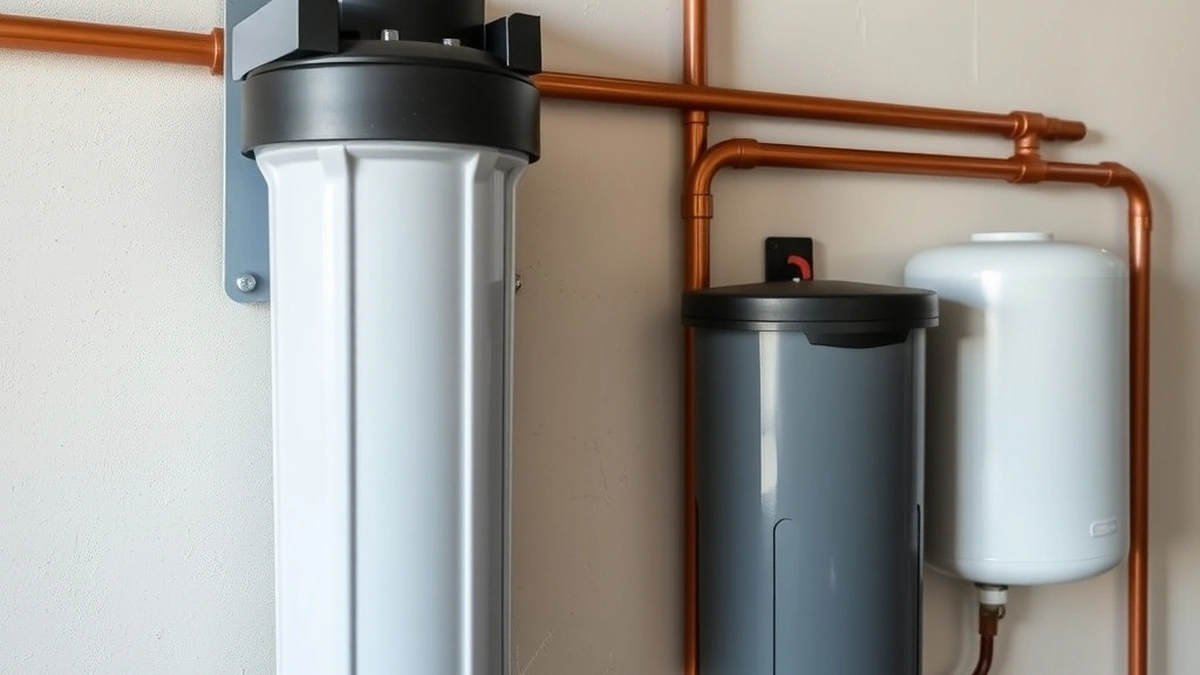
Whole house water filter installation takes 3-6 hours and costs $500-$1,800 installed. The job is a cut-in on the main line after the meter, a bypass valve, a mounting bracket, and a pressure check at the farthest fixture.
- Installed cost
- $500 - $1,800
- Labor time
- 3 - 6 hours
- Typical flow
- 8 - 15 GPM
- Pressure loss
- 3 - 8 psi
- Cartridge life
- 3 - 12 months
Some links on this page are affiliate links.If you buy through them we may earn a commission at no extra cost to you. We do not accept payment for rankings. Read the full disclosure.
Whole house water filter installation takes 3-6 hours and costs $500-$1,800 installed for a typical two-stage system. The work is a cut-in on the main line, a bypass valve, a wall bracket, and a pressure check. No drain and no electrical line are needed, which keeps the job simpler than a softener install.
What a whole house filter is
A whole house water filter is a point-of-entry device that treats every gallon entering the house, usually with sediment and carbon stages in series. It mounts on the main line after the meter or pressure tank and before the water heater, so cold and hot water both get filtered.
Because it sits on the main, installation is plumbing work rather than appliance work. The filter has to be isolated, supported, and sized so it does not starve the house at peak demand.
Flow rating is the number that matters: whole-house units commonly support 8-15 GPM. A home with two showers, a dishwasher, and a washing machine can draw 8-10 GPM at once, so a unit rated at 5 GPM will cause pressure complaints at the far bathroom.
The installation, stage by stage
| Stage | Work performed | Time |
|---|---|---|
| Shutoff and drain | Close main, open lowest faucet | 20 min |
| Cut-in | Remove pipe section, fit tees | 45 - 90 min |
| Bypass and valves | Install 3-valve bypass | 30 - 60 min |
| Bracket and housings | Anchor to wall, set housings level | 30 - 45 min |
| Connect and pressure test | Solder or press, pressurize, check | 45 - 90 min |
| Flush and label | Run 10 minutes, date cartridges | 20 min |
A 3/4-inch copper main in an unfinished basement is the four-hour case. A 1-inch PEX main in a garage with no shutoff and a water heater in the way is the seven-hour case.
What the price covers
Equipment for a two-stage 10-inch system runs $150-$450. A 20-inch two-stage system runs $250-$650. Bypass valve and fittings add $60-$150. Labor at $95-$175 per hour for 3-6 hours is $285-$1,050.
Low end: $150 + $60 + $285 = $495. High end: $650 + $150 + $1,050 = $1,850. The $500-$1,800 installed band sits right on that arithmetic, which is why it is a reliable planning figure.
Ongoing cost is cartridges. Carbon cartridges cost $80-$300 per year and are changed every 6-12 months; sediment cartridges are changed every 3-6 months and cost $10-$30 each.
Sediment first, carbon second
Order matters. A sediment cartridge ahead of carbon catches rust, sand, and pipe debris that would otherwise blind the carbon block in weeks. Reversing the order is the single most common installation error, and it shows up as a $40 carbon cartridge failing in two months.
Put a 5-micron sediment cartridge first if the water carries visible particles, and a 20-micron if the load is heavy enough to clog quickly. Then carbon at 5 microns or below for taste, odor, and chlorine.
If the water is from a well with iron or sulfur, carbon alone will not solve it. Iron above 2-3 ppm coats media and shortens cartridge life. Iron in well water explains the treatment order, and sediment in well water covers the pre-filtration side.
Two-stage versus three-stage
A two-stage system (sediment plus carbon) handles most municipal water and lightly loaded wells. It costs $500-$1,200 installed and uses two cartridges per change.
A three-stage system adds a second carbon block or a specialty media for lead, PFAS, or chloramine. It costs $900-$1,800 installed and adds $60-$150 per year in cartridges. The extra stage is worth it when a lab report names a specific contaminant the first carbon stage cannot hold at the flow rate.
A four-stage system with a softener cartridge is a different product and a different price band. If hardness is the problem, a dedicated softener at $1,200-$4,500 installed is the correct tool, and the whole house filter versus softener comparison explains why.
Pressure, the number people ignore
Every filter costs pressure. A clean two-stage system drops 3-8 psi. A loaded sediment cartridge can drop 15-20 psi, which shows up as weak shower pressure and a dishwasher that never quite fills.
Install a $15-$25 pressure gauge downstream of the housing. When the reading falls 10 psi below the clean baseline, change the cartridge. That single gauge replaces guesswork and prevents most “my filter ruined my pressure” calls.
If the house already runs at 40 psi, a filter that drops 8 psi puts the far shower at 32 psi, which is marginal. A larger housing or a 1-inch body reduces the drop. Low water pressure causes covers the other explanations before you blame the filter.
Five steps before the install day
- Test the water for sediment, chlorine, iron, and hardness.
- Find the main shutoff and confirm it actually closes.
- Measure the pipe size and material at the proposed location.
- Check clearance below the housings for cartridge removal, at least 10 inches.
- Ask the building department whether a permit is required for a main-line cut-in.
What changes the quote
The spread comes from four things: housing size (10-inch versus 20-inch), stage count, pipe material (copper soldering takes longer than PEX press), and access. A filter installed in a tight crawlspace can double labor.
Retrofits also reveal problems. Galvanized pipe that crumbles when cut adds a re-pipe section. A main with no shutoff adds a valve install at $150-$350. A water heater directly in the path adds a reroute.
Budget the middle of the range, keep $200 in reserve for what the wall reveals, and the job usually lands inside $500-$1,800. For the filter-change rhythm afterward, whole house filter change sets the interval by cartridge type.
Frequently asked questions
Where does a whole house filter get installed?
On the main water line after the meter or pressure tank and before the water heater, ideally in a basement, garage, or utility closet with a shutoff nearby.
How long does whole house filter installation take?
Three to six hours for a single-cartridge or two-stage system on an accessible main. A three-stage system with a softener adds another two hours.
Do I need a permit for a whole house water filter?
Many jurisdictions do not require one for an appliance on an existing line, but cutting and rerouting the main can trigger a plumbing permit. Ask the local building department before scheduling.
Will a whole house filter reduce water pressure?
A clean filter typically drops 3-8 psi. A clogged cartridge can drop 15 psi or more, which is why a pressure gauge before and after the housing is worth the $20.
Can a whole house filter be installed on a well system?
Yes, and it is common. Install it after the pressure tank and before the softener, with a sediment stage first to protect the carbon cartridge.
What size filter housing fits a house?
A 10-inch or 20-inch housing in a 4.5-inch diameter is typical. The 20-inch housing costs $60-$120 more but roughly doubles cartridge life and lowers pressure loss.
Sources
Some links are affiliate links.If you buy through them we may earn a commission at no extra cost to you. We do not accept payment for rankings. Read the full disclosure.


