
countertop reverse osmosis installation: what it involves
Countertop RO installation takes 10 minutes and needs no plumbing, no drain, and no tools. See power, placement, flush, and daily refill requirements.
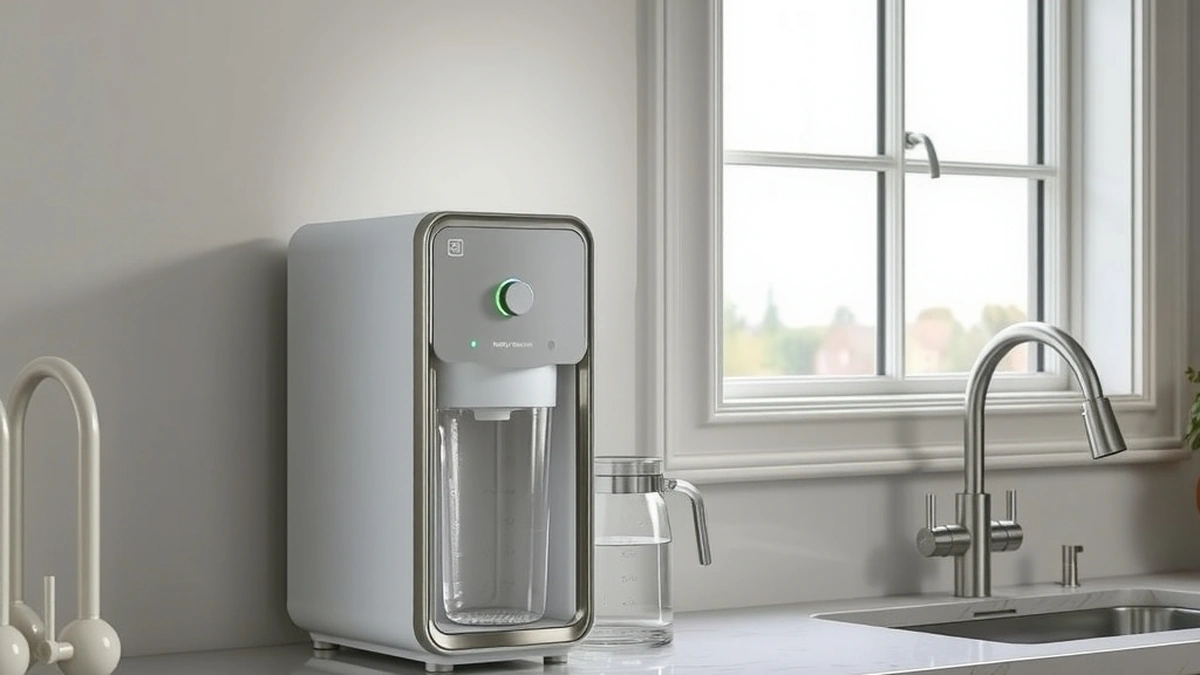
Countertop reverse osmosis installation takes 10-15 minutes and needs no plumbing. You set the unit on the counter, fill the reservoir from the tap, plug it in, and run two or three flush cycles before the first glass.
- Setup time
- 10 - 15 minutes
- Plumbing required
- None
- Power required
- Standard 120V outlet
- Reservoir size
- 1 - 2.5 gallons
- Unit cost
- $200 - $600
Some links on this page are affiliate links.If you buy through them we may earn a commission at no extra cost to you. We do not accept payment for rankings. Read the full disclosure.
Countertop reverse osmosis installation takes 10-15 minutes and involves no plumbing at all. You rinse the reservoir, set the unit on the counter, plug it in, and run two or three flush cycles. There is no supply tee, no drain saddle, and no faucet hole to drill.
What makes this install different
A countertop reverse osmosis system is a self-contained point-of-use unit that draws from a fill reservoir instead of a plumbed supply line. Water passes through sediment and carbon stages, then the membrane, and collects in a pitcher or internal tank.
Because it is not connected to the plumbing, the entire installation is setup: unbox, rinse, place, plug in, flush. The tradeoff is manual labor forever after, since every gallon has to be carried to the reservoir.
That trade is the whole decision. A renter who cannot drill a counter and a homeowner who does not want another under-sink appliance are the two buyers for this format.
Setup, in order
- Remove the reservoir, pitcher, and any packing from the membrane housing.
- Wash the reservoir and pitcher with warm soapy water, then rinse thoroughly.
- Seat the membrane and cartridges per the manual; most ship installed but need the membrane’s protective cap removed.
- Place the unit on a level counter with 2-3 inches of rear clearance and access to a 120V outlet.
- Fill the reservoir to the marked line with tap water.
- Run two or three full cycles and discard the water, then fill once more for drinking.
The first flush matters. New carbon cartridges shed fine dust, and a membrane that has been dry-shipped needs to hydrate. Discarding the first 2-3 batches is standard and is not a defect.
Space, power, and placement
| Requirement | Detail |
|---|---|
| Counter footprint | 10 - 14 inches wide, 12 - 16 inches deep |
| Height | 14 - 18 inches, plus lid clearance |
| Power | Standard 120V grounded outlet |
| Reservoir | 1 - 2.5 gallons |
| Clearance | 2 - 3 inches behind for airflow |
| Weight full | 20 - 30 pounds |
Placement rules are simple. Keep it out of direct sunlight, since a translucent reservoir in a sunny window grows algae within weeks. Keep it away from the stove, because heat degrades the membrane and the plastic. Keep it on a stable surface, because a unit that vibrates off the counter is a warranty claim waiting to happen.
Check the overhead cabinet before buying. Most units have a lid that lifts straight up and needs 8-10 inches of clearance. A deep upper cabinet over a shallow counter can make a 17-inch unit unusable.
Countertop versus under sink
| Factor | Countertop RO | Under-sink RO |
|---|---|---|
| Install time | 10 - 15 minutes | 1 - 3 hours |
| Plumbing | None | Supply, drain, faucet |
| Cost | $200 - $600 | $300 - $900 installed |
| Output | 1 - 3 gallons per fill | 50 - 100 GPD on demand |
| Rental friendly | Yes | No |
| Manual labor | Refill daily | None |
An under-sink system at $300-$900 installed produces water continuously and needs no refilling. A countertop unit at $200-$600 costs less up front and about the same per year in filters, but it caps daily output at whatever the reservoir holds.
For a household using 3-5 gallons of drinking water per day, a countertop unit means two or three refills and two or three waits. That is the real cost, and it is measured in minutes rather than dollars.
The waste ratio in a bucket
Countertop units use the same membranes as under-sink models, so the waste ratio is still 3-4:1. A 1-gallon reservoir therefore yields about 0.75 gallons of permeate and sends roughly 2.5-3 gallons to the drain, except that in a countertop unit the concentrate often goes back into the reservoir loop or into a second chamber rather than a drain.
Some units recirculate concentrate to boost recovery, which reduces waste but concentrates minerals in the feed water and shortens membrane life. Read the manual for the actual recovery figure rather than assuming.
If you are hauling water because the tap is questionable, the arithmetic changes. A family using 4 gallons per day at a 3:1 ratio needs 16 gallons of feed water carried and poured weekly. That is a real chore, and it is why most countertop buyers use the unit for drinking only.
Daily rhythm and filter life
The membrane lasts 2-3 years and costs $40-$80. Sediment and carbon cartridges last 6-12 months at $30-$90 per set. Cleaning the reservoir weekly with a mild vinegar solution keeps biofilm from forming, which is the most common reason a countertop unit starts tasting off.
Descale the heating or chiller element if the unit has one, following the manual’s interval. Hard water at 7-10 grains per gallon will scale any heated surface faster than soft water.
If the unit sits unused for more than a week, empty and dry the reservoir. Standing water in a warm kitchen is the ideal environment for the pink biofilm that shows up in bathroom fixtures too; pink slime in the bathroom covers the same organism in a different room.
Where it falls short
Output is the first limit. A countertop unit cannot supply a whole-house demand, a humidifier, or an ice maker plumbed to a line. It fills a glass and a pot.
Counter space is the second. A 12-inch-wide unit on a 24-inch counter is half the workspace gone, and it does not move easily once filled.
Temperature is the third. Most units produce water at room temperature, and chilled models cost $100-$200 more and use more power.
For the plumbed alternative, under sink water filter installation covers the 30-90 minute job, and tankless reverse osmosis installation explains the middle path: no tank, but still plumbed. If you are still choosing a format, how to choose a countertop reverse osmosis compares recovery rates and reservoir designs directly.
Frequently asked questions
Does a countertop RO need plumbing?
No. You fill the reservoir by hand from the kitchen tap, and the unit processes it into a separate pitcher or tank. There is no supply line, no drain line, and no faucet to install.
How long does countertop RO setup take?
About 10-15 minutes including unboxing, rinsing the reservoir, and running the first flush cycles. There is nothing to drill, cut, or plumb.
Where should a countertop RO unit sit?
On a flat, stable counter within reach of an outlet and away from direct heat. Leave 2-3 inches behind it for airflow, and keep it out of direct sunlight to limit algae growth in the reservoir.
How much counter space does a countertop RO take?
Most units are 10-14 inches wide and 14-18 inches tall, roughly the footprint of a coffee maker. Check overhead cabinet clearance before buying, since the lid usually lifts straight up.
How often do you refill a countertop RO reservoir?
Once or twice a day for a two-person household using it for drinking and cooking. A 1-gallon reservoir yields roughly 0.7-0.8 gallons of permeate at a 3-4:1 waste ratio.
Can you install a countertop RO in a rental?
Yes. Nothing is permanent, no holes are drilled, and the unit lifts off the counter when you move. That is the main reason renters choose this format over under-sink systems.
Sources
Some links are affiliate links.If you buy through them we may earn a commission at no extra cost to you. We do not accept payment for rankings. Read the full disclosure.


