
Do Water Softeners Filter Water? No, and Here Is Why
A softener removes calcium and magnesium, not sediment, chlorine, or microbes. See what passes through and which filter handles each contaminant.
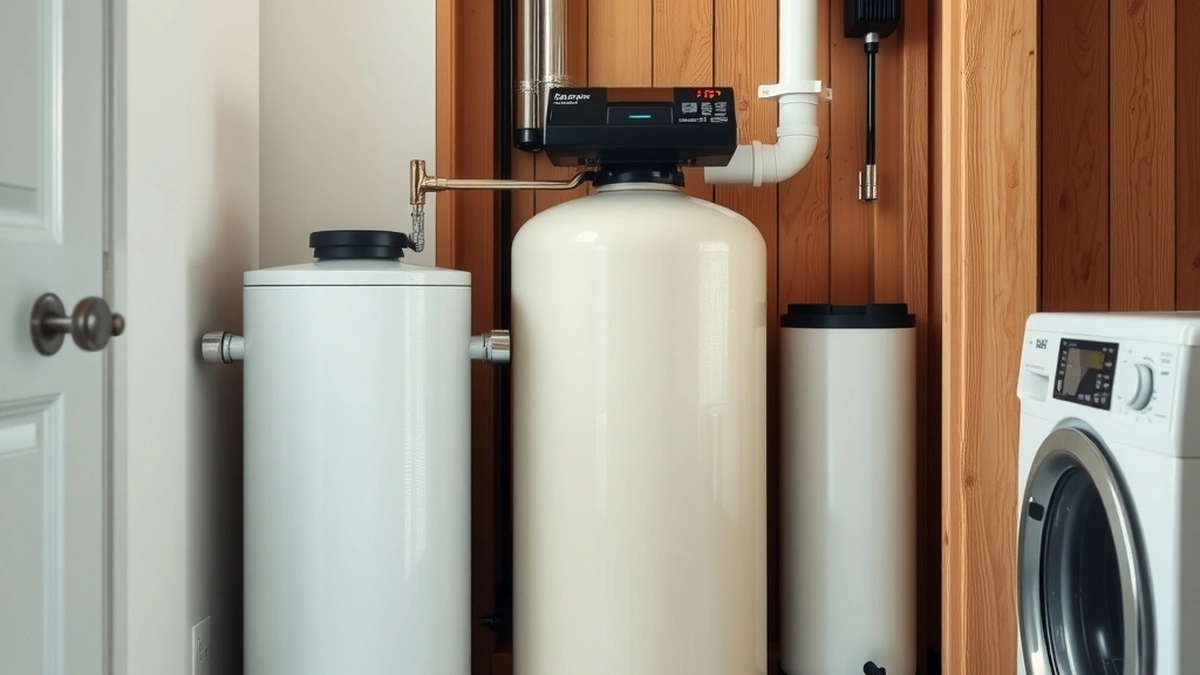
Water softeners do not filter water. They remove dissolved calcium and magnesium through ion exchange and leave sediment, chlorine, nitrate, arsenic, lead, and bacteria in the water. Filtration and softening are separate stages that are often installed together.
- Removes hardness
- Yes
- Removes sediment
- No
- Removes chlorine
- No
- Removes nitrate
- No
- Softener installed
- $1,200 - $4,500
Some links on this page are affiliate links.If you buy through them we may earn a commission at no extra cost to you. We do not accept payment for rankings. Read the full disclosure.
Water softeners do not filter water. They remove dissolved calcium and magnesium through ion exchange, swapping them for sodium, and everything else in the water passes through. That includes sediment, chlorine, nitrate, arsenic, lead, and bacteria.
Softening Is Not Filtration
Filtration removes particles or adsorbs chemicals. A sediment filter catches grit, a carbon block adsorbs chlorine and organics, and a membrane rejects dissolved solids. Those are physical and chemical removal processes.
Softening is an exchange. The resin does not trap calcium and magnesium; it trades sodium for them. The total dissolved solids in the water barely change, and nothing is physically filtered out.
That is why a softener can make water feel slippery and lather well while leaving nitrate untouched. The two outcomes are unrelated.
What Passes Straight Through
| Contaminant | Softener effect | What handles it |
|---|---|---|
| Sediment | None | Sediment prefilter |
| Chlorine | None | Carbon filter |
| Nitrate | None | Reverse osmosis |
| Arsenic | None | Adsorptive media or RO |
| Lead | None | RO or certified filter |
| Bacteria | None | Disinfection and UV |
| PFAS | None | Activated carbon or RO |
| Iron | Partial, to 2 - 3 PPM | Iron filter |
| Hardness | Removed | Softener |
The iron line is the only partial one. Resin does capture some dissolved iron, but the capacity is limited and the beads foul above 2 - 3 PPM.
Every other row needs its own stage. A softener sold as a complete water treatment solution is a softener plus a story.
Why the Confusion Exists
Softener marketing uses words like “clean,” “pure,” and “filtered,” and the equipment sits next to filters in the same aisle. The plumbing looks similar: a tank, a valve, and a drain.
The confusion also comes from the visible result. Soft water spots less, lathers better, and leaves the shower feeling cleaner. Those effects feel like filtration even though they are chemistry.
The test that settles it is a lab panel. Compare the before and after for hardness: it drops. Compare nitrate, arsenic, or lead: they do not.
What a Softener Does Remove
It removes calcium and magnesium, which is the definition of hardness. It also removes a limited amount of dissolved iron and manganese, and it can reduce some metals through the same exchange mechanism.
It does not remove the sodium that replaces them. Softened water has slightly more sodium than the source, which is why sodium-restricted households sometimes keep an unsoftened tap.
It also removes the conditions that make soap fail. That is a real benefit, and it is not filtration.
Building a Treatment Train
- Test the raw water for hardness, iron, nitrate, arsenic, lead, and bacteria.
- Install a sediment prefilter to protect everything downstream.
- Add iron or sulfur treatment if the test shows those contaminants.
- Add the softener for hardness.
- Add carbon for chlorine, taste, and odor.
- Add UV if bacteria are a concern, after the water is clear.
- Add point-of-use RO for nitrate, arsenic, lead, or high TDS.
The order is not arbitrary. Sediment protects carbon and resin, iron treatment protects the softener, and UV needs clear water to work.
Costs of the Two Categories
A softener costs $600 - $2,500 for equipment, $500 - $1,500 for installation, and $1,200 - $4,500 installed. Salt runs $120 - $400 a year.
A whole-house carbon filter costs $500 - $1,800 installed, with cartridges at $80 - $300 a year. Sediment cartridges run $5 - $20 and change every 3 - 6 months.
An under-sink RO costs $300 - $900 installed, with $60 - $150 a year in filters. It treats one tap, which is usually enough for drinking water.
What to Ask a Seller
Ask what the system removes, specifically, by contaminant and by test standard. A softener should be listed to NSF/ANSI 44; a carbon filter to 42 or 53; an RO system to 58.
Ask for the removal claim in writing with the model number. “Removes contaminants” is not a claim; “reduces lead by X percent per NSF/ANSI 53” is.
Ask whether the quote includes a prefilter. A softener installed without one on sediment-heavy water will channel and foul, and the warranty may not cover it.
What This Means for Well Owners
A private well is the case where the distinction matters most. Well water can carry hardness, iron, sulfur, sediment, bacteria, nitrate, and arsenic at the same time, and a softener addresses one of those.
A household that installs a softener and stops there may still be drinking water with nitrate above 10 mg/L or bacteria from a compromised casing. The water feels soft and the shower is clean, and the safety problem is invisible.
That is why the annual bacteria and nitrate test matters more than the hardness test. Hardness is a comfort and equipment issue; bacteria and nitrate are the parameters that decide whether the water is safe.
The treatment train follows the test. A softener is one stage, and on a well it is rarely the first one installed.
Softened water contains sodium, chloride, and everything else the source water carried. If the source has 8 mg/L nitrate, the softened water has roughly 8 mg/L nitrate.
That surprises people who assume the softener “cleans” the water. It does not, and the sodium it adds is the only meaningful change beyond hardness.
For drinking water, a point-of-use RO unit at $300 - $900 installed removes nitrate, arsenic, lead, and most dissolved solids. That is the stage that makes softened well water suitable for the kitchen tap.
If the complaint is scale, soap, or stiff laundry, think softening. If the complaint is taste, odor, staining, or a lab result, think filtration and treatment.
Most households with both kinds of complaint need both kinds of equipment. That is normal, and it is why treatment trains exist rather than single boxes.
For the mechanism, see how does a water softener work. For the filter side, see water softener vs water filter and whole house water filter cost. For contaminant-specific treatment, see iron in water treatment.
Frequently asked questions
Does a water softener filter out contaminants?
No. It exchanges calcium and magnesium for sodium and does not remove sediment, chlorine, nitrate, arsenic, lead, or microorganisms.
What is the difference between softening and filtering?
Softening is an ion-exchange process that targets dissolved hardness minerals. Filtration physically removes particles or adsorbs chemicals through a medium.
Do I need a filter if I have a softener?
Often yes. A carbon filter for chlorine and taste or a sediment prefilter is commonly installed with a softener, and specific contaminants need their own stages.
Does a softener remove iron?
Partly, up to about 2-3 PPM. Above that, resin fouls and an iron filter is needed ahead of the softener.
Can a softener remove lead?
No. Lead needs reverse osmosis, an adsorptive media, or a certified filter. Softening does not remove it.
Will a softener make well water safe to drink?
No. Safety depends on bacteria, nitrate, arsenic, and other contaminants that a softener does not address. Test the water and treat each parameter.
Sources
Some links are affiliate links.If you buy through them we may earn a commission at no extra cost to you. We do not accept payment for rankings. Read the full disclosure.


