How to choose a whole house water filter
Choose a whole house filter by contaminant and peak flow, then stage count. See micron ratings, GPM sizing, and the $500-$1,800 installed range.
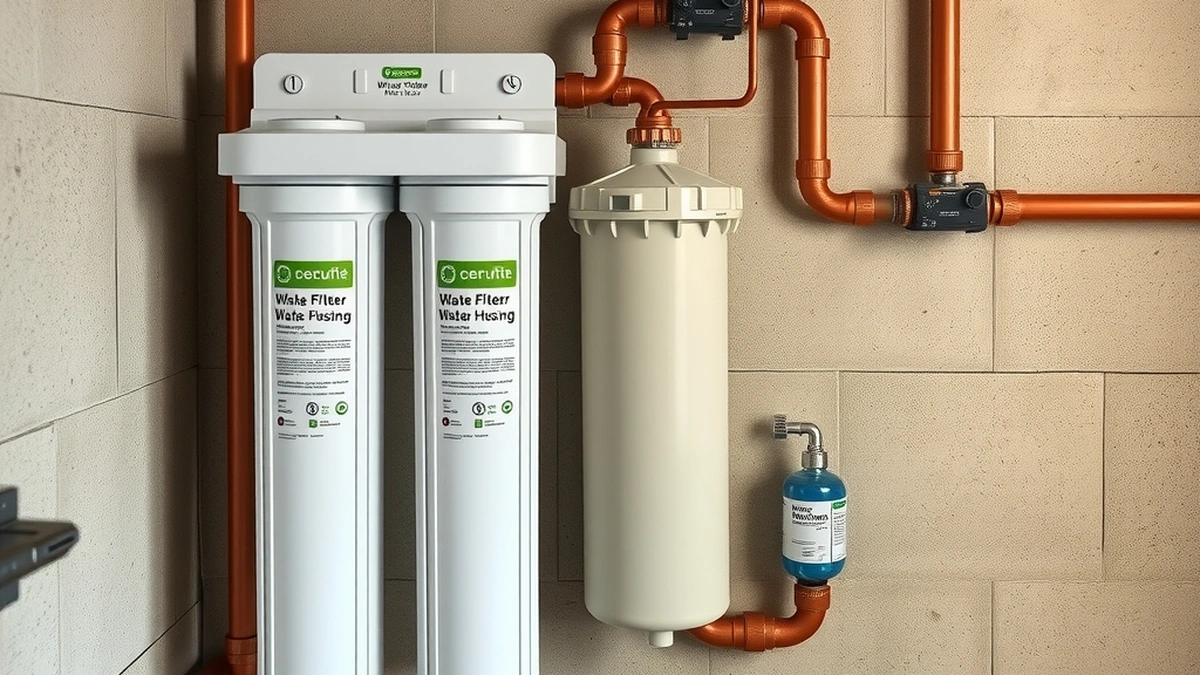
Choose a whole house water filter by first identifying the contaminant from a lab test, then sizing to 8-15 GPM of peak household flow. Two stages handle most municipal water; iron or sulfur needs dedicated equipment instead.
- Installed cost
- $500 - $1,800
- Typical flow
- 8 - 15 GPM
- Stages
- 2 - 3
- Pressure loss
- 3 - 8 psi
- Cartridge life
- 3 - 12 months
Some links on this page are affiliate links.If you buy through them we may earn a commission at no extra cost to you. We do not accept payment for rankings. Read the full disclosure.
Choose a whole house water filter by contaminant first, flow second, stage count third. A lab test tells you what to remove; peak flow tells you what size housing will not choke the house. Most homes land on a two-stage system at $500-$1,800 installed.
Contaminant first, always
A whole house water filter is a point-of-entry system that treats every gallon entering the house. What it treats depends on the cartridges inside, and the cartridges should be chosen from a lab report.
Sediment, chlorine, and taste are the common targets. Those are handled by a sediment stage and a carbon stage, and they cover most municipal water and lightly loaded wells.
Iron, manganese, sulfur, nitrate, arsenic, and hardness are different problems. A carbon filter does not solve any of them, and buying one for iron is the most common wasted $800 in this category.
A lab panel at $40-$150 settles it. Test raw water at a bypass tap if the house has a well, and at the kitchen cold tap if it is municipal.
Flow sizing in GPM
Flow is the number that decides housing size. Whole-house units commonly support 8-15 GPM, and a three-bathroom home can draw 8-10 GPM with two showers, a dishwasher, and laundry running.
Count the fixtures that can run at once and add 2 GPM of headroom. A home with one bathroom and two occupants peaks near 4-5 GPM; a home with three bathrooms and irrigation tied to the treated line can exceed 15.
An undersized filter drops pressure at the far fixtures, and the symptom looks like a plumbing problem rather than a filter problem. A 1-inch body or a 20-inch housing reduces the drop without changing cartridges.
Stages and what each adds
| Stages | Typical setup | Cost | Handles |
|---|---|---|---|
| 1 | Sediment only | $300 - $800 | Sand, rust, grit |
| 2 | Sediment + carbon | $500 - $1,800 | Particles, chlorine, taste |
| 3 | Sediment + 2 carbon | $900 - $1,800 | Lead, chloramine, some PFAS |
| 4 | Sediment + carbon + specialty | $1,200 - $2,500 | Named contaminant targets |
Each additional stage adds pressure drop and a cartridge to change. A third stage is worth it when a lab report names something the second cannot hold, not as a default upgrade.
Micron ratings
A 20-50 micron sediment cartridge handles heavy grit and protects downstream stages. A 5 micron cartridge is the general-purpose choice. A 1 micron cartridge is for membrane protection and clogs fast.
Put the coarser cartridge first. A 5-micron sediment stage ahead of a 5-micron carbon block catches the load that would blind the carbon in weeks.
Reversing the order is the most common installation error, and it shows up as a $40 carbon cartridge failing in two months. Sediment filter micron ratings maps particle sizes to ratings.
Housings, bypass, and pressure
A 10-inch housing is compact and cheap; a 20-inch housing costs $30-$70 more and roughly doubles cartridge life. On a well, the 20-inch is usually the better buy.
A three-valve bypass is mandatory for service. Without it, every cartridge change shuts water off to the whole house.
A pressure gauge downstream of the housing costs $15-$25 and replaces guesswork. When the reading falls 10 psi from the clean baseline, the cartridge is loaded.
When a filter is the wrong purchase
Iron above 2-3 ppm needs oxidation and filtration, not carbon. Sulfur needs a dedicated filter at $1,000-$3,000. Hardness above 7 gpg needs a softener at $1,200-$4,500.
A whole-house filter can sit ahead of those devices as pretreatment, which is a legitimate role. It cannot replace them.
If the concern is drinking water only, a point-of-use system at $60-$900 is cheaper and does a better job at the tap. Whole house versus under sink filter covers that decision.
A buying sequence
- Test the water and list the contaminants in order of concentration.
- Measure peak flow by counting simultaneous fixtures.
- Pick the stage count that addresses the list, not the catalog.
- Choose housing size based on cartridge life and pressure loss.
- Confirm drain-free placement and a working main shutoff.
- Get a quote that names cartridge models and replacement prices.
What to ignore
Ignore “removes up to 99 percent” claims without a standard number. NSF/ANSI 42 covers taste and chlorine; 53 covers lead and cysts.
Ignore systems sized in gallons per day. Flow in GPM is what matters at the main line.
Ignore lifetime housing warranties that exclude O-rings and labor, which are the parts that actually fail.
Ignore the word “purifier” on a carbon filter. A purifier implies a certified reduction claim against a specific contaminant. A filter that removes chlorine is a filter, and the difference matters when you are trying to decide how much to spend.
Ignore, too, any recommendation that starts with a stage count. Two stages with 20-inch housings often outperform four stages with 10-inch housings, because media volume and contact time do the work. Ask what is inside and how much, not how many.
For the install detail, whole house water filter installation covers the cut-in, and whole house water filter cost breaks the price bands down by stage count. If you are still deciding whether the treatment belongs at the main or the sink, point of use versus point of entry explains the coverage difference in cost terms. “”
Frequently asked questions
How many stages does a whole house filter need?
Two for most municipal water: a sediment stage and a carbon stage. A third stage is justified when a lab report names a specific contaminant the carbon cannot hold at full flow.
What flow rate should a whole house filter support?
Eight to fifteen GPM for a typical single-family home. Size for peak simultaneous demand, not average use, or the far shower will lose pressure.
How much does a whole house water filter cost installed?
Five hundred to one thousand eight hundred dollars installed, including housings, cartridges, bypass, and 3-6 hours of plumbing labor.
Will a whole house filter remove iron?
No. A sediment or carbon filter catches particles but does not remove dissolved iron. Above 2-3 ppm, an iron filter at $800-$2,500 is the correct equipment.
Do I need a water softener if I install a whole house filter?
They solve different problems. A filter handles sediment and chlorine; a softener removes hardness. If hardness is above 7 gpg, both may be needed.
Where should a whole house filter be installed?
On the main line after the meter or pressure tank and before the water heater. A basement, garage, or utility closet with a drain is ideal.
Sources
Some links are affiliate links.If you buy through them we may earn a commission at no extra cost to you. We do not accept payment for rankings. Read the full disclosure.