Ion Exchange vs Nanofiltration for Home Water Treatment
Compare ion exchange and nanofiltration systems by cost, capacity, maintenance, and best use cases for hard water and dissolved contaminants.
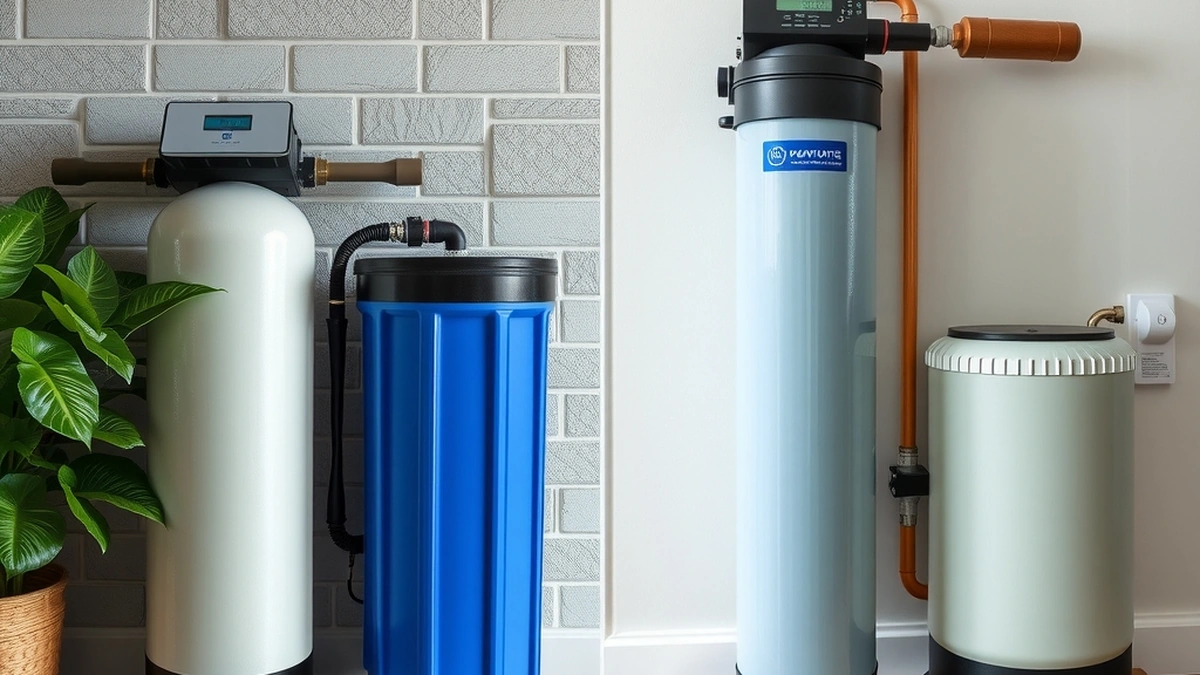
Ion exchange softens hard water by swapping calcium and magnesium for sodium; nanofiltration uses a membrane to remove hardness and some dissolved solids without adding salt.
- Best for hardness removal
- Ion exchange
- Best for dissolved organics and some salts
- Nanofiltration
- Softener installed cost
- $1,200–$4,500
- Nanofiltration typical installed cost
- Varies by system; whole-house RO $3,000–$8,000
- Ongoing cost
- Salt for ion exchange; membranes and energy for NF
Some links on this page are affiliate links.If you buy through them we may earn a commission at no extra cost to you. We do not accept payment for rankings. Read the full disclosure.
Ion exchange and nanofiltration treat different water problems through different mechanisms. Ion exchange removes hardness by swapping calcium and magnesium ions for sodium or potassium ions on a resin bed. Nanofiltration uses a semi-permeable membrane to block divalent ions and larger molecules while allowing monovalent ions and water to pass. The right choice depends on your water test results, flow requirements, and willingness to manage salt or membrane maintenance.
How Ion Exchange Works
Ion exchange is the core technology in most conventional water softeners. Hard water flows through a tank filled with resin beads charged with sodium ions. As water passes over the beads, calcium and magnesium attach to the resin and sodium is released into the water. Once the resin approaches its exchange limit, the system regenerates by flushing a concentrated salt brine through the tank, swapping the hardness minerals off the beads and down the drain.
Resin capacity is measured in grains. Common residential softeners range from 24,000 to 64,000 grains. To estimate the load on a system, multiply grains per gallon of hardness by daily water use. For example, a household using 300 gallons per day with 10 grains per gallon hardness generates 3,000 grains of hardness per day. A 32,000-grain system would theoretically reach capacity in roughly 10 days before regeneration, though actual settings vary by valve and efficiency.
Equipment costs typically run $600 to $2,500, with installation adding $500 to $1,500 for an installed range of $1,200 to $4,500. Salt costs average $120 to $400 per year, and a resin rebed costs $300 to $600. Resin life is commonly 8 to 12 years, while full system life is often 10 to 15 years. Salt use is typically 8 to 12 pounds per regeneration. For more detail on equipment pricing, see how much does a water softener cost, and for installation pricing, see water softener installation cost.
Ion exchange is effective for hardness and can handle dissolved iron up to about 2 to 3 parts per million in some softener configurations, though higher iron usually requires dedicated pretreatment. It does not remove bacteria, viruses, or most dissolved organic contaminants.
How Nanofiltration Works
Nanofiltration is a membrane process with pore sizes between reverse osmosis and ultrafiltration. It is often described as a loose reverse osmosis membrane because it rejects many divalent ions, such as calcium and magnesium, while allowing more sodium and chloride to pass than a tight RO membrane. Nanofiltration can reduce hardness, color, some dissolved organic matter, and certain contaminants, but it is not a universal treatment for every water chemistry issue.
Because nanofiltration is membrane-based, it produces a concentrate or reject stream that must be discharged. Recovery rates vary by design, and operating pressure is typically lower than reverse osmosis but higher than standard filtration. Pretreatment is often necessary to protect the membrane from scaling, fouling, or chlorine damage, depending on the feed water.
Whole-house membrane systems are less common than point-of-use reverse osmosis. Whole-house reverse osmosis installed costs are listed at $3,000 to $8,000 in the reference data, which provides a rough cost anchor for whole-house membrane treatment, though nanofiltration pricing can differ by manufacturer and flow rating. For broader whole-house filtration pricing context, see whole house water filter cost.
Cost Comparison
Direct nanofiltration pricing varies widely by system size and application, so the following comparison uses the canonical softener figures alongside the whole-house RO cost range as a membrane benchmark.
| Item | Ion Exchange Softener | Whole-House Membrane Benchmark |
|---|---|---|
| Equipment | $600–$2,500 | Not separately listed |
| Installed | $1,200–$4,500 | $3,000–$8,000 |
| Annual consumables | $120–$400 salt | Membrane and energy dependent |
| Resin/membrane life | Resin 8–12 years | Membrane dependent |
| Full system life | 10–15 years | System dependent |
Arithmetic example: If a softener costs $2,500 installed and salt runs $250 per year, the five-year cost is approximately $3,750 before any resin rebed. If a whole-house membrane system costs $5,000 installed and membrane replacement averages $500 every few years, the five-year cost could be roughly $6,000 to $6,500, excluding energy and pretreatment. These are estimates, not quotes.
For drinking-water-only membrane treatment, under-sink reverse osmosis equipment costs $200 to $600, installed costs $300 to $900, and running costs are $60 to $150 per year. More detail is available at reverse osmosis system cost. This is not a nanofiltration price, but it illustrates the cost structure of under-sink membrane systems.
When to Choose Ion Exchange
Choose ion exchange if your primary goal is hardness removal and your water test shows moderate to hard water. The hardness scale used here is: soft 0–3 grains per gallon, moderate 3–7 grains per gallon, hard 7–10 grains per gallon, and very hard 10+ grains per gallon. Ion exchange is well matched to these conditions, especially when hardness is above 7 grains per gallon.
Ion exchange is also the simpler choice when you want whole-house softened water for plumbing and appliance protection without managing a membrane reject stream. It adds sodium to the water, which may matter for people on sodium-restricted diets, though the amount depends on hardness and water consumption.
A water test is the first step. Lab testing costs $40 to $150. Test for hardness, iron, manganese, pH, and total dissolved solids before selecting equipment. If iron exceeds the softener limit of 2 to 3 parts per million, an iron filter may be needed first; installed iron filter costs are $800 to $2,500. For more, see iron filter cost.
When to Choose Nanofiltration
Choose nanofiltration if your water test shows hardness combined with dissolved organics, color, or certain divalent contaminants that a softener does not address. Nanofiltration can reduce hardness without adding sodium, which is a practical difference for households avoiding softened water for drinking or cooking.
Nanofiltration is less appropriate as a standalone solution for very hard water if the goal is complete hardness removal across the whole house. Membranes can scale when hardness is high, and pretreatment such as softening may be required ahead of the nanofiltration unit. It also does not treat microbiological contamination by itself; disinfection such as UV may still be needed. UV lamps typically require replacement every 12 months at $30 to $90 per lamp. See uv water purifier cost for context.
Nanofiltration systems require monitoring of pressure differentials, membrane cleaning, and eventual replacement. They also produce wastewater, so you need a drain connection and acceptable reject disposal.
Maintenance and Operating Differences
Ion exchange maintenance centers on salt. You must keep the brine tank filled, set regeneration frequency based on hardness and usage, and occasionally clean the brine tank. Resin eventually loses capacity and may need rebedding at $300 to $600. Salt cost is $120 to $400 per year; see water softener salt cost for more detail.
Nanofiltration maintenance centers on membrane integrity. You must replace prefilters, monitor feed pressure, clean or replace the membrane, and manage concentrate flow. Membrane life depends on feed water quality and pretreatment, so there is no universal replacement interval comparable to the 8- to 12-year resin life listed for softeners.
Both systems need a drain connection. Ion exchange discharges brine during regeneration; nanofiltration discharges concentrate continuously during operation. Neither system removes all contaminants, so post-treatment such as carbon or UV may still be appropriate depending on test results. Carbon filter systems cost $500 to $1,800 installed, with cartridges at $80 to $300 per year and replacement every 6 to 12 months. Sediment cartridges typically last 3 to 6 months.
Water Test First
Water Treatment Pro follows a test-first, equipment-second approach. Before buying a softener or nanofiltration system, get a lab test for hardness, iron, manganese, pH, total dissolved solids, and any contaminants of local concern. Lab tests cost $40 to $150. Use the results to match the technology to the water chemistry rather than relying on symptoms like scale or soap scum alone.
If you are on a private well, testing is especially important because well water quality varies by location and can change over time. For well-specific guidance, see well water treatment cost.
Frequently asked questions
What is the main difference between ion exchange and nanofiltration?
Ion exchange trades hardness minerals for sodium using resin beads, while nanofiltration pushes water through a membrane that blocks divalent ions and some larger molecules.
Does nanofiltration remove all hardness like a softener?
Nanofiltration reduces hardness but is not a direct replacement for a water softener in very hard water; performance depends on membrane rating and feed chemistry.
How often does a softener need salt?
Salt use depends on regeneration frequency and hardness; expect roughly $120 to $400 per year for salt, with 8 to 12 pounds used per regeneration.
Can nanofiltration treat well water?
Nanofiltration can treat some well water issues, but you should test for iron, manganese, and hardness first because pretreatment may be required.
Which system wastes more water?
Nanofiltration and reverse osmosis membranes produce a concentrate stream; ion exchange uses water during regeneration but does not continuously reject water like a membrane.
Where can I find local help?
Ask a licensed contractor or installer who has worked with the same system and can inspect your site.
Sources
Some links are affiliate links.If you buy through them we may earn a commission at no extra cost to you. We do not accept payment for rankings. Read the full disclosure.