
Salt Free Water Softeners: What They Do and Do Not Do
Salt-free conditioners change how hardness minerals crystallize but do not remove them. See how they work, what they cost, and when they disappoint.
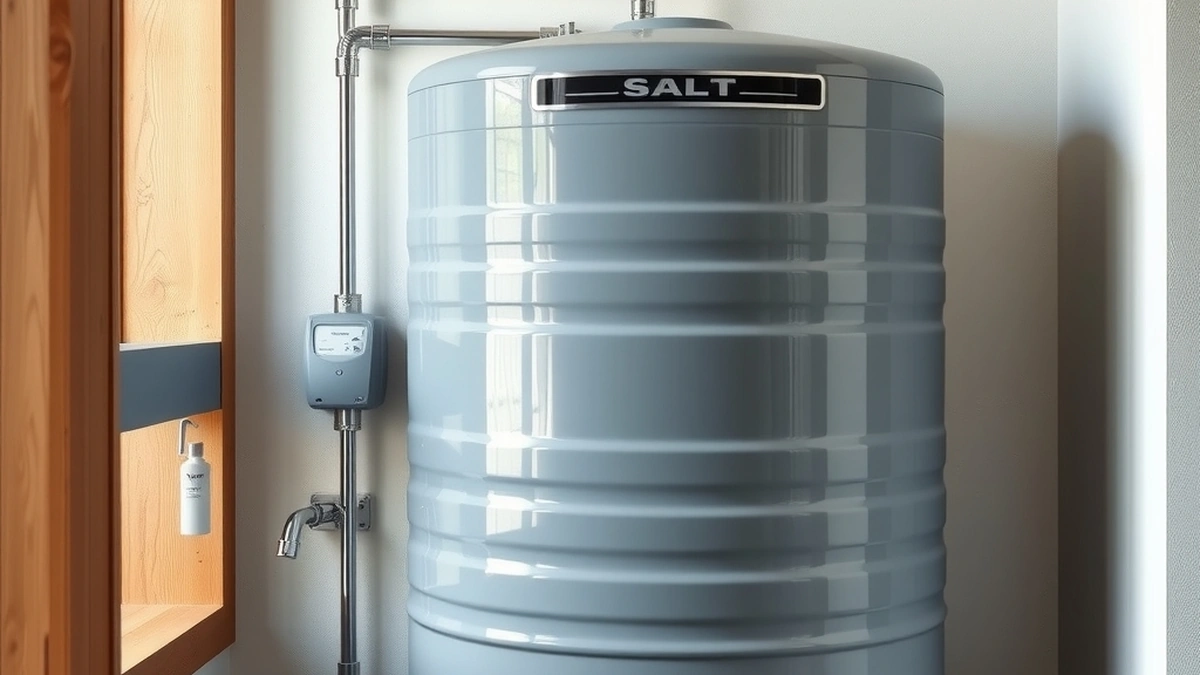
Salt-free water softeners are conditioners that change how calcium and magnesium crystallize so scale adheres less readily. They do not remove hardness, do not lower grains per gallon, and cost $500 - $1,800 installed against $1,200 - $4,500 for a true softener.
- Installed cost
- $500 - $1,800
- Removes hardness
- No
- Salt use
- None
- Wastewater
- None
- Media life
- 3 - 10 years by system
Some links on this page are affiliate links.If you buy through them we may earn a commission at no extra cost to you. We do not accept payment for rankings. Read the full disclosure.
Salt-free water softeners are water conditioners, not softeners. They change how calcium and magnesium form crystals so scale sticks less to pipes and fixtures, but they leave the minerals in the water and do not lower the grains per gallon reading. Installed cost is $500 - $1,800.
What Salt-Free Conditioning Does
The dominant salt-free technology is template assisted crystallization, usually shortened to TAC. Water passes through a bed of polymer beads that provide nucleation sites. Hardness minerals precipitate onto those sites as microscopic crystals rather than forming the jagged deposits that anchor to surfaces.
The crystals stay suspended and flow through the plumbing. Because they are already formed, they do not readily attach to pipe walls, heating elements, or glass. The water still contains the same calcium and magnesium.
That is the honest description: conditioning changes the physical form of the mineral, not the mineral content. A lab test on conditioned water reads the same hardness as the raw supply.
What It Does Not Do
A salt-free system does not remove hardness. It does not reduce the grains per gallon. It does not remove iron, manganese, nitrate, arsenic, lead, or bacteria.
It also does not produce the slippery feel of softened water. Soap lather in conditioned water is closer to hard water than to soft, because the minerals that interfere with lather are still present.
That matters for buyers who expect softener results. If the goal is spotless glass, fluffy towels, and low soap use, conditioning will disappoint. If the goal is less scale buildup inside a water heater or a tankless coil, conditioning has a reasonable track record.
It also does not remove existing scale. A water heater that has already collected two inches of deposit will not shed it because a conditioner was installed downstream. The unit prevents new deposition; it does not dissolve old rock.
Warranty and media availability deserve the same scrutiny as the price. Some conditioners use a branded media that only the original dealer stocks, which gives the dealer pricing power for a decade. Ask for the media part number and the replacement price before you buy, and check whether a third-party equivalent exists. A $900 unit with a $400 proprietary media change every four years costs more than its sticker over the equipment’s life.
The same logic applies to installation. Salt-free units are simple enough for a homeowner with basic plumbing skills, and a bypass valve is still worth the $30 - $60 it costs. Without one, every future service call means shutting off water to the whole house.
Salt-Free vs Salt-Based
| Feature | Salt-free conditioner | Ion-exchange softener |
|---|---|---|
| Removes hardness | No | Yes |
| Lowers GPG reading | No | Yes, to near zero |
| Salt use | None | $120 - $400 per year |
| Wastewater | None | Regeneration discharge |
| Electricity | Usually none | Needed for the valve |
| Installed cost | $500 - $1,800 | $1,200 - $4,500 |
| Sodium added | None | Small amount |
| Media life | 3 - 10 years | Resin 8 - 12 years |
The price gap is real but smaller than it looks once media replacement is counted. A $900 conditioner with $250 media every five years costs $1,400 over ten years. A $2,000 softener with $250 a year in salt costs $4,500 over the same period.
The softener still delivers soft water. The conditioner delivers water that scales differently. Those are different products for different priorities.
Where Salt-Free Fits
Salt-free conditioning fits three situations well. The first is a household that wants to reduce scale in a water heater or a tankless coil without adding sodium or a regeneration drain. The second is a home on a septic system where the extra brine discharge is unwelcome. The third is irrigation, where softened water’s sodium is a soil concern.
It fits poorly when the complaint is soap scum, spotting, or stiff laundry. Those are hardness symptoms, and conditioning does not address them. It also fits poorly on well water with iron, because iron fouls the media and the system loses effectiveness.
Installation and Maintenance
Installation is simpler than a softener. There is no drain, no brine tank, and usually no electrical connection, so the unit goes inline after the pressure tank or meter.
- Test the water first and confirm hardness and iron levels.
- Mount the tank on a level surface with a bypass valve.
- Connect the inlet and outlet in the direction marked on the head.
- Flush the media for several minutes before putting the house back in service.
- Record the install date and the media replacement interval.
- Retest hardness annually; the reading should not change.
Media replacement is the main service event. Depending on the system, that is every three to ten years, and the cost should be quoted before purchase. A unit with a $400 media charge every four years is more expensive than its sticker suggests.
Reading the Claims Carefully
Marketing for this category is loose. Look for language that says “prevents scale” or “conditions water” rather than “softens” or “removes hardness.” A product that claims to soften without salt and without removing minerals is using the word differently than a lab does.
Check for third-party testing. NSF/ANSI 44 covers cation exchange softeners, and a salt-free conditioner will not carry that listing because it does not perform ion exchange. Some conditioners carry separate certifications for scale prevention, and the scope of the claim matters.
Ask for the grains per gallon before and after in writing. If the seller cannot provide a test showing a reduction, the product does not soften. That is not a flaw; it is a definition.
For the direct comparison, see salt based vs salt free softener and softener vs conditioner. For pricing, see salt free water softener cost. For the full treatment decision, see how to treat hard water.
Frequently asked questions
Do salt-free softeners actually soften water?
Not by the standard definition. They condition water by altering crystal structure, but calcium and magnesium remain, so a test still reads hard.
What is template assisted crystallization?
It is a salt-free media that provides nucleation sites where hardness minerals form microscopic crystals instead of clinging scale deposits.
Will a salt-free system stop white spots on dishes?
It may reduce them, but it will not eliminate spotting in hard water. Dishwashers often still need a rinse aid or a softened feed.
Is salt-free water safe for plants and gardens?
Yes, and that is a real advantage. Because no sodium is added, conditioned water can be used for irrigation without the soil concerns of softened water.
How long does salt-free media last?
Media life varies by system, from about three years to ten or more. Replacement is the main running cost and should be priced before purchase.
Do salt-free systems remove iron?
No. Some media tolerate low iron, but they do not remove it. Iron above 0.3 PPM can foul the media and needs a dedicated iron filter.
Sources
Some links are affiliate links.If you buy through them we may earn a commission at no extra cost to you. We do not accept payment for rankings. Read the full disclosure.


