
Tankless Reverse Osmosis System: Pros, Cons, Cost
Tankless RO systems produce water on demand with no storage tank. Compare flow rates, pressure needs, cost, and when a tank still makes more sense.
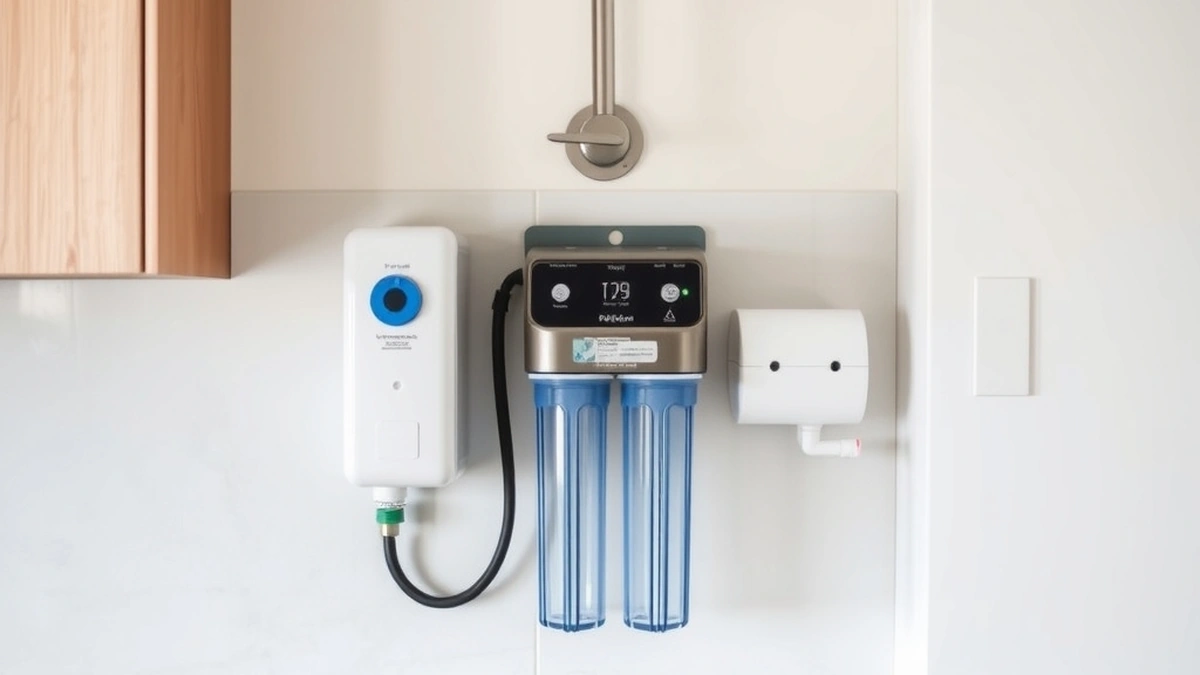
A tankless reverse osmosis system filters water on demand through a high-flow membrane instead of storing it in a pressure tank. Units cost $400 - $900, need 40 - 80 PSI supply pressure, and deliver a steady flow without the tank refill delay.
- Unit price
- $400 - $900
- Production
- 400 - 800 gallons per day
- Supply pressure needed
- 40 - 80 PSI
- Annual filter cost
- $60 - $150
- Waste ratio
- 3 - 4 gallons per gallon
Some links on this page are affiliate links.If you buy through them we may earn a commission at no extra cost to you. We do not accept payment for rankings. Read the full disclosure.
A tankless reverse osmosis system filters water on demand instead of storing it in a pressure tank. It uses a higher-flow membrane and a booster pump to deliver 0.5 - 1 gallon per minute at the faucet. Units cost $400 - $900 and need 40 - 80 PSI of supply pressure plus a nearby outlet.
What Changes Without a Tank
A conventional RO system makes water slowly and stores it in a 2 - 4 gallon pressure tank. The tank is why the faucet delivers a steady stream: you are drawing stored water, not freshly filtered water. When the tank empties, the faucet slows to a trickle until it refills.
A tankless RO removes that buffer. The membrane is larger, the pump pushes harder, and water passes through the stages as you draw it. Production ratings of 400 - 800 gallons per day translate to roughly 0.3 - 0.6 gallons per minute continuously, with peaks near 1 GPM on some units.
The tradeoff is dependence on pressure and power. A tank system can run on line pressure alone. A tankless unit needs a booster pump, which means an outlet under the sink and a unit that stops producing during a power outage.
Tank vs Tankless, Side by Side
| Feature | Tank RO | Tankless RO |
|---|---|---|
| Price | $200 - $600 | $400 - $900 |
| Installed | $300 - $900 | $500 - $1,100 |
| Storage | 2 - 4 gallon pressure tank | None |
| Flow at faucet | Steady until tank empties | 0.5 - 1 GPM continuous |
| Power needed | Usually no | Yes, booster pump |
| Cabinet space | Tank occupies floor space | Compact, wall-mounted |
| Stagnation risk | Water sits in tank | No stored water |
The stagnation point is real but often overstated. A tank that turns over daily is not a problem. A tank in a vacation home that sits for a month can develop a flat taste, which a postfilter addresses.
The space point is underrated. A pressure tank is roughly 11 inches in diameter and 15 inches tall, and it eats the floor of a kitchen cabinet. In a small kitchen or a condo, that is the difference between usable storage and none.
Pressure, Flow, and Sizing
Tankless systems are sensitive to inlet pressure. Most specify 40 - 80 PSI. Below 40 PSI, the booster pump runs continuously and production falls short of the rating. Above 80 PSI, a pressure-reducing valve protects the housings and fittings.
Measure pressure with a $15 gauge on a hose bib or a sink faucet adapter. If the house runs at 35 PSI, fix the pressure problem before buying a tankless unit, because the pump cannot compensate indefinitely.
Size by simultaneous demand. One faucet at a time needs 0.5 GPM, which nearly any tankless unit delivers. A kitchen faucet plus a refrigerator line plus a pot filler can exceed 1 GPM, and that is where a tank still wins. Most households draw from one tap at a time, so the practical difference is small.
What It Costs to Run
Purchase price is $400 - $900, against $200 - $600 for a tank system. Installation runs $500 - $1,100 installed for tankless, because the pump needs an outlet and the fittings are often proprietary.
Filters cost $60 - $150 a year on either design. Tankless membranes sometimes cost more, $60 - $150 against $40 - $120, because the element is larger. A membrane lasts 2 - 3 years in both cases.
Electricity is the new line item. A booster pump drawing 30 - 50 watts for an hour a day uses about 1 - 1.5 kWh a month, or $2 - $3 a year at 15 cents per kWh. Not a budget item, but it is a dependency.
Five-year arithmetic for a tankless unit: $650 purchase plus $500 filters plus $100 membrane plus $12 electricity equals $1,262. A tank unit at $400 plus $450 filters plus $90 membrane equals $940. The tankless premium is roughly $300 over five years, paid for space and flow.
Installation Notes
- Confirm an outlet is available under the sink, or plan to add a GFCI receptacle.
- Measure static pressure and install a regulator if it exceeds 80 PSI.
- Mount the unit on the cabinet wall with the supplied bracket, leaving clearance for cartridge removal.
- Connect the feed to the cold line with a shutoff valve, and route reject water to the drain through an air gap.
- Flush the system for 5 - 10 minutes before first use to clear carbon fines.
- Label each cartridge with the install date and log the membrane date.
The air gap matters. A direct drain connection can allow backflow into the unit, and many plumbing codes require an air gap or a check valve on the reject line. Follow the local code and the manufacturer’s diagram.
Where Tankless Makes Sense
Choose tankless when cabinet space is tight, when the faucet is used continuously through the day, when the house already has good pressure and an outlet under the sink, or when you want to avoid stored water in a home that sits empty for weeks.
Stay with a tank when the budget is tight, when there is no outlet under the sink, when supply pressure is marginal, or when the household draws from several points at once. A tank system is simpler and has fewer failure points.
For the countertop alternative, see countertop reverse osmosis. For maintenance on either design, see reverse osmosis maintenance. The direct comparison is also covered in tankless RO vs tank RO, and system pricing sits in reverse osmosis system cost.
Frequently asked questions
What does tankless mean on an RO system?
It means the system has no pressure storage tank. Water is filtered as it is drawn, using a higher-flow membrane and a booster pump rather than a reservoir.
Do tankless RO systems need electricity?
Most do. A booster pump maintains the pressure needed to push water through the membrane at flow, so the unit needs a nearby outlet.
Is tankless RO better than a tank system?
It is better for continuous flow and cabinet space. A tank system is simpler, cheaper, and does not need a pump or a power outlet.
How much water can a tankless RO deliver at once?
Typical units deliver 0.5-1 gallon per minute at the faucet, enough to fill a pitcher or a pot without the slow refill of a tank system.
What water pressure does a tankless RO require?
Most specify 40-80 PSI at the inlet. Below 40 PSI the booster pump works harder and production drops; above 80 PSI a regulator is needed.
How often do tankless RO filters change?
Prefilters every 6-12 months and the membrane every 2-3 years, similar to a tank system, though the higher-flow membrane may cost more to replace.
Sources
Some links are affiliate links.If you buy through them we may earn a commission at no extra cost to you. We do not accept payment for rankings. Read the full disclosure.


