
Water Filter and Salt Based Softener: A Combined System
A carbon filter ahead of a salt-based softener removes chlorine, taste, and hardness in one package. See why order matters and what the combination costs.
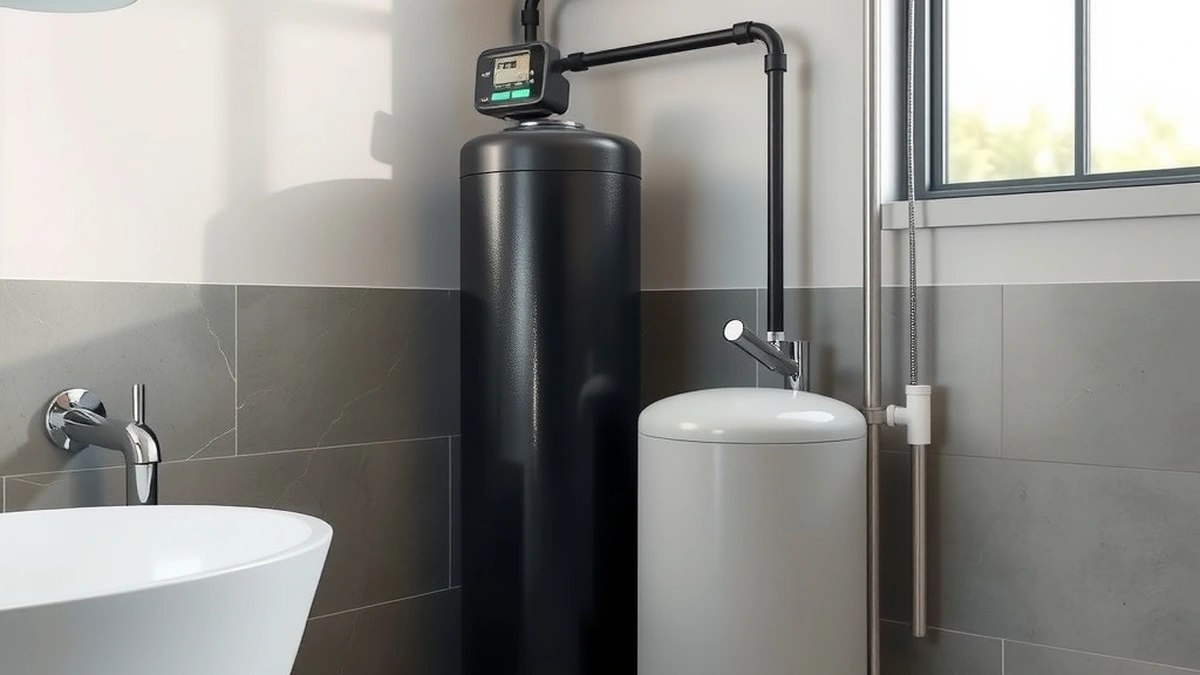
A water filter and salt-based softener system pairs a carbon filter with an ion-exchange softener. The filter goes first to remove chlorine and sediment that would degrade resin, and the pair costs $1,700 - $6,300 installed depending on capacity and flow.
- Carbon filter installed
- $500 - $1,800
- Softener installed
- $1,200 - $4,500
- Combined range
- $1,700 - $6,300
- Cartridge life
- 6 - 12 months
- Salt per year
- $120 - $400
Some links on this page are affiliate links.If you buy through them we may earn a commission at no extra cost to you. We do not accept payment for rankings. Read the full disclosure.
A water filter and salt-based softener system combines two jobs in one installation: carbon filtration for chlorine, taste, and sediment, and ion exchange for hardness. The filter goes first. That order protects the resin and decides whether the combination lasts ten years or five.
Why Combine Them
Municipal water is usually chlorinated, and chlorine attacks the polystyrene resin in a softener. Over years, the beads lose capacity and the bed compacts. A carbon filter ahead of the softener removes the chlorine before it reaches the resin.
The filter also catches sediment that would otherwise coat the bed. Grit in a resin tank causes channeling, where water finds a path through the bed instead of passing evenly, and softening performance drops.
The combination also improves taste. Softened water is not necessarily better tasting; it is simply lower in calcium and magnesium. Carbon removes the chlorine and organic notes that people actually notice in a glass.
The Correct Order
| Position | Stage | Removes | Why it is there |
|---|---|---|---|
| 1 | Sediment prefilter | Sand, rust, grit | Protects carbon and resin |
| 2 | Carbon filter | Chlorine, taste, odor | Protects resin from oxidation |
| 3 | Softener | Calcium, magnesium | Removes hardness |
| 4 | Post-carbon | Residual taste | Polishes before the tap |
Reversing the order is a common installation mistake. Carbon after the softener still removes taste, but the resin has already seen the chlorine. On chlorinated water, that shortens resin life from 8 - 12 years toward the low end.
On well water, the order changes slightly: sediment first, then iron or sulfur treatment, then carbon, then the softener. Carbon goes after iron removal because iron fouls carbon quickly.
What Each Stage Costs
A whole-house carbon filter runs $500 - $1,800 installed, with cartridges at $80 - $300 a year and replacement every 6 - 12 months. Sediment cartridges run $5 - $20 and change every 3 - 6 months.
A salt-based softener runs $1,200 - $4,500 installed, with equipment at $600 - $2,500 and installation at $500 - $1,500. Salt costs $120 - $400 a year, and a resin rebed runs $300 - $600 around years 8 - 12.
The combined installed range is $1,700 - $6,300. A realistic mid-range package: $900 carbon filter plus $2,200 softener equals $3,100 installed, plus $250 a year in cartridges and salt.
Sizing the Combination
Size the filter by flow, and the softener by grains. A whole-house filter typically flows 8 - 15 GPM, and the softener needs a service flow that matches peak demand.
A house with two bathrooms and a laundry can draw 12 - 15 GPM. A filter rated at 8 GPM becomes the bottleneck, and the shower weakens when the washing machine fills. Check both ratings, not just the price.
Softener capacity follows hardness times daily gallons. A family of four at 12 GPG using 250 gallons a day carries 3,000 grains daily and 21,000 weekly, which points to a 32,000-grain unit with reserve.
Installation Requirements
- Choose a location on the main line with room for both vessels and a bypass.
- Install the sediment prefilter first, then the carbon stage, then the softener.
- Provide a drain with an air gap for softener regeneration and filter backwash.
- Provide a grounded outlet for the softener valve and any backwashing filter.
- Set the softener hardness and capacity from the lab report, not a guess.
- Run a manual regeneration and flush the carbon before returning the house to service.
- Test hardness and chlorine downstream to confirm both stages work.
Space is the practical constraint. Two tanks plus a brine tank need roughly 4 feet by 3 feet of floor and 5 feet of height, plus clearance to service the valve and fill the brine tank.
Maintenance Over Ten Years
Carbon cartridges cost $80 - $300 a year, sediment $20 - $80, and salt $120 - $400. Add a resin rebed at $300 - $600 around year ten, and the ten-year running cost lands near $2,500 - $7,000 depending on the equipment.
That is the honest ownership picture. The equipment is the visible price; the consumables are the real one. Budget them before the install, not after the first cartridge change.
When a Combination Is the Wrong Buy
A combined filter and softener is not always the right package. If the water is municipal and lightly chlorinated, a softener alone may be enough, and the carbon stage adds $500 - $1,800 without changing the outcome much. The resin will last somewhat less, but the savings on day one are real.
If the water is hard and the household mainly objects to drinking water taste, a point-of-use reverse osmosis unit at $300 - $900 installed may be a better spend than a whole-house carbon filter. It treats the water people actually drink and leaves the rest alone.
If iron, sulfur, or bacteria are present, neither stage addresses them. Those problems need their own equipment, and a combined filter and softener package bought before testing will miss them entirely.
The safe sequence is always the same: lab report, contaminant list, stage order, then price. A package bought first and fitted to the water second is how households end up with three tanks and water that still smells.
For the filter side, see how does a whole house filter work and whole house water filter cost. For the softener side, see how does a water softener work and water softener cost. For the alternative, see salt free water softeners.
Frequently asked questions
Should the filter go before or after the softener?
The carbon filter goes before the softener. Removing chlorine and sediment first protects the resin from oxidation and fouling, which extends its life.
Does a carbon filter remove hardness?
No. Carbon removes chlorine, taste, odor, and some organics. Hardness minerals pass through and are removed by the softener's resin.
How much does a combined filter and softener cost?
A carbon filter runs $500-$1,800 installed and a softener $1,200-$4,500, so the pair typically lands at $1,700-$6,300 before any iron or UV stages.
Can I add a filter to an existing softener?
Yes. A cartridge or backwashing carbon filter can be installed upstream of an existing softener as long as there is space, a drain for backwashing, and a bypass.
How often do the carbon cartridges need changing?
Every 6-12 months for most whole-house carbon filters, or when pressure drop rises or taste returns. Sediment prefilters change every 3-6 months.
Does the combination remove iron?
No. Iron needs a dedicated iron filter ahead of both stages. Carbon will foul on high iron, and softener resin tolerates only about 2-3 PPM.
Sources
Some links are affiliate links.If you buy through them we may earn a commission at no extra cost to you. We do not accept payment for rankings. Read the full disclosure.


