
Water Filtration for a Rental Apartment: Options and Costs
Practical filtration choices for renters, including pitcher, faucet, and under-sink systems, with installed cost and maintenance numbers.
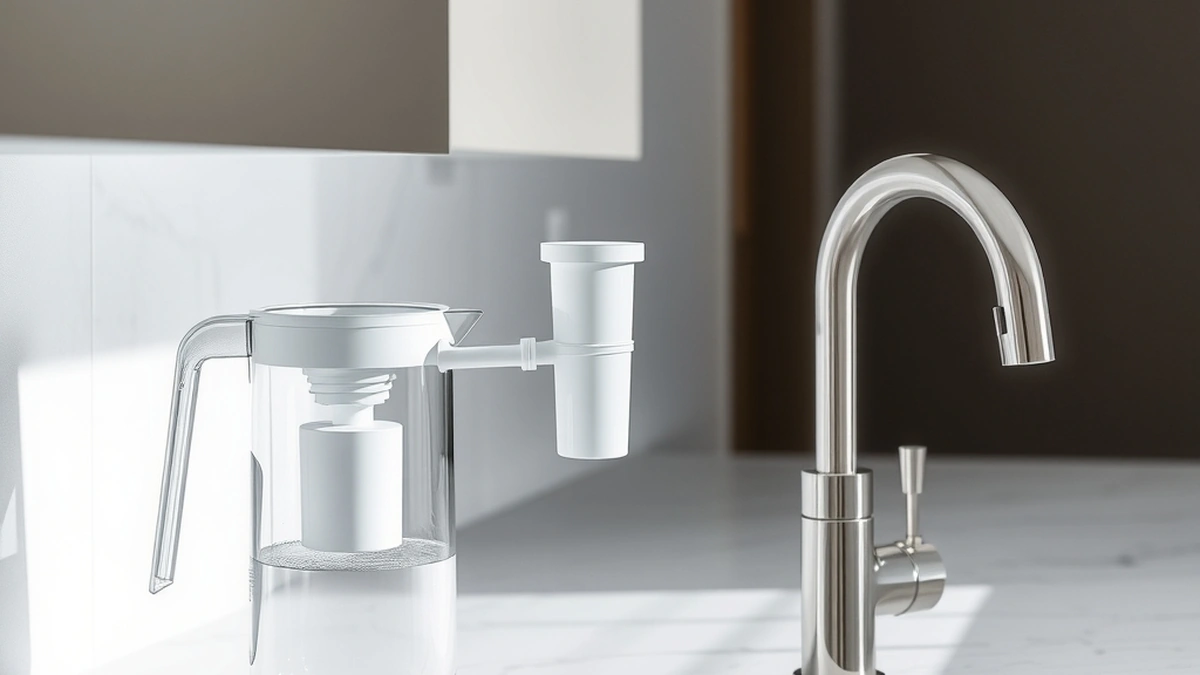
Renters should start with a lab water test, then choose non-permanent pitcher, faucet, or under-sink filtration based on results and landlord approval.
- Best first step
- Lab water test
- Renter-friendly options
- Pitcher, faucet mount, under-sink RO
- Typical installed cost
- $20–$900 depending on system
- Permanent softener
- Usually not practical in rentals
Some links on this page are affiliate links.If you buy through them we may earn a commission at no extra cost to you. We do not accept payment for rankings. Read the full disclosure.
Water filtration for a rental apartment starts with a water test, then matches the result to a system you can install without altering the property. Renters usually choose pitcher filters, faucet-mounted carbon filters, or under-sink reverse osmosis if the landlord approves plumbing changes. Whole-house softeners and permanent treatment equipment are generally impractical unless the lease allows installation and you plan to stay long enough to recover the cost.
Test Before You Buy
Water quality varies by building, neighborhood, and whether the supply comes from a municipal system or a private well. A lab test typically costs $40 to $150 and identifies hardness, iron, chlorine, and other parameters. Without results, you risk buying a carbon filter for hardness or a softener for chlorine, neither of which addresses the wrong target.
Hardness is measured in grains per gallon (GPG). Water at 0 to 3 GPG is soft, 3 to 7 GPG is moderately hard, 7 to 10 GPG is hard, and 10+ GPG is very hard. If your test shows moderate hardness and your main concern is scale on fixtures, a softener may be relevant, but in an apartment that usually means negotiating with the landlord. If the test shows chlorine taste or odor, carbon filtration is the more appropriate match.
What Renters Can Install
Rental-friendly filtration falls into two categories: no-install and minor-install. No-install options include pitcher filters and countertop models that sit on the counter and connect to the faucet with an adapter or require manual filling. Minor-install options include faucet-mounted filters that screw onto the aerator and under-sink systems that connect to the cold-water supply line and drain.
Before buying anything, review the lease. Some landlords prohibit any plumbing modification, while others allow reversible changes if the unit is restored at move-out. Even a faucet mount can be an issue if the aerator is non-standard or the landlord considers it a fixture alteration.
Pitcher and Faucet Carbon Filters
Pitcher filters are the lowest-cost entry point. Equipment typically costs $20 to $60, and replacement cartridges run roughly $80 to $300 per year depending on capacity and usage. Cartridge life is commonly rated at 6 to 12 months. For two people drinking 2 liters per day each, that is about 1,460 gallons per year, so a cartridge rated for 40 gallons would need replacement about 37 times per year if used exclusively for drinking water, which makes rated capacity and replacement cost worth checking before purchase.
Faucet-mounted carbon filters cost roughly $20 to $100 up front and use cartridges replaced on a similar 6-to-12-month schedule. They treat water at the tap for drinking and cooking but do not soften water or treat the shower, laundry, or dishwasher. These systems are best for chlorine taste, odor, and some particulate reduction, not for hardness or dissolved solids.
Under-Sink Reverse Osmosis
Under-sink reverse osmosis equipment costs $200 to $600, with installed cost typically $300 to $900 if a plumber connects the supply line, dedicated faucet, and drain saddle. Running costs are estimated at $60 to $150 per year. Membranes last about 2 to 3 years, while pre- and post-carbon cartridges follow the usual 6-to-12-month replacement cycle.
RO systems reject an estimated 80 to 95 percent of dissolved solids, depending on the contaminant and membrane condition. The waste ratio is typically 3 to 4 gallons of wastewater for every 1 gallon of product water. In an apartment, that wastewater goes to the kitchen drain, so water and sewer bills may rise slightly if you are billed by usage.
Under-sink RO requires landlord permission because it modifies the sink plumbing. If approved, it can usually be removed at move-out and the original plumbing restored. For more on equipment and installed pricing, see reverse osmosis system cost.
Why Softeners Are Usually a Poor Fit for Rentals
Conventional water softeners cost $600 to $2,500 for equipment, with installation adding $500 to $1,500, for a total installed range of $1,200 to $4,500. Salt costs $120 to $400 per year, and resin rebeds run $300 to $600 every 8 to 12 years. Softener capacity ranges from 24,000 to 64,000 grains, and salt use per regeneration is typically 8 to 12 pounds.
A softener also needs a drain connection, electrical outlet, and enough space for the brine tank and resin tank. In most apartments, that means the basement utility closet or under a kitchen sink, neither of which is typically available to a tenant. Because softeners are permanent plumbing fixtures, moving one to a new apartment is expensive and often impractical.
Salt-free conditioners cost $500 to $1,800 installed and do not use salt or regenerate, but they still require plumbing connections and are rarely suited to short-term rentals. For detailed softener pricing, see how much does a water softener cost and water softener installation cost. For salt pricing, see water softener salt cost.
Whole-House Filtration in Multi-Unit Buildings
Whole-house filters treat water at the point of entry, with flow rates commonly 8 to 15 gallons per minute. Installed costs range widely by technology: carbon whole-house systems run $500 to $1,800, iron filters $800 to $2,500, sulfur filters $1,000 to $3,000, and whole-house RO $3,000 to $8,000.
In an apartment, you generally do not control the point of entry. The main shutoff and water meter often serve multiple units or are locked in a building utility room. Installing whole-house equipment usually requires building ownership approval, not just your landlord. If you live in a single-family rental with a private well, whole-house treatment may be negotiable, but for a standard apartment it is normally off the table. For context on whole-house pricing, see whole house water filter cost.
Cost Comparison for Common Renter Options
| System | Equipment USD | Installed USD | Typical yearly running cost |
|---|---|---|---|
| Pitcher carbon | 20–60 | 20–60 | 80–300 |
| Faucet mount carbon | 20–100 | 20–100 | 80–300 |
| Under-sink RO | 200–600 | 300–900 | 60–150 |
| Salt-free conditioner | — | 500–1,800 | Varies by media |
| Conventional softener | 600–2,500 | 1,200–4,500 | 120–400 salt |
Running costs are estimates and vary with local water prices, filter ratings, and household volume. Sediment pre-filters, where used, typically need replacement every 3 to 6 months.
Moving and Maintenance Planning
Choose systems you can disconnect and move. Pitcher and faucet filters pack in a box. Under-sink RO can be uninstalled, but you should keep the original faucet hole cover and drain parts so the sink can be restored. Carbon cartridges should be replaced on schedule regardless of whether you move; old cartridges can become breeding points for bacteria and reduce flow.
If your apartment water test shows nitrate at or above 10 mg/L, standard carbon filters will not remove it. RO is one option for nitrate reduction, but in a rental you must weigh the installed cost against the lease length. UV systems treat microorganisms and require lamp replacement every 12 months at roughly $30 to $90 per lamp, but they also need electrical power and plumbing access, making them uncommon in apartments unless a specific contaminant requires it.
Start with the lab test, match the technology to the result, confirm what your lease allows, and buy only the capacity you actually need. A $30 pitcher that fixes chlorine taste is a better rental investment than a $3,000 system you cannot take with you.
Frequently asked questions
Can I install a water softener in an apartment?
Most conventional softeners require plumbing access, a drain, and space, so they are usually impractical unless the landlord approves permanent changes.
What filter works without plumbing changes?
Pitcher and faucet-mounted carbon filters require no installation beyond filling or screwing onto a standard faucet aerator.
How often do carbon cartridges need replacement?
Carbon cartridges typically need replacement every 6 to 12 months, while sediment cartridges often need replacement every 3 to 6 months.
Is under-sink reverse osmosis allowed in rentals?
It depends on the lease; under-sink RO connects to the cold-water line and drain, so written landlord approval is usually required.
How much does under-sink RO cost to run yearly?
Running costs are estimated at $60 to $150 per year, including cartridge and membrane replacement.
Should I test my apartment water before buying a filter?
Yes. A lab test identifies what is actually in the water so you buy the right filter instead of guessing.
Sources
Some links are affiliate links.If you buy through them we may earn a commission at no extra cost to you. We do not accept payment for rankings. Read the full disclosure.


