
Water filter pitcher filters
Pitcher cartridges differ in media, rated volume, and certification. See how to match a replacement to the pitcher and when a cartridge is exhausted.
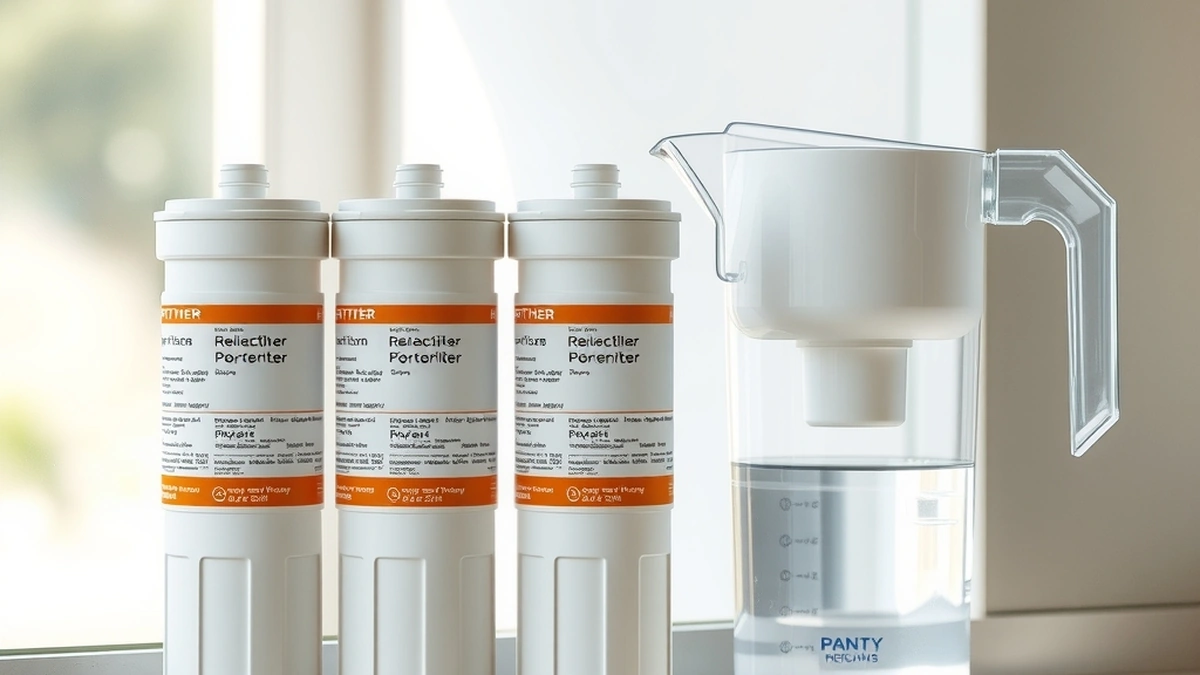
Pitcher filters are carbon cartridges, sometimes with ion exchange media, rated for about 40 gallons and costing $6 to $20. Match the cartridge to the pitcher model number, change on the rated volume, and check the certification for lead or other health claims.
- Cartridge cost
- $6 - $20
- Rated volume
- About 40 gallons
- Change interval
- 2 months average
- Certification
- NSF/ANSI 42, some 53
- Annual cost
- $60 - $180
Some links on this page are affiliate links.If you buy through them we may earn a commission at no extra cost to you. We do not accept payment for rankings. Read the full disclosure.
Pitcher filters are carbon cartridges rated for about 40 gallons and priced at $6 to $20. The two things that go wrong are buying the wrong cartridge for the pitcher and running it past its volume. Both are avoidable with the model number and a calendar.
What Is Inside
A pitcher cartridge is a small carbon block, sometimes with a layer of ion exchange resin, sealed inside a plastic housing that fits one pitcher design. Water seeps through by gravity rather than pressure, which is why the flow is slow and why the cartridge has to be small. A pressurised housing could hold ten times the media in the same footprint, and that is exactly why an under-sink filter lasts so much longer.
| Media | Removes | Typical use |
|---|---|---|
| Carbon only | Chlorine, taste, odour | Basic pitchers |
| Carbon plus ion exchange | Some metals, hardness ions at trace levels | Certified models |
| Carbon plus silver | Same, with antimicrobial claims | Long-life cartridges |
The ion exchange layer is small, measured in a few cubic centimetres rather than the cubic feet a softener holds. It handles trace lead and copper, not the calcium and magnesium load that makes water hard. A pitcher marketed as “softening” is using the word loosely, and a hardness test before and after will show the same number.
Silver-treated carbon is a separate variation. The silver inhibits bacterial growth inside the cartridge between uses, which addresses a real problem with a filter that sits wet on a counter. It does not disinfect the water passing through, and it is not a substitute for UV on a well.
Matching Cartridge to Pitcher
Cartridges are not universal. Brands key their housings, and model years change the fit.
- Read the model number inside the lid or on the base of the pitcher.
- Check the old cartridge for a part number.
- Confirm the listing names your pitcher model, not just the brand.
A cartridge that fits loosely allows water to bypass the media entirely. The pitcher still works, the water still flows, and nothing is being filtered. That is the failure mode to avoid, and it is invisible from the outside because the only symptom is water that tastes the same as the tap.
The keying is deliberate. Manufacturers change the housing shape between generations partly to control quality and partly to keep replacement sales. That is why a cartridge bought for a pitcher from five years ago may not seat in the current model with the same name, and why the model number on the base matters more than the brand on the lid.
Rated Volume and Real Life
Forty gallons is the standard rating, and it assumes average municipal water with modest chlorine.
| Water condition | Effective life |
|---|---|
| Low chlorine, soft water | 40 - 50 gallons |
| Average municipal | About 40 gallons |
| High chlorine | 25 - 35 gallons |
| Turbid or sediment-heavy | 15 - 25 gallons |
The rated number is a ceiling, not a promise. A household on heavily chlorinated water will exhaust the carbon sooner, because the media has a fixed capacity for chlorine and a higher concentration uses it faster. A household on turbid well water will blind the cartridge with particles long before the carbon is spent, which shows up as slow flow rather than bad taste.
Temperature matters too, though less than most people assume. Water straight from a cold main filters more slowly than water at room temperature, and a pitcher filled from a cold line in winter may take noticeably longer to drain through.
When It Is Spent
Three signals, in order of reliability.
Flow slows. The cartridge is loading up. This is the most reliable physical sign.
Taste returns. Chlorine breaking through means the carbon is spent.
The gallon count is reached. If you track it, this is the cleanest method.
The indicator light is usually a timer set for average use. It can lag a heavy-use household by weeks.
Cost and Frequency
At $8 to $20 per cartridge and six changes a year, the annual cost is $48 to $120. A household using 2 gallons a day needs more like nine cartridges, or $72 to $180.
| Household | Gallons/year | Cartridges | Annual cost |
|---|---|---|---|
| 1 person | 180 | 5 | $40 - $100 |
| 2 people | 365 | 9 | $72 - $180 |
| 4 people | 730 | 18 | $144 - $360 |
At four people, the pitcher stops being economical. An under-sink carbon filter at $150 to $500 installed costs $40 to $120 a year to run and delivers far more water. The crossover is roughly two people drinking a normal amount; above that, the convenience argument starts to favour a plumbed filter even for a renter who has to remove it later.
The other cost is time. Eighteen cartridge changes a year is eighteen trips to the store or eighteen online orders, and each change means flushing and refilling. That is not a large burden individually, and it is the reason pitchers get abandoned.
Five Steps to Buy
- Find the pitcher model number.
- Confirm the cartridge lists that model.
- Check the certification if you need lead reduction.
- Compare cost per gallon across cartridges.
- Buy two, so a replacement is on hand when the first exhausts.
Maintenance
Rinse the reservoir weekly with warm soapy water. The cartridge does not clean the pitcher, and a dirty reservoir recontaminates the water after filtration. Pay attention to the lid and the spout, which are the two places biofilm accumulates first because they stay wet and are rarely scrubbed.
Do not put the lid or reservoir in a dishwasher unless the manufacturer says they are dishwasher safe. Heat can warp the housing and break the seal that keeps unfiltered water from mixing with filtered water, which turns a working pitcher into an expensive jug.
Do not store a partially used cartridge dry for months. If you are putting the pitcher away for a season, discard the cartridge and start fresh.
Keep spares sealed. An open cartridge in a humid cabinet can grow mould in the carbon.
When to Change Format
If you are buying 18 cartridges a year, the format is telling you something. An under-sink carbon filter treats more water for less, and a faucet mount sits between the two.
If the complaint is scale, no cartridge helps. If it is nitrate, no cartridge helps. Those need a softener and reverse osmosis respectively.
For the pitcher comparison, see best water filter pitcher and water filter pitcher reviews. For the step up, under sink water filter covers the installation, and water filter for sink compares the formats.
Frequently asked questions
How do I know which pitcher filter to buy?
Match the cartridge to the pitcher's model number, which is usually printed inside the lid or on the base; cartridges are not interchangeable across brands or even across model years.
How long does a pitcher filter last?
About 40 gallons, which is roughly two months for an average household, and shorter if the water carries high chlorine or sediment.
How can I tell when a pitcher filter is spent?
Flow slows, taste returns, or the rated gallon count is reached; the indicator light is usually a timer and can lag actual exhaustion.
Are all pitcher filters the same?
No. Media differs between basic carbon and carbon plus ion exchange, and only some models are certified to NSF/ANSI 53 for lead or other health claims.
Can I use a generic cartridge in a branded pitcher?
Only if it is listed for that exact model; a loose fit allows water to bypass the media, which makes the filter ineffective even though water still flows.
How should I store spare cartridges?
Keep them sealed and dry at room temperature; an opened cartridge in a humid cabinet can grow mould in the carbon before use.
Sources
Some links are affiliate links.If you buy through them we may earn a commission at no extra cost to you. We do not accept payment for rankings. Read the full disclosure.


