
Water Softener Salts: A Buying Guide to Every Type
Pellets, crystals, blocks, potassium chloride, and additive blends all feed a softener. Compare purity, price, and which one your tank actually needs.
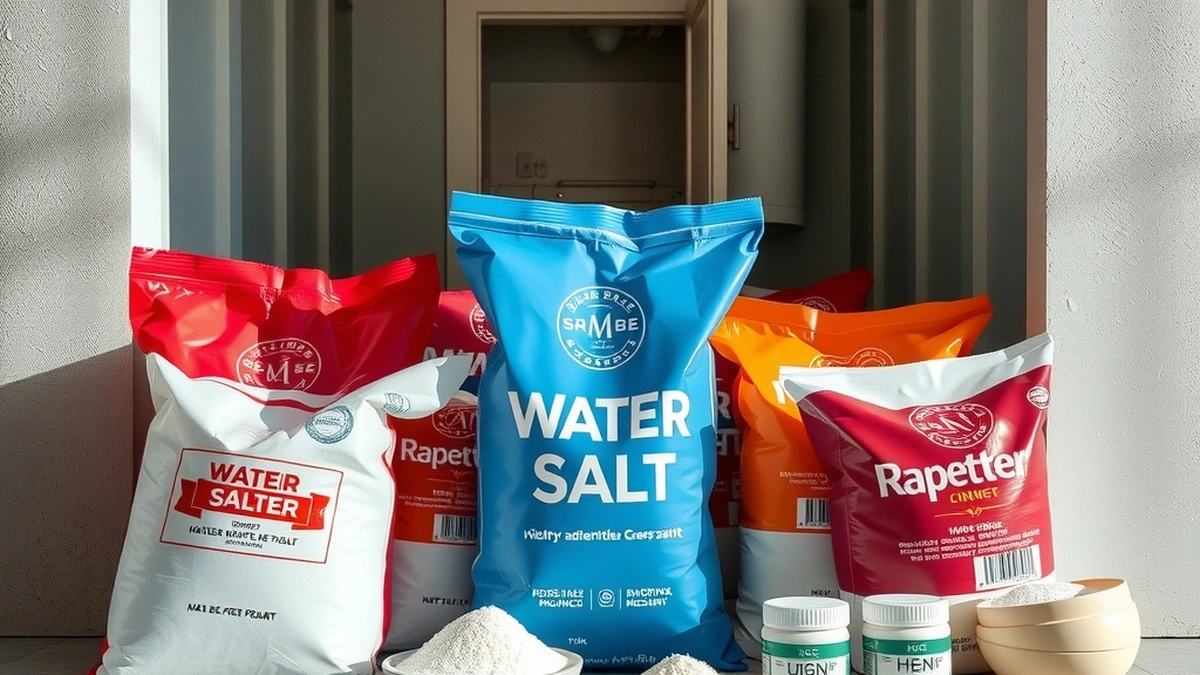
Water softener salts include sodium chloride pellets, solar crystals, blocks, potassium chloride, and additive blends, priced from $6 to $40 per 40-pound bag. Pellets suit most homes, crystals save money in dry rooms, and potassium chloride is for sodium-restricted households.
- Pellets
- $7 - $12 per 40 lb
- Crystals
- $6 - $10 per 40 lb
- Potassium chloride
- $25 - $40 per 40 lb
- Annual use
- 800 - 1,200 lb
- Annual cost
- $120 - $400
Some links on this page are affiliate links.If you buy through them we may earn a commission at no extra cost to you. We do not accept payment for rankings. Read the full disclosure.
Water softener salts are all sodium chloride or potassium chloride in different physical forms. Pellets, crystals, blocks, and additive blends all dissolve into brine and regenerate the same resin. The differences are price, purity, dissolving behavior, and how much tank cleaning they demand.
Sodium Chloride in Four Forms
Pellets are compressed solar salt, about 99.5 percent pure, formed into small pillows under pressure. They dissolve evenly and leave little residue.
Solar crystals are coarse salt from evaporation ponds, dried and graded without compression. They cost less and dissolve faster, with more fines that settle as sludge.
Blocks are pressed slabs, common in parts of Europe and rare in US homes. They dissolve very slowly and need a tank designed to hold them.
Rock salt is the cheapest and crudest form, mined rather than evaporated. It carries the most insoluble material and is the usual cause of a tank full of sludge. Most manufacturers advise against it.
Potassium Chloride
Potassium chloride works in the same softener with a setting change. It exchanges calcium and magnesium for potassium instead of sodium, which matters for households watching sodium intake.
The price is the catch: $25 - $40 per 40-pound bag against $7 - $12 for sodium chloride. A household using 20 bags a year spends $500 - $800 instead of $140 - $240.
Potassium chloride also requires a slightly higher dose per regeneration because the molecule is heavier, so consumption rises modestly on top of the price difference.
Additive Blends
Some pellets include a resin cleaner or a rust inhibitor. The bag usually says “clean and protect” or “rust remover” and costs $3 - $5 more.
A resin cleaner helps when the water test shows 1 - 2 PPM iron and the softener is the only iron treatment in the house. It lifts iron from the beads during regeneration and slows capacity loss.
It does not replace an iron filter. Softener resin tolerates about 2 - 3 PPM of dissolved iron before fouling accelerates, and no additive changes that ceiling. Above that level, an iron filter at $800 - $2,500 installed belongs ahead of the softener.
Price and Performance Compared
| Type | Bag price | Price per lb | Residue | Best use |
|---|---|---|---|---|
| Pellets | $7 - $12 | $0.18 - $0.30 | Low | Most homes |
| Solar crystals | $6 - $10 | $0.15 - $0.25 | Moderate | Dry rooms, budget |
| Blocks | $8 - $14 | $0.20 - $0.35 | Very low | Specialty tanks |
| Rock salt | $5 - $8 | $0.13 - $0.20 | High | Not recommended |
| Potassium chloride | $25 - $40 | $0.63 - $1.00 | Low | Sodium restriction |
| Additive pellets | $10 - $16 | $0.25 - $0.40 | Low | Iron in water |
Price per pound is the only fair comparison, because bag sizes range from 25 to 50 pounds. A 25-pound bag at $8 is $0.32 per pound, more than a 40-pound bag at $11.
How Much a Household Uses
Salt use follows hardness and occupancy. A softener draws 8 - 12 pounds per regeneration, and regeneration frequency follows the daily grain load.
A family of four at 10 GPG uses 250 gallons a day, or 2,500 grains. A 32,000-grain unit regenerating near 24,000 grains cycles about every nine days, roughly 40 times a year. At 10 pounds per cycle, that is 400 pounds, or 10 bags.
At 18 GPG the same household reaches about 720 pounds, or 18 bags. A five-person home at 20 GPG can hit 1,200 pounds. The $120 - $400 annual cost range covers all three cases at sodium chloride prices.
Buying and Storing
- Compare price per pound across bag sizes and stores.
- Buy three to six bags at a time unless storage is genuinely dry.
- Stack on a pallet, off concrete and away from exterior walls.
- Keep the tank half to two-thirds full and check monthly.
- Break up crusts and never tamp the salt.
- Clean the tank annually and remove sludge before refilling.
Sales cluster in spring and fall, and a pallet bought on sale saves $25 - $50 a year. A pallet stored in a damp garage saves nothing once the bottom bags fuse into a block.
Matching Salt to the Situation
Buy pellets for a humid basement, a narrow fill opening, or a household that wants to clean the tank once a year. Buy crystals for a dry utility room and a wide opening. Buy potassium chloride only when sodium is a documented concern.
Buy additive pellets only with a test showing iron. Otherwise the premium buys nothing, and the money is better spent on the test that would have told you the iron level in the first place.
What Salt Does Not Change
Salt choice affects dissolving, residue, and price. It does not change the softener’s capacity, the hardness setting, or the quality of the treated water. A unit fed potassium chloride and a unit fed pellets produce water with the same hardness; only the exchanged ion differs.
That is worth stating because salt marketing implies otherwise. A bag of “clean and protect” pellets will not fix a water softener that is regenerating with weak brine, and a premium crystal will not raise the grains removed per cycle. The valve settings and the brine draw decide those outcomes.
If the water tests hard after a regeneration, the diagnosis starts at the salt level, the bridge, the injector, and the brine line. The bag is almost never the problem.
For brand-specific detail, see Diamond Crystal water softener salt and Morton water softener salt. For the form comparison, see softener salt types. For pricing, see water softener salt cost.
Frequently asked questions
What are the main types of water softener salt?
Sodium chloride pellets, solar crystals, block salt, potassium chloride, and pellet blends with resin cleaners or rust inhibitors. Each works in a standard brine tank.
Is potassium chloride worth the price?
It avoids adding sodium to softened water, which matters for sodium-restricted households. At $25-$40 per bag it costs roughly three times as much as sodium chloride.
Do I need salt with resin cleaner?
Only if the water test shows iron or the resin is already fouled. Plain pellets are fine for iron-free water, and additive salt costs $3-$5 more per bag.
How much salt should I keep in the tank?
Keep the tank half to two-thirds full. That is enough to feed the brine draw without reducing air circulation or encouraging bridging.
Can I use water softener salt in a pool or on ice?
Some forms work for ice melting, but pool salt is a separate product with different purity and grain size. Do not substitute without checking the label.
Why do salt prices vary so much between stores?
Retail markup, bag size, and regional freight drive the spread. Compare price per pound, not price per bag, and watch for 25-pound bags priced like 40-pound ones.
Sources
Some links are affiliate links.If you buy through them we may earn a commission at no extra cost to you. We do not accept payment for rankings. Read the full disclosure.


