
Reverse osmosis water filtration system
An RO filtration system combines sediment, carbon, membrane, and polishing stages. See how the stages interact and what each costs to replace.
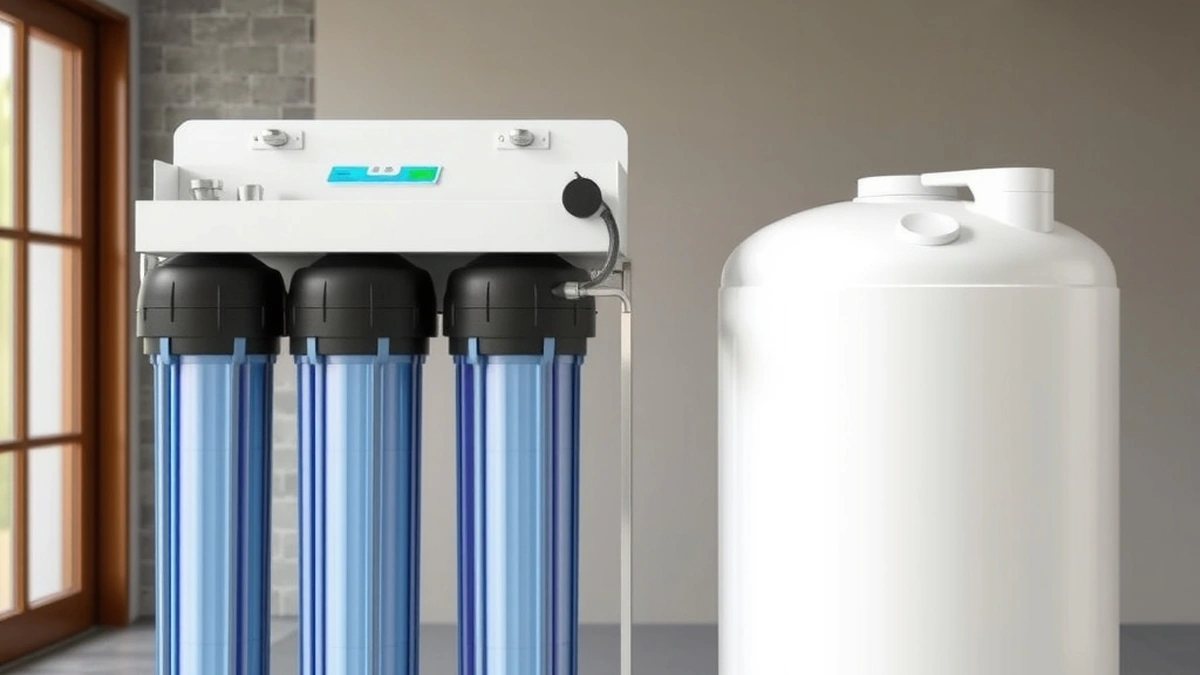
A reverse osmosis water filtration system stacks a sediment filter, carbon block, TFC membrane, and post-carbon filter, with the membrane rejecting 80 to 95 percent of dissolved solids. Under-sink units cost $300 to $900 installed and $60 to $150 a year to run.
- Installed
- $300 - $900
- Rejection
- 80 - 95 percent
- Annual consumables
- $60 - $150
- Membrane life
- 2 - 3 years
- Waste ratio
- 3 - 4:1
Some links on this page are affiliate links.If you buy through them we may earn a commission at no extra cost to you. We do not accept payment for rankings. Read the full disclosure.
A reverse osmosis water filtration system is a chain of cartridges ending at a membrane. Each stage has one job, and the system only works as designed when every stage is present and current. Skipping a pre-filter is the most common reason a membrane fails years early.
The Four Stages
Sediment pre-filter. A pleated or spun cartridge, usually 5 micron, that catches particles before they reach the carbon block. Protects the membrane from fouling at the surface.
Carbon block. Extruded carbon that removes chlorine and some organics. This stage exists specifically because chlorine destroys the polyamide membrane.
TFC membrane. The active barrier. Applied pressure forces water across, leaving dissolved ions and larger molecules behind. Rejection is 80 to 95 percent.
Post-carbon filter. A final carbon stage that polishes taste and catches anything from the storage tank.
| Stage | Removes | Life | Cost |
|---|---|---|---|
| Sediment | Particles | 3 - 6 months | $5 - $20 |
| Carbon block | Chlorine, taste | 6 - 12 months | $10 - $40 |
| TFC membrane | Dissolved solids | 2 - 3 years | $40 - $80 |
| Post-carbon | Taste | 6 - 12 months | $10 - $30 |
How the Membrane Separates
Osmosis moves water from a dilute solution to a concentrated one across a semi-permeable membrane. Reverse osmosis applies pressure above the osmotic pressure, forcing water the other way.
The membrane is a thin polyamide film on a porous support, wound into a spiral element with spacer mesh. Feed water enters one end, permeate collects in the center tube, and concentrate exits the other end.
Two operating requirements follow. The feed needs about 40 psi to produce at rate, and it needs a continuous cross-flow to carry rejected salts away. That cross-flow is why the system sends 3 to 4 gallons to drain per gallon produced.
What It Removes
| Contaminant | Rejection |
|---|---|
| Sodium | 85 - 95 percent |
| Calcium and magnesium | 90 - 98 percent |
| Nitrate | 80 - 95 percent |
| Lead | 90 - 98 percent |
| PFAS | High with certified membrane |
| Chlorine | Low, handled by carbon |
| Bacteria | Not a reliable barrier |
The chlorine row explains the stage order. The bacteria row explains why RO is not a substitute for UV on a well with a positive bacteria test.
Cost Over Five Years
A $450 unit with professional installation at $350: $800 installed. Cartridges at $100 per year for five years is $500. One membrane at $60. Total $1,360, or $272 per year.
A cheaper $250 unit with DIY install: $250 + $500 + $60 = $810, or $162 per year. The difference is mostly the labor and the housing quality, not the water.
Compare that with bottled water at $1 per gallon for a household using 2 gallons a day: $730 per year. The RO system is cheaper from the first year, and the gap widens as the years pass. The full comparison is in bottled water versus a filter.
Installation Requirements
The system needs a cold water supply, a drain connection, and a faucet hole. Most kits include a saddle valve for the supply and a drain adapter for the sink.
The faucet is the step that stops most DIY installs, because it requires drilling a hole in the countertop or replacing a soap dispenser. A 1/2 inch hole through granite needs a diamond bit and patience; through stainless steel it needs a step bit and a steady hand. Measure twice, and check underneath for a cabinet rail before drilling.
| Requirement | Detail |
|---|---|
| Supply | Cold line, 3/8 inch tubing |
| Pressure | 40 psi minimum |
| Drain | Sink trap or dedicated drain |
| Faucet | 1/2 inch hole in counter |
| Power | None for tank models |
Below 40 psi, production falls and the tank refills slowly. A permeate pump or booster helps, covered in permeate pumps.
Five Maintenance Steps
- Change sediment every 3 to 6 months.
- Change carbon blocks every 6 to 12 months.
- Check rejection annually with a TDS meter.
- Replace the membrane at 2 to 3 years or below 80 percent rejection.
- Sanitize the tank and lines at membrane change if the manufacturer specifies it.
Common Failures
Membrane failure from chlorine. Caused by an exhausted carbon block. The fix is a schedule, not a better membrane.
Scale on the membrane. Caused by hardness above 7 GPG with no softener ahead of the RO. The fix is softening, not more frequent membrane changes.
Slow production. Usually pressure or a clogged pre-filter, not the membrane. Check pressure first.
Tank waterlogging. The bladder fails and the tank fills with water. The faucet runs slowly and the tank feels heavy. Replacement is $40 to $80.
Leaks at push-fit fittings. The tube was not cut square or not pushed fully home. Cut a fresh end and reseat it; do not overtighten anything on a plastic fitting.
A TDS meter answers most questions. Measure feed and product, then calculate rejection as (feed − product) ÷ feed × 100. Feed at 320 ppm and product at 32 ppm gives 90 percent, which is healthy. Feed at 320 and product at 90 gives 72 percent, which means the membrane is spent or the pre-filters have failed.
If rejection is good but production is slow, the problem is hydraulic: low pressure, a clogged sediment filter, a cold feed line, or a waterlogged tank. If rejection is poor, the problem is the membrane or a bypass inside the unit. That split, performance versus production, saves a lot of unnecessary part swapping.
Where It Belongs
At the kitchen tap, after a softener if the water is hard. It is not a whole-house device at residential scale, and it is not a softener. Reverse osmosis water filter covers the buying decision, reverse osmosis maintenance covers the schedule in detail, and whole house reverse osmosis system covers the larger format when the whole supply genuinely needs it.
Frequently asked questions
What are the stages of a reverse osmosis filtration system?
A sediment pre-filter, a carbon block for chlorine removal, the TFC membrane itself, and a post-carbon polishing filter, with an optional fifth stage for chloramine or remineralization.
How much does an RO filtration system cost?
Under-sink systems run $300 to $900 installed, with consumables at $60 to $150 per year and a membrane replacement every 2 to 3 years.
How often do RO filters need changing?
Sediment every 3 to 6 months, carbon blocks every 6 to 12 months, and the membrane every 2 to 3 years, with the schedule tightened if the water is turbid or hard.
Why is a carbon filter needed before an RO membrane?
Chlorine degrades the polyamide membrane, so carbon removes it first; without that stage the membrane fails in months instead of years.
Can an RO system run on well water?
Yes, with pre-treatment: sediment, iron removal if needed, and softening above 7 GPG, or the membrane will foul and scale prematurely.
How much water does an RO system waste?
Three to four gallons go to drain for each gallon produced, so a household using 2 gallons a day sends roughly 6 to 8 gallons to drain.
Sources
Some links are affiliate links.If you buy through them we may earn a commission at no extra cost to you. We do not accept payment for rankings. Read the full disclosure.


