
Water softener salt
Pellets, crystals, blocks, and potassium chloride differ in purity, residue, and price. See which salt to use and what it costs per year.
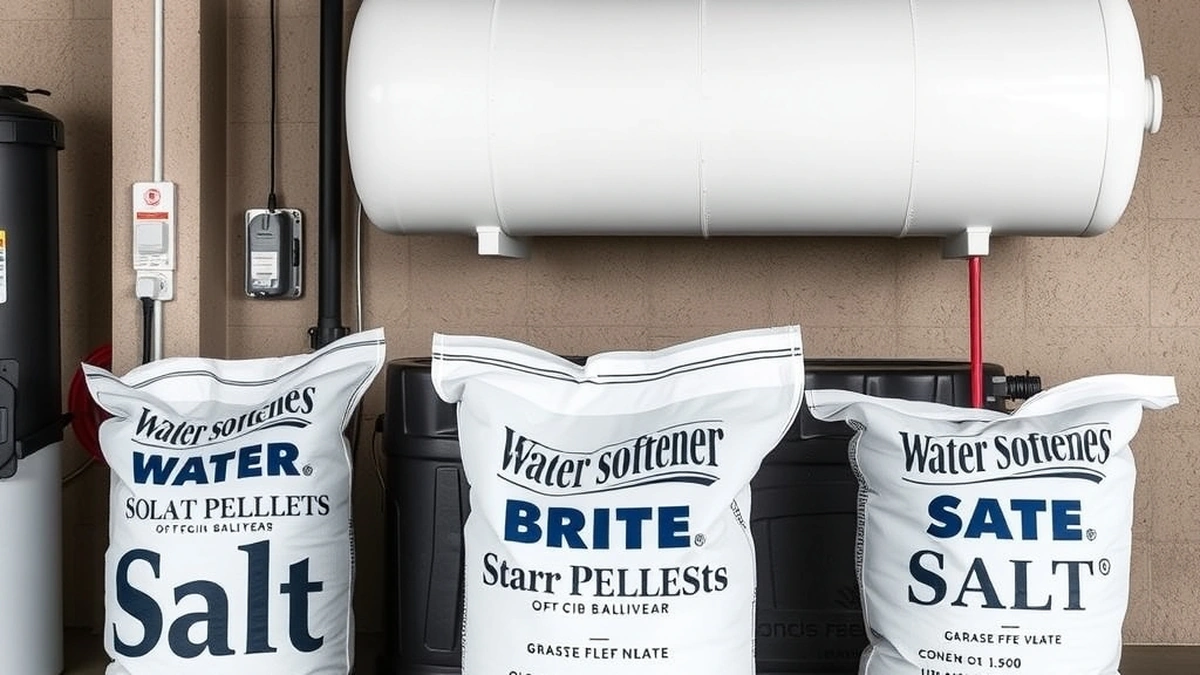
Most homes should use evaporated salt pellets, which dissolve cleanly and leave little residue at roughly $120 to $400 per year. Coarse solar salt is comparable, rock salt is cheaper but dirtier, and potassium chloride costs two to three times more.
- Annual cost
- $120 - $400
- Salt per regeneration
- 8 - 12 pounds
- Best default
- Evaporated pellets
- Potassium chloride
- 2 - 3 times the price
- Brine tank cleaning
- Annually
Some links on this page are affiliate links.If you buy through them we may earn a commission at no extra cost to you. We do not accept payment for rankings. Read the full disclosure.
Water softener salt is the consumable that makes regeneration possible. Evaporated pellets are the default for most homes: they dissolve cleanly, leave little residue, and cost $120 to $400 a year for a typical household. The other forms work too, with trade-offs in purity, residue, and price.
What Salt Does
Salt does not soften water. The resin does that. Salt makes the brine that regenerates the resin.
During regeneration, concentrated brine flows through the bed. The high sodium concentration drives calcium and magnesium off the exchange sites and into the drain. Without brine, the resin loads up and stops softening within days.
That is why a softener that “uses no salt” is either not a softener or not working. The salt is the fuel.
The Salt Types
| Type | Purity | Dissolve speed | Residue | Cost |
|---|---|---|---|---|
| Evaporated pellets | High, 99%+ | Moderate | Very low | Moderate |
| Solar coarse crystals | High | Moderate | Low | Moderate |
| Rock salt | Lower | Slow | High | Low |
| Block salt | High | Slow | Low | Moderate |
| Potassium chloride | High | Moderate | Low | High |
Evaporated pellets are made by evaporating brine solution, which leaves very little insoluble matter. They are the safest default and the easiest to find.
Solar salt is harvested from seawater evaporation and is nearly as pure. Coarse crystals dissolve a little differently but perform well.
Rock salt is mined and contains more insoluble material. It is cheaper per bag and costs more in cleaning time and blocked pickups.
Potassium chloride replaces sodium with potassium. It suits households watching sodium intake, at two to three times the price.
How Much You Need
Consumption depends on hardness, household size, and regeneration settings.
A household of four on 12 GPG water uses about 3,600 grains per day. At 10 pounds of salt per regeneration and roughly 40 regenerations a year, that is 400 pounds.
| Household | Hardness | Salt per year |
|---|---|---|
| 2 people | 8 GPG | 200 - 280 lb |
| 4 people | 12 GPG | 360 - 440 lb |
| 4 people | 20 GPG | 520 - 640 lb |
| 6 people | 15 GPG | 560 - 680 lb |
Those are estimates. A unit set with a higher salt dose per regeneration uses more salt but softer water and less regeneration water. The trade is covered in salt dose and efficiency.
What It Costs
A 40 pound bag of pellets runs roughly $8 to $15 depending on region and season. At 400 pounds a year, that is 10 bags, or $80 to $150. At the higher end of consumption, 600 pounds is 15 bags, or $120 to $225.
The published range of $120 to $400 per year covers most households including potassium chloride users at the top.
Buying in bulk lowers the per-bag price but requires dry storage. Salt absorbs moisture, and a damp bag turns into the mush described in salt mushing.
Ten-year arithmetic for a typical household at 400 pounds a year and $12 per bag: 10 bags × $12 = $120 per year, or $1,200 over a decade. That is the second-largest cost of owning a softener after the equipment itself, and it is the one most sensitive to settings. A unit regenerating twice as often as necessary doubles it without improving the water.
Pellets vs Crystals vs Blocks
Pellets are the practical default: clean, available, and easy to pour. Crystals are comparable and sometimes cheaper in bulk. Blocks are compact and tidy but dissolve slowly and are less common in the US.
The choice matters less than the maintenance. Any salt type will work if the brine tank is cleaned annually and the water level is correct. No salt type will work if the tank is overfilled and the pickup is buried in sludge.
| Priority | Best choice |
|---|---|
| Lowest residue | Evaporated pellets |
| Lowest price | Rock salt, with more cleaning |
| Lowest sodium | Potassium chloride |
| Least storage space | Block salt |
Five Steps to Manage Salt
- Check the level monthly and refill before it empties.
- Fill to two-thirds, not to the top.
- Break any bridge with a broom handle if the surface crusts.
- Clean the tank annually, usually when the level is low.
- Watch consumption for a sudden change, which signals a fault.
A softener that suddenly uses far more salt is regenerating too often. A softener that suddenly uses none has a salt or brine problem. Both are covered in softener stopped softening.
Buying and Storing
Buy from a store with turnover. Salt that has sat in a humid stockroom may already be caked.
Store bags off the floor on a pallet or shelf, and keep them dry. Do not stack them against a concrete wall that sweats.
If you buy potassium chloride, check the softener’s manual for the dose adjustment. It is less effective per pound, so the same setting produces weaker brine.
Never mix salt types in the same tank without emptying it first. Pellets and crystals dissolve at different rates, and a mix can leave one type sitting in water while the other feeds the brine line, which produces inconsistent brine strength and uneven softening. Pick one type, finish the tank, then switch if you want to.
One buying habit saves money without any risk: buy when the price drops, not when the tank is empty. Salt keeps indefinitely if it stays dry, and a spare bag means you are never choosing between full price and letting the softener run out. Running out is worse than paying a few dollars more, because the first regeneration after a refill has to work with a bed that has already been sitting hard for several days.
For the broader maintenance picture, see clean brine tank and how often to add salt. If you are choosing between salt-based and salt-free, salt-based versus salt-free softener covers the difference in outcomes.
Frequently asked questions
What kind of salt should I put in my water softener?
Evaporated salt pellets are the default for most homes because they dissolve cleanly, leave little insoluble residue, and are widely available in 40 pound bags.
Is rock salt bad for a water softener?
It works, but it carries more insoluble material that settles as sludge, so the brine tank needs cleaning more often and the risk of a blocked pickup is higher.
How much salt does a softener use per year?
At 8 to 12 pounds per regeneration and roughly 40 regenerations a year, expect 320 to 480 pounds, costing $120 to $400 depending on salt type and local prices.
Can I use potassium chloride in any softener?
Most softeners can use it with a setting change, but it costs two to three times as much and may require a higher dose because it is less effective per pound.
Do salt-free conditioners use salt?
No, and they do not remove hardness, so they are not a substitute for a salt-based softener if soft water is the goal.
How full should the brine tank be?
About two-thirds full is the practical maximum; overfilling compacts the salt, keeps the lower layers wet, and encourages mushing.
Sources
Some links are affiliate links.If you buy through them we may earn a commission at no extra cost to you. We do not accept payment for rankings. Read the full disclosure.


